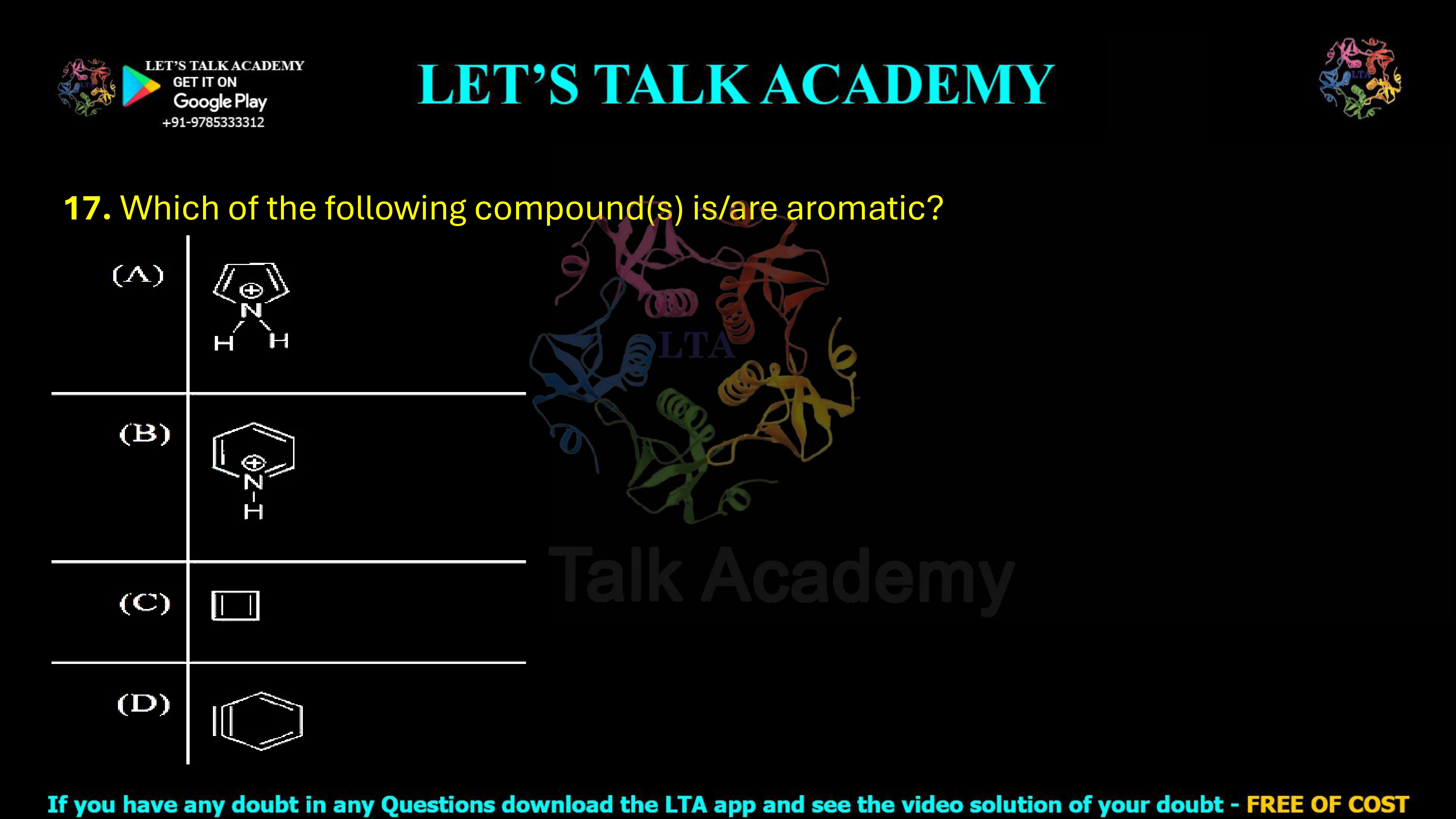
17. Which of the following compound(s) is/are aromatic?
Which of the Following Compounds Are Aromatic?
Correct Answer: Only Option (B)
Among the four given compounds, only option (B), the pyridinium ion, is aromatic. The correct classification of the compounds is: option (A) is antiaromatic, option (B) is aromatic, option (C) is antiaromatic, and option (D) is nonaromatic.
To solve this aromaticity question correctly, it is necessary to check every structural requirement for aromaticity rather than simply counting the number of double bonds. An aromatic compound must be cyclic, planar, completely conjugated, and must contain (4n + 2) π electrons, where n is a non-negative integer. Option (B) satisfies all these conditions and contains 6 π electrons. Therefore, only option (B) is aromatic.
Conditions Required for a Compound to Be Aromatic
A compound is classified as aromatic only when it satisfies four essential conditions simultaneously. First, the molecule must have a cyclic structure. Second, the ring must be planar or sufficiently close to planar for effective orbital overlap. Third, every atom around the cyclic pathway must possess a p orbital so that uninterrupted cyclic conjugation is possible. Finally, the completely conjugated cyclic system must contain (4n + 2) π electrons according to Hückel’s rule.
The possible Hückel numbers are obtained from the expression:
Number of π electrons = 4n + 2
For n = 0, 1, 2, and 3, the allowed numbers of π electrons are 2, 6, 10, and 14, respectively. A planar, cyclic, completely conjugated system containing one of these numbers of π electrons is aromatic.
In contrast, a planar and completely conjugated cyclic compound containing 4n π electrons is antiaromatic. The 4n series gives 4, 8, 12, and 16 π electrons for n = 1, 2, 3, and 4, respectively. If a molecule avoids planarity or lacks continuous conjugation, it is classified as nonaromatic rather than antiaromatic.
Detailed Aromaticity Analysis of Each Option
Option (A): Protonated Pyrrole-Type Ring
Option (A) shows a five-membered ring containing two carbon-carbon double bonds and a positively charged nitrogen bonded to two hydrogen atoms. The important difference between this structure and ordinary pyrrole is the protonation of the nitrogen atom.
In ordinary pyrrole, the nitrogen atom has one hydrogen and a lone pair of electrons. That lone pair occupies a p orbital and contributes two π electrons to the cyclic conjugated system. The two carbon-carbon double bonds contribute four more π electrons, giving a total of six π electrons. Therefore, ordinary pyrrole is aromatic.
In the structure shown in option (A), however, the nitrogen atom is protonated and bears a positive charge. Its lone pair has been used to form an additional N–H sigma bond. Therefore, the nitrogen lone pair that normally contributes two electrons to the aromatic π system is no longer available.
The cyclic π system is consequently left with only the four π electrons supplied by the two carbon-carbon double bonds:
2 double bonds × 2 π electrons = 4 π electrons
A cyclic conjugated system with four π electrons follows the 4n rule, where n = 1. Therefore, the structure represented in option (A) is not aromatic. In the idealized conjugated form shown, it is classified as antiaromatic.
Conclusion: Option (A) is not aromatic.
Option (B): Pyridinium Ion
Option (B) represents the pyridinium ion, which is formed when the nitrogen atom of pyridine accepts a proton. This compound remains aromatic after protonation because the lone pair involved in proton bonding was never part of the aromatic π-electron system of pyridine.
In pyridine, each of the six ring atoms is sp2 hybridized and possesses an unhybridized p orbital. These six p orbitals overlap continuously around the planar six-membered ring. The three alternating π bonds contribute a total of six π electrons.
The π-electron count is:
3 double bonds × 2 π electrons = 6 π electrons
According to Hückel’s rule:
4n + 2 = 6
4n = 4
n = 1
Since n is an integer, the six π electrons satisfy the (4n + 2) rule. The pyridinium ion is also cyclic, planar, and completely conjugated. Therefore, it fulfills all the conditions required for aromaticity.
Protonation does not destroy the aromaticity because the nitrogen lone pair of pyridine lies in an sp2 hybrid orbital in the plane of the ring and does not participate in the aromatic π system. The proton attaches to this lone pair, while the six π electrons in the perpendicular p-orbital system remain unchanged.
Conclusion: Option (B) is aromatic.
Option (C): Cyclobutadiene
Option (C) represents cyclobutadiene, a four-membered cyclic compound containing two double bonds. The two double bonds provide a total of four π electrons.
The π-electron count is:
2 double bonds × 2 π electrons = 4 π electrons
For the 4n rule:
4n = 4
n = 1
Therefore, cyclobutadiene contains a 4n number of π electrons. It is cyclic and has a conjugated π system, but the four π electrons produce severe electronic destabilization. Consequently, cyclobutadiene is a classic example of an antiaromatic compound.
Cyclobutadiene is extremely unstable compared with aromatic compounds such as benzene. Its four π electrons do not satisfy the (4n + 2) requirement for aromatic stabilization.
Conclusion: Option (C) is antiaromatic and is not counted.
Option (D): Cyclooctatetraene
Option (D) represents cyclooctatetraene, commonly abbreviated as COT. It contains four carbon-carbon double bonds and therefore has a total of eight π electrons.
The π-electron count is:
4 double bonds × 2 π electrons = 8 π electrons
Eight π electrons satisfy the 4n expression:
4n = 8
n = 2
If cyclooctatetraene were planar and completely conjugated around the ring, its eight π electrons would make it antiaromatic and highly unstable. However, the molecule avoids this destabilization by adopting a nonplanar tub-shaped conformation.
Because the ring is nonplanar, the p orbitals cannot overlap continuously around the entire cyclic structure. The molecule therefore does not have a fully delocalized cyclic π-electron system. As a result, cyclooctatetraene is classified as nonaromatic, not antiaromatic.
Conclusion: Option (D) is nonaromatic and is not counted.
Comparison of All Four Compounds
Option (A): 4 π electrons → antiaromatic → not aromatic
Option (B): 6 π electrons → aromatic
Option (C): 4 π electrons → antiaromatic → not aromatic
Option (D): 8 π electrons but nonplanar → nonaromatic
Therefore, only the pyridinium ion shown in option (B) satisfies all the essential conditions of aromaticity.
Why Protonation Affects Pyrrole and Pyridine Differently
The comparison between options (A) and (B) is the central concept of this question. Both structures contain nitrogen, but the location and role of the nitrogen lone pair are different.
In a pyrrole-type ring, the nitrogen lone pair is located in a p orbital and contributes two electrons to the aromatic sextet. Protonation uses this lone pair to form a new N–H bond. As a result, the two electrons are removed from the cyclic π-electron system, and aromaticity is lost.
In pyridine, the nitrogen atom contributes one electron from its p orbital to the aromatic π system, just like each carbon atom in the ring. Its lone pair occupies an sp2 hybrid orbital lying in the plane of the molecule and does not participate in the aromatic sextet. Therefore, protonation of this lone pair does not disturb the six π electrons responsible for aromaticity.
This is why the protonated pyrrole-type structure in option (A) is not aromatic, whereas the protonated pyridine structure in option (B) remains aromatic.
Aromatic, Antiaromatic, and Nonaromatic Classification
An aromatic compound must be cyclic, planar, completely conjugated, and contain (4n + 2) π electrons. A compound is antiaromatic when it is cyclic, planar, completely conjugated, but contains 4n π electrons. A compound is nonaromatic when it fails one or more of the basic structural requirements for cyclic delocalization, such as planarity or continuous conjugation.
Applying these definitions to the given structures explains the complete result. Option (B) is aromatic because it has a planar, cyclic, completely conjugated six-π-electron system. Options (A) and (C) contain four π electrons in conjugated cyclic systems and are antiaromatic, while option (D) avoids antiaromaticity by becoming nonplanar and is therefore nonaromatic.
Final Answer
Among the four given compounds, only the pyridinium ion shown in option (B) is aromatic. It contains six π electrons in a cyclic, planar, and completely conjugated system and therefore satisfies Hückel’s (4n + 2) rule for n = 1.
Option (A) loses the nitrogen lone-pair contribution after protonation and has a four-π-electron antiaromatic system. Cyclobutadiene in option (C) also has four π electrons and is antiaromatic. Cyclooctatetraene in option (D) contains eight π electrons but adopts a nonplanar tub conformation, making it nonaromatic.
Correct Answer: Only Option (B)


