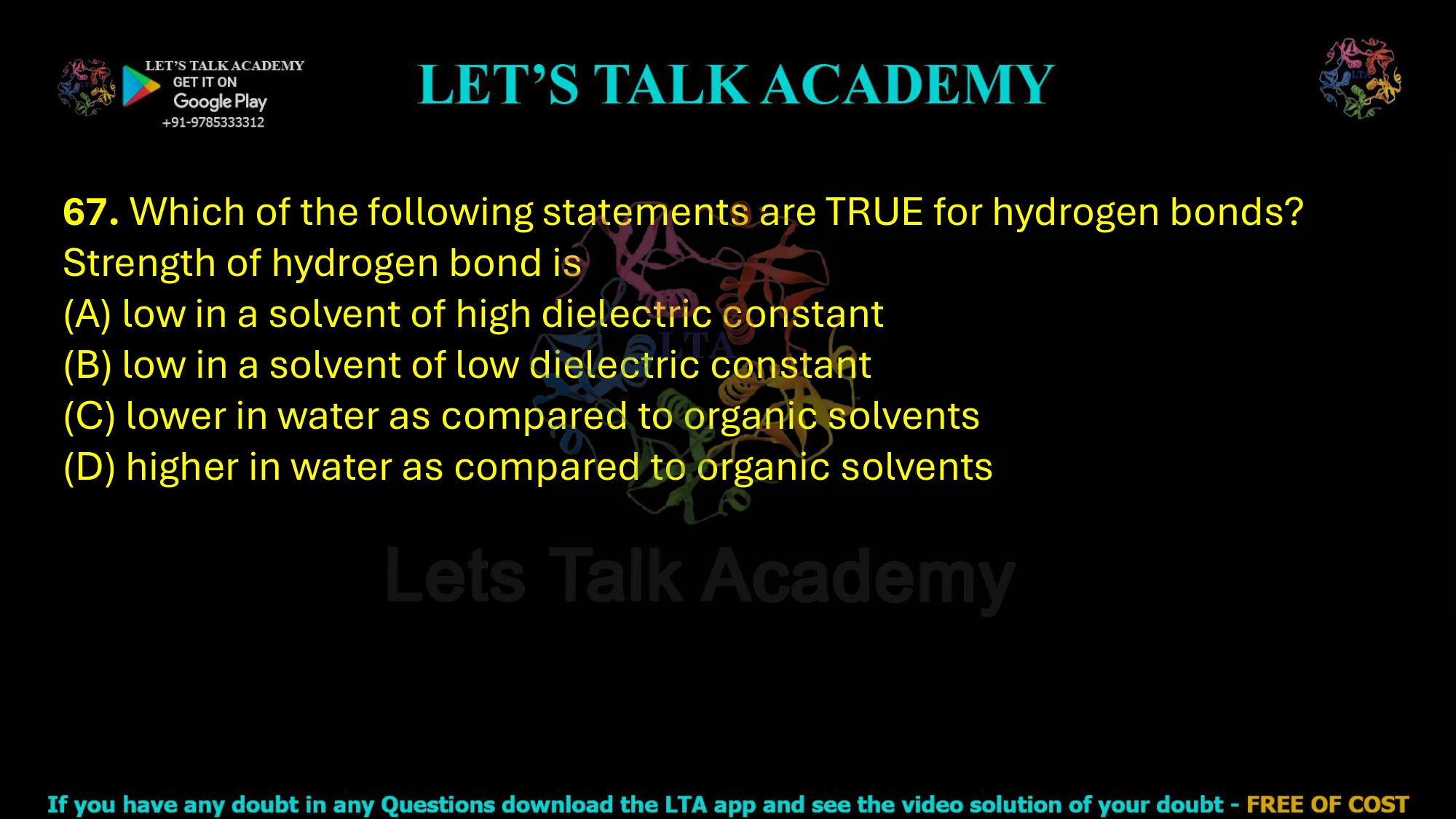
67. Which of the following statements are TRUE for hydrogen bonds?
Strength of hydrogen bond is
(A) low in a solvent of high dielectric constant
(B) low in a solvent of low dielectric constant
(C) lower in water as compared to organic solvents
(D) higher in water as compared to organic solvents
True Statements About Hydrogen Bond Strength in Different Solvents
Correct Answer
✅ Correct Options: (A) and (C)
Understanding Hydrogen Bonding
A hydrogen bond is an attractive interaction formed between a hydrogen atom covalently bonded to a highly electronegative atom such as oxygen, nitrogen, or fluorine and another electronegative atom possessing a lone pair of electrons. Although hydrogen bonds are weaker than covalent bonds, they are significantly stronger than ordinary van der Waals interactions and are responsible for the remarkable physical and biological properties of many substances.
The strength of a hydrogen bond is not constant and depends on several factors, including the nature of the donor and acceptor atoms, molecular geometry, temperature, and most importantly, the surrounding solvent. The solvent can either strengthen or weaken hydrogen bonding depending on its polarity and dielectric constant.
Effect of Dielectric Constant on Hydrogen Bond Strength
The dielectric constant is a measure of a solvent’s ability to reduce electrostatic interactions between charged or polar species. Solvents with a high dielectric constant, such as water, stabilize polar molecules very effectively. Because the solvent molecules themselves strongly interact with hydrogen bond donors and acceptors, they compete with intermolecular hydrogen bond formation.
As a result, hydrogen bonds formed between solute molecules become weaker in highly polar solvents. Therefore, the strength of hydrogen bonding is generally lower in solvents having a high dielectric constant.
In contrast, solvents with a low dielectric constant cannot efficiently stabilize polar groups. Since there is less competition from the solvent, hydrogen bond donors and acceptors interact more strongly with one another, leading to stronger hydrogen bonds.
Why Water Weakens Hydrogen Bonding Between Solute Molecules
Water is one of the most polar solvents known and possesses a very high dielectric constant of approximately 80 at room temperature. Every water molecule is capable of both donating and accepting hydrogen bonds. Consequently, water surrounds polar molecules and forms extensive hydration shells around them.
This extensive solvation competes directly with hydrogen bonds that might otherwise form between solute molecules. Although hydrogen bonding within pure water is extensive, hydrogen bonds between dissolved molecules are generally weaker because water molecules interrupt these interactions. Therefore, intermolecular hydrogen bonds between solutes are usually weaker in water than in many organic solvents.
Explanation of Each Option
Option (A): Low in a Solvent of High Dielectric Constant
This statement is correct. High dielectric constant solvents strongly stabilize polar groups and compete for hydrogen bond formation. Consequently, hydrogen bonds between solute molecules become weaker. Water is the best-known example of such a solvent.
Option (B): Low in a Solvent of Low Dielectric Constant
This statement is incorrect. Solvents with a low dielectric constant provide very little competition for hydrogen bond formation. Therefore, hydrogen bonds between molecules become stronger rather than weaker. Organic solvents such as chloroform or carbon tetrachloride often allow stronger intermolecular hydrogen bonding than water.
Option (C): Lower in Water as Compared to Organic Solvents
This statement is correct. Water molecules extensively hydrogen bond with dissolved compounds, reducing the effective strength of hydrogen bonds between solute molecules. In many organic solvents, fewer competing interactions exist, allowing stronger hydrogen bonding between solute molecules.
Option (D): Higher in Water as Compared to Organic Solvents
This statement is incorrect. Although water itself possesses an extensive hydrogen-bonding network, it weakens hydrogen bonding between dissolved molecules because of strong solvation effects. Therefore, hydrogen bond strength between solutes is generally lower in water than in less polar organic solvents.
Scientific Concept Behind the Question
This question evaluates the relationship between solvent polarity and intermolecular interactions. Hydrogen bonding is governed not only by the participating molecules but also by the environment surrounding them. High dielectric constant solvents stabilize polar functional groups independently, thereby reducing direct hydrogen bond formation between molecules. Low dielectric constant solvents lack this stabilizing ability, making intermolecular hydrogen bonding comparatively stronger. Understanding this concept is essential in physical chemistry, biochemistry, protein folding, enzyme-substrate interactions, molecular recognition, and drug design.
Final Answer
The strength of hydrogen bonding decreases in solvents having a high dielectric constant because the solvent competes for hydrogen bond formation. Since water is a highly polar solvent, hydrogen bonds between dissolved molecules are generally weaker than in many organic solvents.
✅ Correct Answers: (A) and (C)


