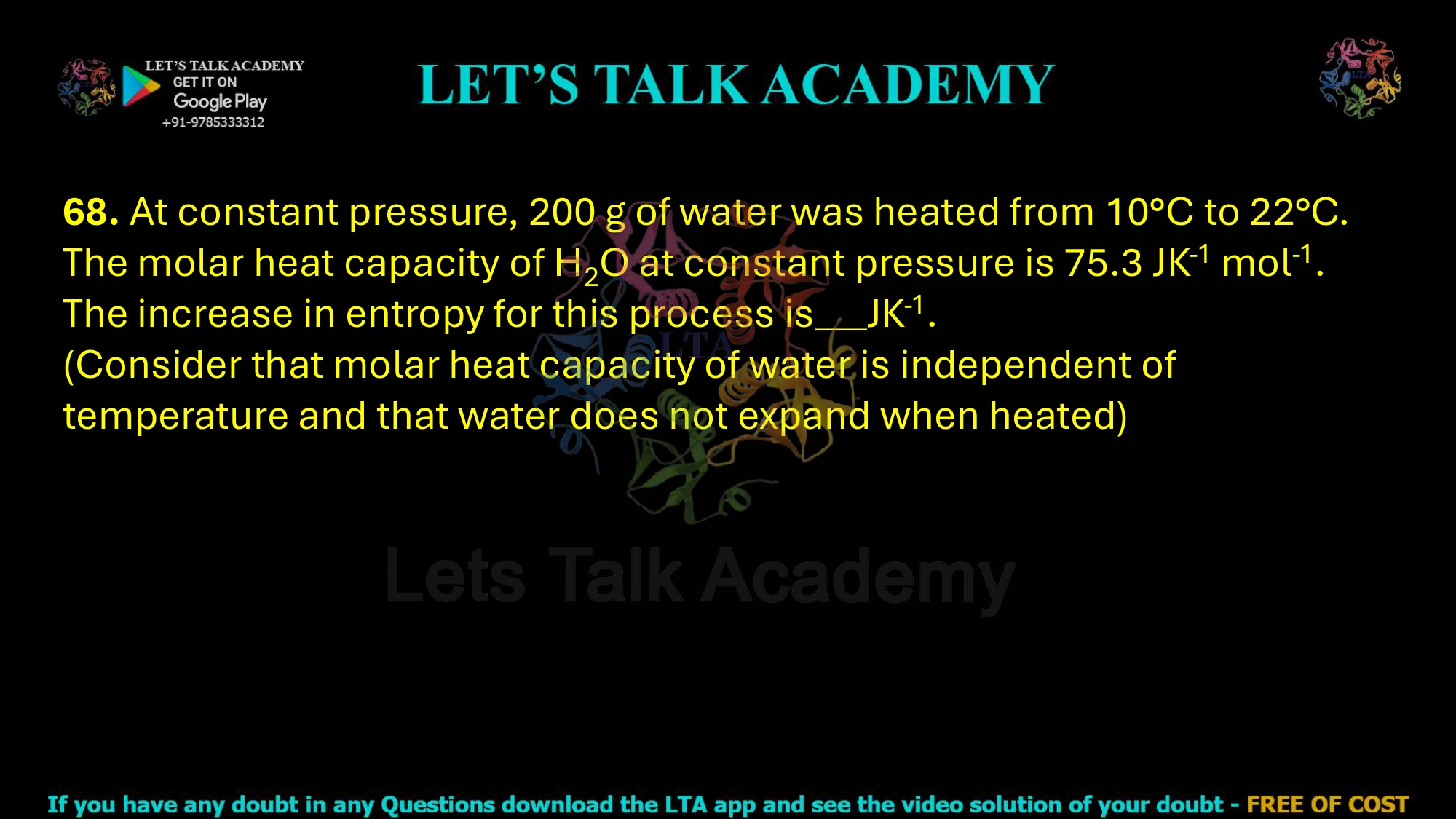
68. At constant pressure, 200 g of water was heated from 10°C to 22°C. The molar heat capacity of H2O at constant pressure is 75.3 JK-1 mol-1. The increase in entropy for this process is JK-1.
(Consider that molar heat capacity of water is independent of temperature and that water does not expand when heated)
Entropy Increase of Water Heated at Constant Pressure
In this question, water is heated from 10°C to 22°C at constant pressure. Since the molar heat capacity remains constant throughout the process and the volume change of water is neglected, the entropy change can be calculated directly using the standard thermodynamic equation for reversible heating. Understanding why this equation works is equally important because it forms the basis of numerous advanced thermodynamics problems.
Concept Behind the Question
Entropy is a thermodynamic property that measures the degree of randomness or energy dispersal within a system. Whenever a substance is heated, its molecules gain kinetic energy and occupy a greater number of accessible microscopic energy states. As a result, the entropy of the system increases.
For a reversible heating process carried out at constant pressure where the heat capacity remains constant, the entropy change is determined by integrating the infinitesimal heat transferred divided by the absolute temperature. This integration leads to one of the most useful equations in thermodynamics:
ΔS = nCp ln(T2/T1)
Here, ΔS represents the entropy change, n is the number of moles, Cp is the molar heat capacity at constant pressure, and T1 and T2 are the initial and final temperatures expressed in Kelvin.
The use of Kelvin is extremely important because entropy calculations depend on absolute temperature. Using temperatures directly in Celsius would produce completely incorrect results.
Step 1: Calculate the Number of Moles
The number of moles of water is obtained from the relation:
n = Mass / Molar Mass
n = 200 / 18
n = 11.11 mol
Step 2: Apply the Entropy Formula
The entropy change during heating at constant pressure is:
ΔS = nCp ln(T2/T1)
Substituting the values,
ΔS = (11.11)(75.3) ln(295/283)
First calculate the logarithmic term:
ln(295/283) = ln(1.0424)
= 0.0415
Now calculate:
11.11 × 75.3 = 836.9
Therefore,
ΔS = 836.9 × 0.0415
ΔS ≈ 34.7 J K−1
Final Answer
The increase in entropy is approximately:
ΔS = 34.7 J K−1
Why Does Entropy Increase During Heating?
Heating supplies energy to water molecules, increasing their translational, rotational, and vibrational motion. This increase in molecular motion creates a larger number of accessible microstates. Since entropy is directly related to the number of microscopic arrangements available to the molecules, the entropy naturally increases as temperature rises.
The increase is not proportional to temperature itself but depends on the logarithm of the temperature ratio. This logarithmic dependence explains why entropy changes become progressively smaller at higher temperatures for the same temperature increase.
Understanding the Formula Physically
The expression ΔS = nCp ln(T2/T1) originates from the definition of entropy:
dS = δQrev/T
For heating at constant pressure, the reversible heat supplied is:
δQ = nCpdT
Substituting into the entropy definition gives:
dS = nCp(dT/T)
Integrating between the initial and final temperatures results in:
ΔS = nCp ln(T2/T1)
This derivation explains why the logarithmic term naturally appears in entropy calculations and why only absolute temperatures are valid.
Key Takeaways
Always Convert Temperature into Kelvin
The entropy equation is derived using absolute temperature. Celsius values must always be converted into Kelvin before substitution.
Heat Capacity Must Be Constant
The logarithmic expression used in this solution is valid because the molar heat capacity is assumed to remain constant throughout the heating process.
Entropy Depends on Temperature Ratio
The entropy change depends on ln(T2/T1) rather than simply the temperature difference. This is why entropy calculations require careful mathematical treatment.
Heating Always Increases Entropy
Whenever a substance is heated without undergoing a phase change, molecular disorder increases and the entropy change is positive.
Conclusion
This problem illustrates one of the most fundamental applications of thermodynamics. By calculating the number of moles, converting temperatures to Kelvin, and applying the entropy equation for constant-pressure heating, the entropy increase is obtained as approximately 34.7 J K−1. More importantly, understanding the physical meaning behind the logarithmic relationship provides a deeper appreciation of why entropy behaves the way it does. Mastering this concept enables students to solve a wide range of thermodynamics problems encountered in CSIR NET and other competitive examinations.


