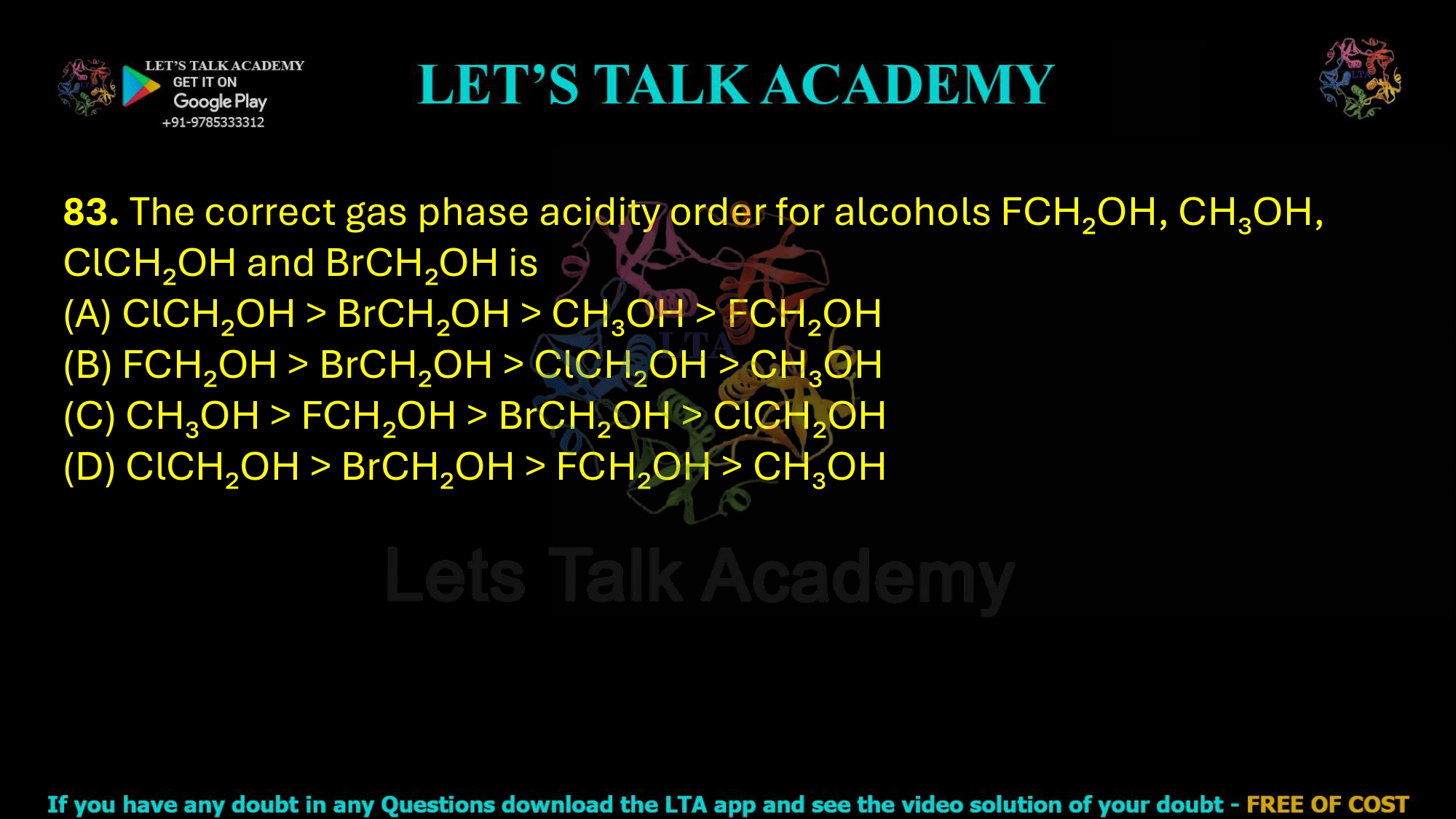
83. The correct gas phase acidity order for alcohols FCH₂OH, CH₃OH, ClCH₂OH and BrCH₂OH is
(A) ClCH₂OH > BrCH₂OH > CH₃OH > FCH₂OH
(B) FCH₂OH > BrCH₂OH > ClCH₂OH > CH₃OH
(C) CH₃OH > FCH₂OH > BrCH₂OH > ClCH₂OH
(D) ClCH₂OH > BrCH₂OH > FCH₂OH > CH₃OH
Gas Phase Acidity Order of FCH₂OH, CH₃OH, ClCH₂OH and BrCH₂OH
Correct Answer
Answer: (B) FCH₂OH > BrCH₂OH > ClCH₂OH > CH₃OH
Understanding Gas Phase Acidity
Gas phase acidity refers to the tendency of a molecule to lose a proton in the gaseous state. Unlike acidity in aqueous solution, where solvation of ions plays a dominant role, gas phase acidity depends mainly on the intrinsic stability of the conjugate base formed after proton removal.
For alcohols, deprotonation produces an alkoxide ion. The more stable this alkoxide ion is, the stronger the corresponding alcohol behaves as an acid in the gas phase.
Role of Electron-Withdrawing Substituents
The substituent attached to the carbon adjacent to the hydroxyl group strongly influences the stability of the alkoxide ion through the −I (electron-withdrawing inductive) effect. Electron-withdrawing groups pull electron density away from the negatively charged oxygen atom, dispersing the negative charge and stabilizing the conjugate base.
Among the halogens, fluorine exhibits the strongest inductive effect because it is the most electronegative element. Therefore, fluoromethanol forms the most stabilized alkoxide ion and shows the highest gas phase acidity.
Although chlorine is more electronegative than bromine, experimental gas phase acidity measurements reveal that bromomethanol is slightly more acidic than chloromethanol. This subtle difference arises from the balance between inductive effects and the intrinsic stability of the gas-phase conjugate base, where polarizability becomes significant.
Comparison of Each Alcohol
FCH₂OH (Fluoromethanol)
Fluorine has the strongest electron-withdrawing inductive effect among all halogens. It efficiently stabilizes the negative charge on the alkoxide ion, making fluoromethanol the strongest acid in the gas phase.
BrCH₂OH (Bromomethanol)
Bromine withdraws electrons less strongly than fluorine but its larger size and higher polarizability contribute to greater stabilization of the conjugate base in the gas phase. Consequently, bromomethanol is slightly more acidic than chloromethanol.
ClCH₂OH (Chloromethanol)
Chlorine also exerts a negative inductive effect and increases acidity compared with methanol. However, its overall gas-phase stabilization of the conjugate base is slightly less effective than that of bromine.
CH₃OH (Methanol)
Methanol contains no electron-withdrawing substituent. The methyl group is weakly electron donating, making the methoxide ion comparatively less stable. Therefore, methanol has the lowest gas phase acidity among the given alcohols.
Option-wise Explanation
Option (A): ClCH₂OH > BrCH₂OH > CH₃OH > FCH₂OH
This option is incorrect because fluoromethanol is actually the strongest gas phase acid due to the exceptionally strong electron-withdrawing nature of fluorine. Placing it at the end of the order is incorrect.
Option (B): FCH₂OH > BrCH₂OH > ClCH₂OH > CH₃OH
This is the correct option. It matches the experimentally observed gas phase acidity order and correctly accounts for the stabilization of the conjugate base in the absence of solvent effects.
Option (C): CH₃OH > FCH₂OH > BrCH₂OH > ClCH₂OH
This option is incorrect because methanol lacks any electron-withdrawing substituent and therefore cannot be the strongest acid.
Option (D): ClCH₂OH > BrCH₂OH > FCH₂OH > CH₃OH
This option is incorrect because fluoromethanol possesses the highest gas phase acidity and should appear at the beginning of the sequence rather than after chlorine and bromine derivatives.
Why Option (B) Is Correct
Gas phase acidity is determined primarily by the stability of the alkoxide ion formed after deprotonation. Electron-withdrawing substituents stabilize the negative charge through the inductive effect. Fluorine provides the strongest stabilization, making fluoromethanol the strongest acid. Experimental measurements further show that bromomethanol is marginally more acidic than chloromethanol in the gas phase, while methanol remains the weakest acid because it lacks an electron-withdrawing substituent.
Final Answer
The correct gas phase acidity order is:
FCH₂OH > BrCH₂OH > ClCH₂OH > CH₃OH
Correct Option: (B)


