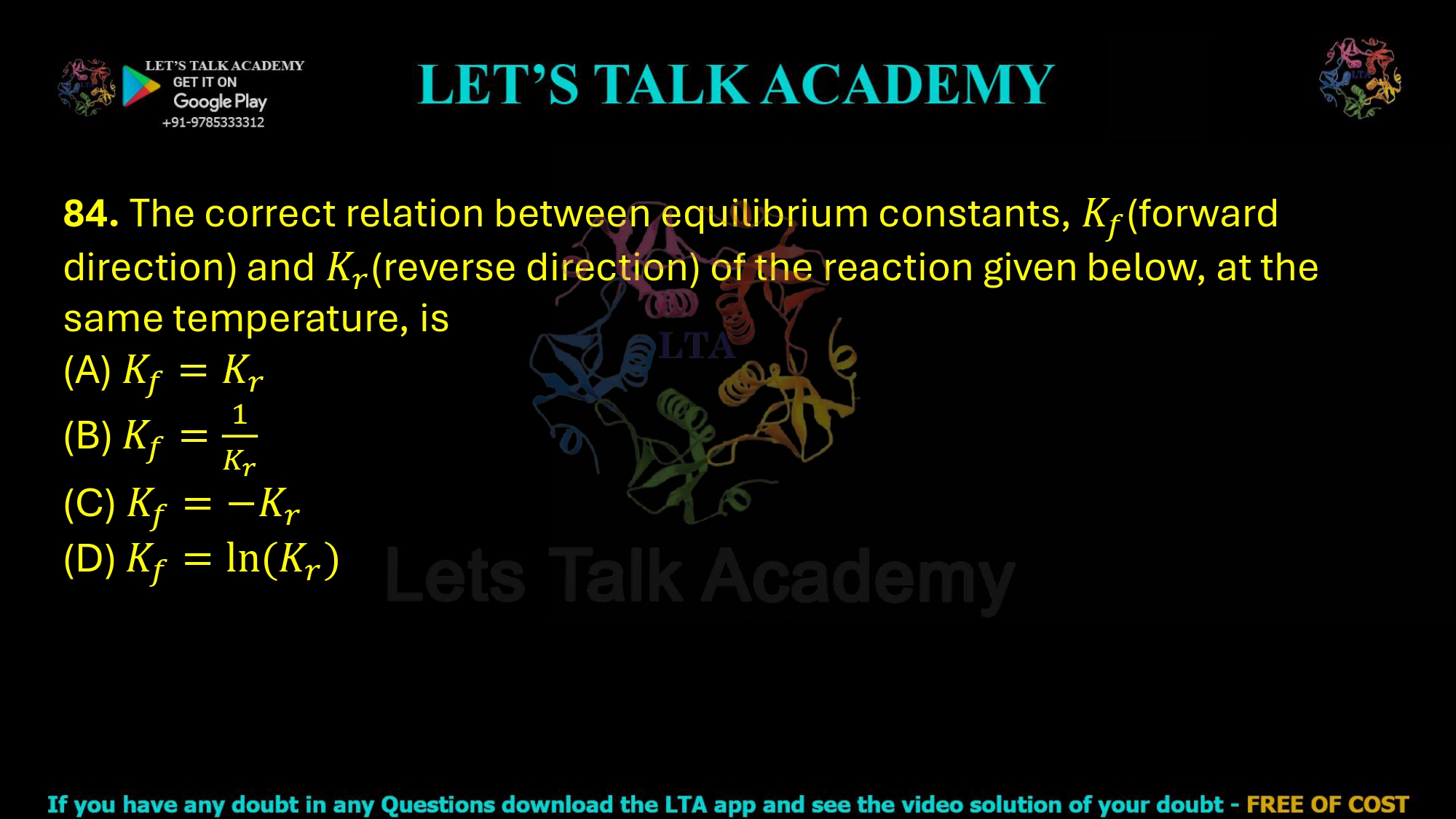
84. The correct relation between the equilibrium constants of the forward reaction (Kf) and the reverse reaction (Kr) at the same temperature is:
(A) Kf = Kr
(B) Kf = 1 / Kr
(C) Kf = –Kr
(D) Kf = ln(Kr)
Relation Between Forward and Reverse Equilibrium Constants
Correct Answer
✅ Correct Option: (B)
Understanding the Equilibrium Constant
The equilibrium constant (K) represents the ratio of the concentrations or partial pressures of products to reactants when a reversible reaction reaches equilibrium. At a fixed temperature, the equilibrium constant has a unique value and depends only on temperature.
Consider the general reversible reaction:
aA + bB ⇌ cC + dD
The equilibrium constant for the forward reaction is given by:
Kf = [C]c[D]d / [A]a[B]b
Now consider the reverse reaction:
cC + dD ⇌ aA + bB
The equilibrium expression becomes:
Kr = [A]a[B]b / [C]c[D]d
Comparing the two expressions clearly shows that the reverse equilibrium constant is simply the reciprocal of the forward equilibrium constant.
Mathematical Relationship
Therefore,
Kr = 1 / Kf
or equivalently,
Kf = 1 / Kr
This relationship is valid for every reversible reaction as long as both equilibrium constants are measured at the same temperature.
Thermodynamic Explanation
The equilibrium constant is directly related to the standard Gibbs free energy change through the equation:
ΔG° = –RT ln K
For the reverse reaction, the sign of the Gibbs free energy changes.
ΔG°reverse = –ΔG°forward
Substituting into the Gibbs free energy equation gives:
ln Kreverse = –ln Kforward
Therefore,
Kreverse = 1 / Kforward
This thermodynamic derivation confirms the same reciprocal relationship obtained from the equilibrium expression.
Explanation of Each Option
Option (A): Kf = Kr
This option is incorrect. The forward and reverse equilibrium constants are generally not equal. They become equal only when both are exactly equal to one, which is a very special case and not true in general.
Option (B): Kf = 1 / Kr
This option is correct. The equilibrium constant for the reverse reaction is always the reciprocal of the equilibrium constant for the forward reaction, provided the temperature remains constant.
Option (C): Kf = –Kr
This option is incorrect. Equilibrium constants are always positive quantities because they are ratios of concentrations or pressures raised to positive powers. They can never have negative values.
Option (D): Kf = ln(Kr)
This option is incorrect. Although the natural logarithm of the equilibrium constant appears in the Gibbs free energy equation, the equilibrium constants themselves are not related through a logarithmic expression.
Concept Behind the Question
This question tests one of the most fundamental properties of chemical equilibrium. Reversing a chemical equation simply inverts the equilibrium expression, causing the equilibrium constant to become its reciprocal. This principle is extensively used while solving equilibrium problems, calculating Gibbs free energy changes, and predicting the direction of reversible reactions.
Final Answer
At the same temperature, the equilibrium constant of the reverse reaction is the reciprocal of the equilibrium constant of the forward reaction.
Kf = 1 / Kr
✅ Correct Answer: Option (B)


