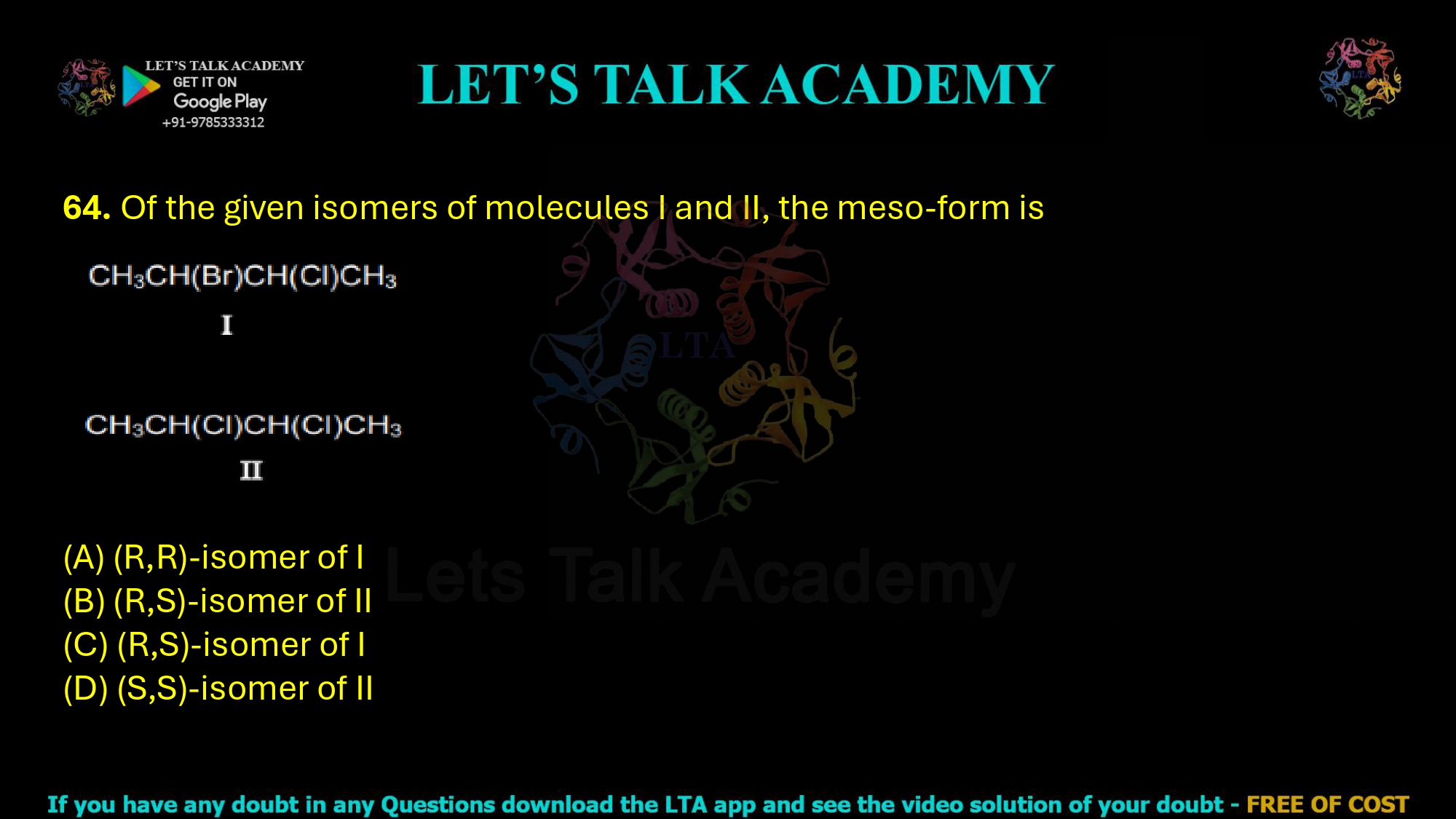
64. Of the given isomers of molecules I and II, the meso-form is
(A) (R,R)-isomer of I
(B) (R,S)-isomer of II
(C) (R,S)-isomer of I
(D) (S,S)-isomer of II
Which Isomer is the Meso Form? Complete Explanation Using R/S Configuration and Molecular Symmetry
In this question, two molecules are given along with different stereochemical configurations. The objective is to identify which stereoisomer represents the meso form.
Understanding a Meso Compound
A meso compound is a molecule that contains two or more stereogenic centers but is optically inactive because it possesses an internal plane of symmetry. Although each stereocenter is chiral, the overall molecule becomes achiral due to internal compensation.
For a meso compound to exist, the stereocenters must usually carry identical substituents so that one half of the molecule is the mirror image of the other.
Analysis of Molecule I
Molecule I is CH3CH(Br)CH(Cl)CH3. The two stereogenic centers do not possess identical substituents because one carbon bears bromine while the other bears chlorine.
Since the substituents are different, the molecule cannot possess an internal plane of symmetry. Therefore, none of the stereoisomers of Molecule I can be meso.
Analysis of Molecule II
Molecule II is CH3CH(Cl)CH(Cl)CH3, which is 2,3-dichlorobutane.
Here, both stereogenic centers have identical substituents. Consequently, the (R,S) (or equivalently S,R) configuration possesses an internal mirror plane passing through the center of the molecule.
Because of this symmetry, the optical rotations of the two stereocenters cancel each other, making the molecule optically inactive even though it contains two chiral carbons.
Thus, the (R,S) isomer of Molecule II is the meso compound.
Explanation of Every Option
Option (A): (R,R)-Isomer of Molecule I
This option is incorrect. Molecule I contains different substituents (Br and Cl), so it lacks internal symmetry. The (R,R) isomer is chiral and optically active.
Option (B): (R,S)-Isomer of Molecule II
This is the correct answer. Molecule II has identical substituents at both stereocenters. The (R,S) configuration introduces an internal plane of symmetry, making the molecule achiral despite the presence of two stereogenic centers. Therefore, it is the meso form.
Option (C): (R,S)-Isomer of Molecule I
This option is incorrect because Molecule I contains different substituents on the two stereocenters. Even with opposite configurations, internal compensation is impossible, so the molecule remains chiral.
Option (D): (S,S)-Isomer of Molecule II
This option is incorrect. The (S,S) isomer is one member of an enantiomeric pair with the (R,R) isomer. Both are optically active and therefore cannot be meso compounds.
Concept Behind Meso Compounds
A meso compound is identified not merely by having opposite configurations but by possessing an internal element of symmetry. If the substituents attached to the stereocenters are different, internal symmetry cannot exist, and the molecule remains optically active. Thus, both identical substituents and opposite configurations (R,S or S,R) are generally required for meso behavior.
Final Answer
Correct Option: (B)
The (R,S)-isomer of Molecule II is the meso compound.


