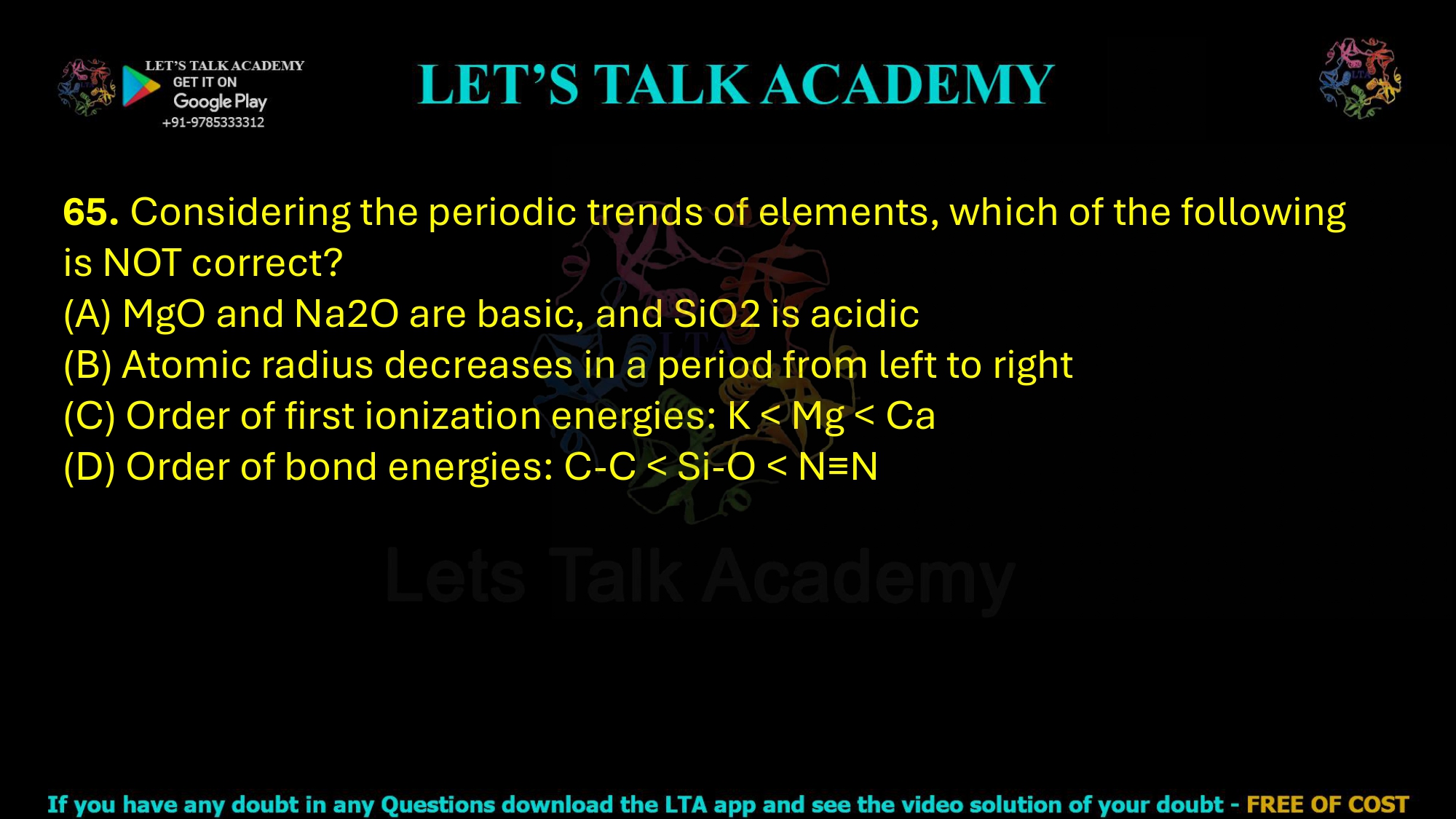
65. Considering the periodic trends of elements, which of the following is NOT correct?
(A) MgO and Na2O are basic, and SiO2 is acidic
(B) Atomic radius decreases in a period from left to right
(C) Order of first ionization energies: K < Mg < Ca
(D) Order of bond energies: C-C < Si-O < N≡N
Which Statement About Periodic Trends of Elements is NOT Correct?
In this question, four statements related to periodic properties are given. Our objective is to identify the statement that is not correct.
Correct Answer
Correct Option: (C)
Explanation of Every Option
Option (A): MgO and Na₂O are Basic, and SiO₂ is Acidic
This statement is correct. Sodium oxide (Na2O) and magnesium oxide (MgO) are metal oxides and exhibit basic character. They react with water or acids to form hydroxides and salts, respectively.
Silicon dioxide (SiO2) is a non-metal oxide and behaves as an acidic oxide. It reacts with strong bases to form silicates. This trend reflects the general periodic behavior in which metallic oxides are basic, while non-metallic oxides become increasingly acidic across a period.
Option (B): Atomic Radius Decreases from Left to Right Across a Period
This statement is also correct. As we move from left to right in a period, the nuclear charge increases while electrons are added to the same principal energy level. The increased effective nuclear charge pulls the electron cloud closer to the nucleus, causing the atomic radius to decrease.
This is one of the most fundamental periodic trends and is observed throughout the periodic table.
Option (C): Order of First Ionization Energies: K < Mg < Ca
This statement is incorrect.
The approximate first ionization energies are:
- Potassium (K) ≈ 419 kJ mol−1
- Calcium (Ca) ≈ 590 kJ mol−1
- Magnesium (Mg) ≈ 738 kJ mol−1
Therefore, the correct order is:
K < Ca < Mg
Magnesium has a higher ionization energy than calcium because magnesium is smaller and its valence electrons experience a stronger effective nuclear attraction. The order given in the option incorrectly places magnesium before calcium.
Option (D): Order of Bond Energies: C–C < Si–O < N≡N
This statement is correct.
Approximate bond dissociation energies are:
- C–C ≈ 348 kJ mol−1
- Si–O ≈ 452 kJ mol−1
- N≡N ≈ 945 kJ mol−1
Thus, the increasing order is:
C–C < Si–O < N≡N
The nitrogen–nitrogen triple bond is among the strongest covalent bonds known because of one sigma bond and two strong pi bonds.
Why Option (C) is Incorrect
Ionization energy generally decreases down a group because atomic size increases and the outermost electron experiences greater shielding. Magnesium lies in Period 3, while calcium lies directly below it in Period 4. Since calcium has a larger atomic radius, its outermost electron is less strongly attracted to the nucleus, making it easier to remove.
Consequently, magnesium has a higher first ionization energy than calcium.
Therefore, the correct order is:
K < Ca < Mg
Since the option states K < Mg < Ca, it is incorrect.
Final Answer
Correct Option: (C)
The correct order of first ionization energies is:
K < Ca < Mg


