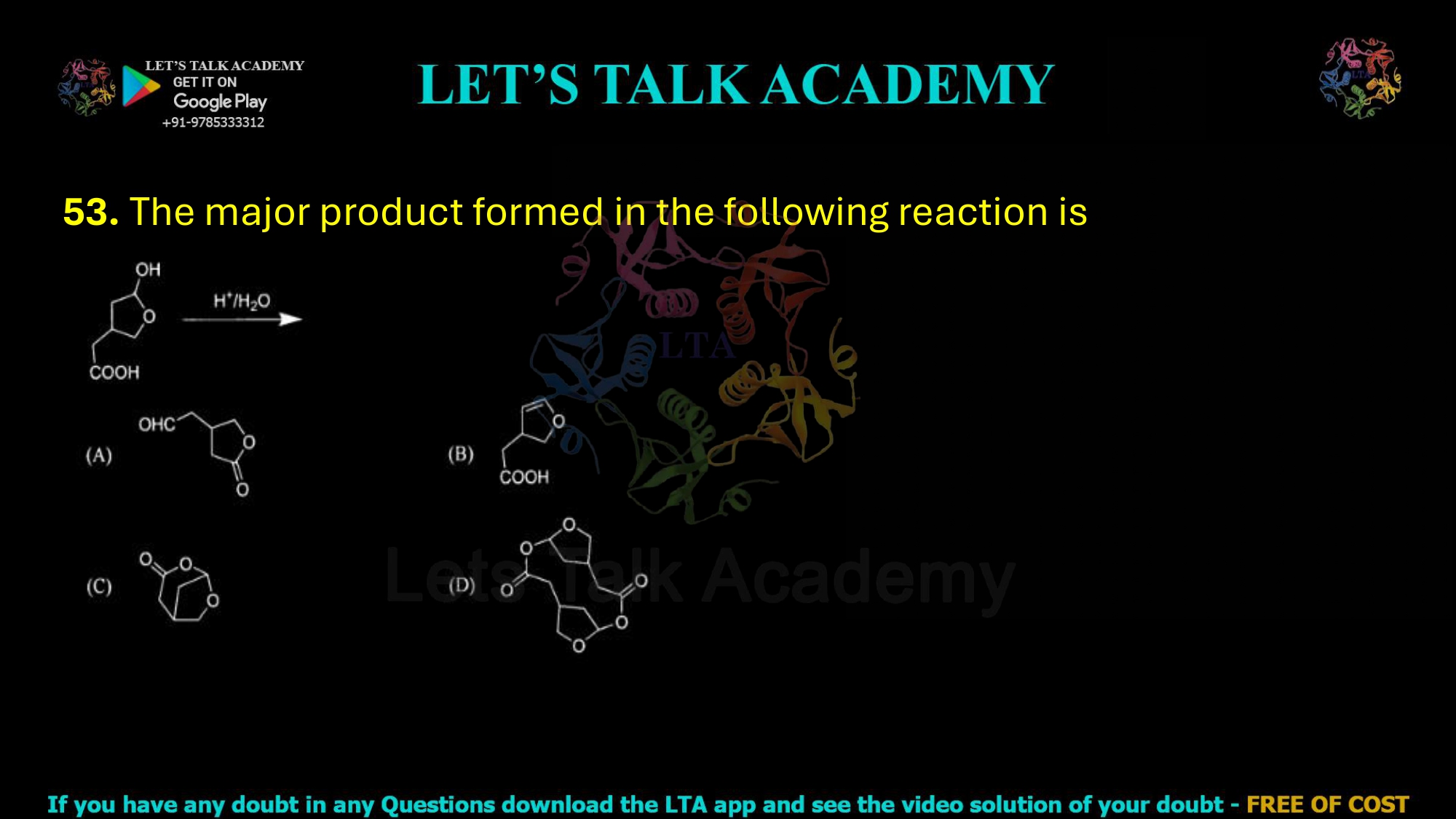
53. The major product formed in the following reaction is
Major Product Formed During Acid-Catalyzed Hydrolysis of a Cyclic Hemiacetal
In the given question, a cyclic hemiacetal containing a carboxylic acid side chain is treated with H+/H2O. Since the reaction is carried out under acidic aqueous conditions, the cyclic hemiacetal undergoes hydrolysis, regenerating its corresponding open-chain carbonyl compound. Understanding why this happens allows students to eliminate incorrect options quickly and confidently.
Understanding the Structure of the Reactant
The given compound is not an ordinary cyclic ether. It is a cyclic hemiacetal (also known as a lactol). A hemiacetal is characterized by the presence of a carbon atom bonded simultaneously to an –OH group and an –OR group. In this molecule, the ring oxygen and the hydroxyl-bearing carbon together form the cyclic hemiacetal framework, while the side chain contains a carboxylic acid group.
Cyclic hemiacetals exist in equilibrium with their corresponding open-chain aldehydes or ketones. This equilibrium is strongly influenced by the reaction conditions. Under acidic aqueous conditions, the equilibrium shifts toward formation of the carbonyl compound through hydrolysis of the hemiacetal linkage.
What Happens in the Presence of H+/H2O?
When the molecule is treated with dilute acid in water, the reaction begins with protonation of the oxygen atom in the cyclic hemiacetal. Protonation makes the carbon–oxygen bond more susceptible to cleavage. Water then participates in the reaction, allowing the ring to open and regenerate the original carbonyl functionality.
The overall transformation converts the cyclic hemiacetal into its corresponding open-chain aldehyde, while the carboxylic acid group remains completely unaffected because it is already present in its most oxidized form.
Therefore, the expected major product is the ring-opened aldehyde.
Reaction Mechanism
Step 1: Protonation of the Ring Oxygen
The oxygen atom of the cyclic hemiacetal accepts a proton from the acidic medium. This activation weakens the carbon–oxygen bond and prepares the ring for cleavage.
Step 2: Cleavage of the C–O Bond
The bond between the anomeric carbon and the ring oxygen breaks. This opens the five-membered ring and generates a positively charged intermediate.
Step 3: Formation of the Carbonyl Group
Loss of a proton restores neutrality and simultaneously reforms the carbonyl group, producing the corresponding aldehyde. Since water is present in large excess, the equilibrium favors hydrolysis rather than cyclization.
Why Option (B) is Correct
Option (B) correctly represents the open-chain aldehyde produced after hydrolysis of the cyclic hemiacetal. The aldehyde group appears at the terminal carbon where the ring was originally closed, while the carboxylic acid side chain remains unchanged. This is exactly the expected product of acid-catalyzed hemiacetal hydrolysis.
The reaction neither oxidizes nor reduces the molecule. It simply converts the cyclic hemiacetal back into the corresponding aldehyde through reversible ring opening.
Explanation of Every Option
Option (A)
This option is incorrect because it represents formation of a lactone. Lactones are cyclic esters that are generally formed through intramolecular esterification or oxidation reactions. Under simple acidic hydrolysis conditions, the reaction proceeds toward ring opening rather than formation of a new cyclic ester. Therefore, this product is not expected.
Option (B)
This is the correct answer. It shows the open-chain aldehyde formed after hydrolysis of the cyclic hemiacetal. The aldehyde functionality is regenerated, and the carboxylic acid remains unchanged. This transformation is completely consistent with the reversible nature of hemiacetal formation.
Option (C)
This option is incorrect because it depicts formation of a bicyclic acetal-like structure. Acidic aqueous conditions do not promote the formation of additional cyclic acetals. Instead, water drives the equilibrium toward hydrolysis, making this structure highly unlikely.
Option (D)
This option is also incorrect because it represents a complex condensation product involving multiple cyclic units. Such products require entirely different reaction conditions and are not formed during simple acid-catalyzed hydrolysis of a hemiacetal.
Concept Behind the Reaction
One of the most important principles in organic chemistry is that hemiacetal formation is reversible. Aldehydes and ketones react with alcohols to form hemiacetals, while acidic aqueous conditions convert those hemiacetals back into their parent carbonyl compounds. This equilibrium plays a vital role in carbohydrate chemistry because monosaccharides continuously interconvert between their cyclic and open-chain forms in solution.
The same principle applies in the present question. The cyclic hemiacetal opens under acidic conditions to regenerate the aldehyde, making Option (B) the thermodynamically favored product.
Final Answer
Correct Option: (B)
The major product formed is the open-chain aldehyde obtained by acid-catalyzed hydrolysis of the cyclic hemiacetal.


