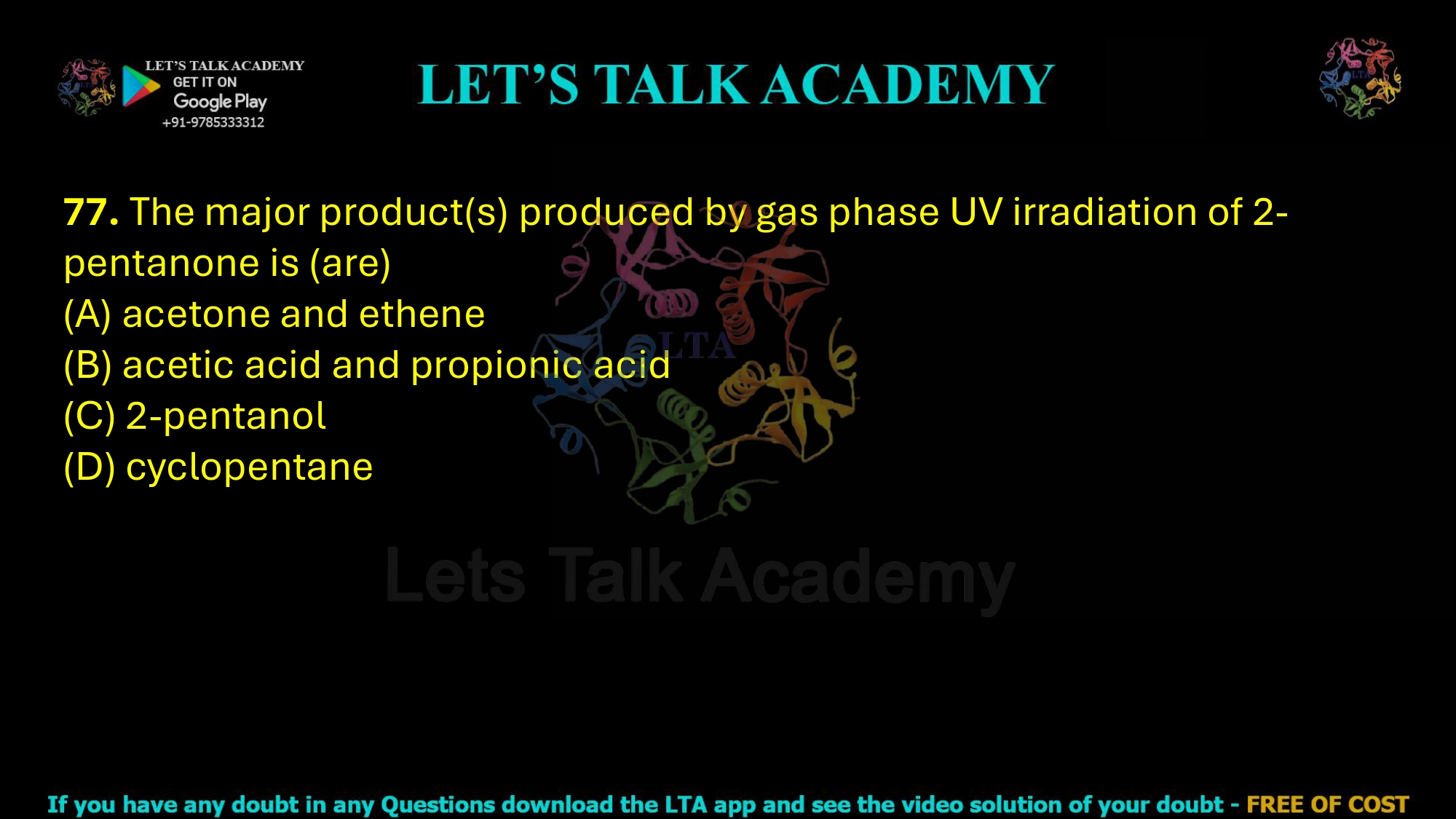
77. The major product(s) produced by gas phase UV irradiation of 2-pentanone is (are)
(A) acetone and ethene
(B) acetic acid and propionic acid
(C) 2-pentanol
(D) cyclopentane
Major Products Formed by Gas Phase UV Irradiation of 2-Pentanone (Norrish Type I Reaction)
Correct Answer
✅ Correct Option: (A)
Understanding the Photochemistry of Ketones
When ketones absorb ultraviolet light, the carbonyl group is promoted to an electronically excited state. The excited molecule becomes highly reactive and undergoes cleavage of the bond adjacent to the carbonyl carbon. This process is known as the Norrish Type I reaction, one of the most common photochemical reactions of aldehydes and ketones.
In a Norrish Type I reaction, homolytic cleavage occurs at the α-carbon–carbon bond, producing two free radicals. These radicals subsequently undergo rearrangement, fragmentation, or hydrogen abstraction to generate stable products.
Structure of 2-Pentanone
The structure of 2-pentanone is:
CH₃–CO–CH₂–CH₂–CH₃
The carbonyl carbon is attached to a methyl group on one side and a propyl group on the other. Under UV irradiation, cleavage occurs preferentially at the bond adjacent to the carbonyl group, generating radical intermediates.
Norrish Type I Mechanism
Step 1: Excitation of the Carbonyl Group
Absorption of ultraviolet light promotes the carbonyl group to an excited electronic state. This excited ketone possesses sufficient energy to undergo homolytic bond cleavage.
Step 2: α-Cleavage
The bond between the carbonyl carbon and the adjacent carbon breaks homolytically, producing radical species. These radicals rapidly undergo secondary reactions to form stable molecules.
Step 3: Formation of Stable Products
For 2-pentanone, radical fragmentation ultimately produces acetone and ethene as the major stable products. These products arise because the radical intermediates undergo β-scission to form the most stable molecules possible under gas-phase photolysis conditions.
Why Option (A) is Correct
Option (A) correctly identifies the major products obtained from the gas-phase photolysis of 2-pentanone. The reaction proceeds through a Norrish Type I α-cleavage mechanism followed by radical fragmentation, yielding acetone and ethene as the principal products. This transformation is well documented in photochemical studies of aliphatic ketones.
Explanation of Each Option
Option (A): Acetone and Ethene
This option is correct. UV irradiation of 2-pentanone proceeds through a Norrish Type I reaction, and subsequent radical fragmentation produces acetone and ethene as the major products. These products are consistent with the established mechanism of ketone photolysis.
Option (B): Acetic Acid and Propionic Acid
This option is incorrect. Formation of carboxylic acids requires oxidation of the carbonyl-containing intermediates. Gas-phase UV irradiation does not involve oxidative conditions, so acetic acid and propionic acid are not formed as major products.
Option (C): 2-Pentanol
This option is incorrect. Reduction of a ketone to an alcohol requires a reducing agent such as sodium borohydride or lithium aluminium hydride. Ultraviolet irradiation alone cannot convert 2-pentanone into 2-pentanol.
Option (D): Cyclopentane
This option is incorrect. Cyclopentane formation would require an intramolecular ring-closing reaction that is not feasible for 2-pentanone under simple UV photolysis conditions. The reaction instead proceeds through radical fragmentation rather than cyclization.
Concept Behind the Question
This question examines the understanding of photochemical reactions of carbonyl compounds, particularly the Norrish Type I reaction. Students are expected to recognize that ultraviolet irradiation excites the carbonyl group, leading to α-cleavage and free radical formation. The stability of the resulting radicals determines the final products.
It is also important to distinguish Norrish Type I reactions from Norrish Type II reactions. Type I involves α-cleavage adjacent to the carbonyl group, whereas Type II involves intramolecular γ-hydrogen abstraction followed by cleavage or cyclization. Identifying the reaction type allows rapid prediction of the products formed during photolysis.
Final Answer
Gas-phase ultraviolet irradiation of 2-pentanone proceeds through a Norrish Type I α-cleavage mechanism. The resulting radical intermediates undergo fragmentation to produce acetone and ethene as the major products.
✅ Correct Answer: Option (A)


