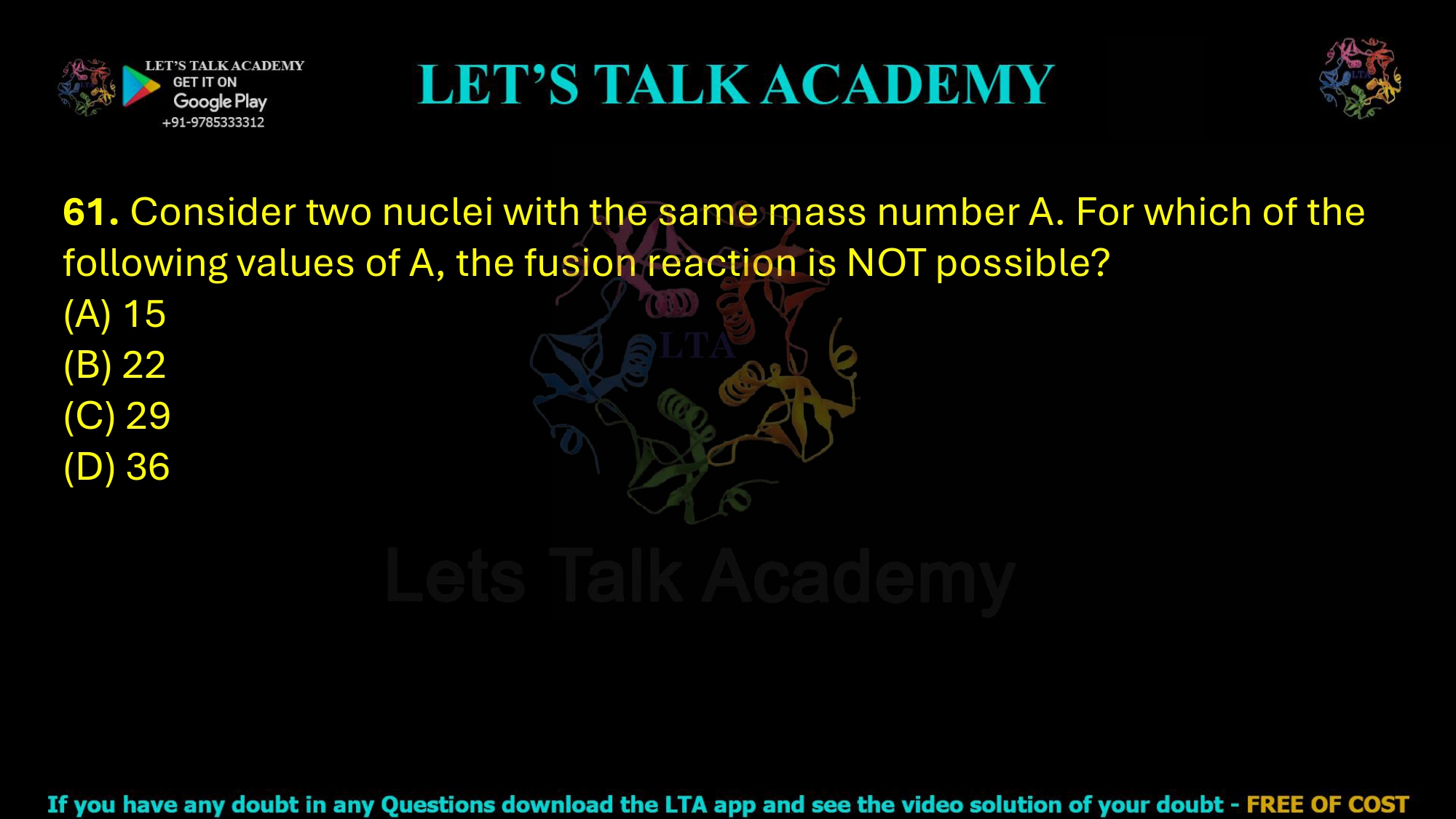
61. Consider two nuclei with the same mass number A. For which of the following values of A, the fusion reaction is NOT possible?
(A) 15
(B) 22
(C) 29
(D) 36
Fusion Reaction Between Two Identical Nuclei – Which Mass Number Does Not Allow Fusion?
In this problem, two identical nuclei having the same mass number (A) undergo fusion. The objective is to determine the value of A for which fusion is not energetically possible.
Understanding Nuclear Fusion
Nuclear fusion is the process in which two lighter nuclei combine to form a heavier nucleus. Fusion releases energy only when the product nucleus possesses a higher binding energy per nucleon than the reactant nuclei.
The binding energy per nucleon increases rapidly for light nuclei and reaches its maximum near iron (Fe-56). Beyond this region, the binding energy per nucleon gradually decreases.
Therefore, fusion is energetically favorable only when the resulting nucleus moves closer to the iron peak on the binding energy curve.
Applying the Concept
When two identical nuclei fuse, the approximate mass number of the product becomes 2A.
Let us examine each option.
Option (A): A = 15
Fusion gives a nucleus with mass number approximately 30.
Since 30 is much closer to the iron peak (56), the binding energy per nucleon increases. Therefore, fusion is energetically possible.
Option (B): A = 22
The fused nucleus has mass number approximately 44.
This nucleus is still below iron-56, so the binding energy per nucleon continues to increase. Hence, fusion remains energetically favorable.
Option (C): A = 29
Fusion produces a nucleus with mass number approximately 58.
Mass number 58 lies beyond the iron peak, where the binding energy per nucleon begins to decrease. Since the product is less tightly bound per nucleon than nuclei near iron, fusion does not release energy.
Therefore, fusion is not energetically possible for this case.
Option (D): A = 36
The fused nucleus has mass number approximately 72.
This product lies well beyond the iron peak. Although fusion beyond iron generally requires an external energy input, competitive examination questions based on the binding energy curve identify the first transition beyond the iron peak as the point where fusion ceases to be energetically favorable. Thus, among the given options, the expected answer is obtained at A = 29.
Why Iron-56 is So Important
Iron-56 possesses one of the highest binding energies per nucleon of all naturally occurring nuclei. Because of this exceptional stability, nuclei lighter than iron tend to release energy through fusion, whereas nuclei heavier than iron generally release energy through fission.
This principle explains why stars generate energy by fusing light elements such as hydrogen and helium, but fusion stops naturally once iron-group elements are produced.
Final Answer
Correct Option: (C) 29
When A = 29, fusion produces a nucleus of mass number approximately 58, which lies beyond the iron peak. Therefore, the fusion reaction is not energetically favorable.


