Oxidative Phosphorylation 1. Introduction 1.1 Meaning of Oxidative Phosphorylation Oxidative phosphorylation is the major ATP-producing process of aerobic respiration. It is the process in which the energy released during the […]
Bioenergetics Introduction Life is possible only because living organisms can continuously acquire, transform, conserve, transfer, and utilize energy. Every living cell, from a simple bacterial cell to a highly specialized […]
Glycolysis Glycolysis: Pathway, Regulation, Energetics 1. Introduction and Significance Glycolysis is the central metabolic pathway through which glucose is converted into pyruvate with the formation of ATP and NADH. The […]
Principles of Biophysical Chemistry: Colligative Properties 1. Introduction to Colligative Properties 1.1 Definition of Colligative Properties Colligative properties are properties of dilute solutions that depend primarily on the number of […]
Principles of Biophysical Chemistry: Thermodynamics 1. Introduction to Thermodynamics Thermodynamics is the branch of physical chemistry that deals with energy, heat, work, temperature, and the transformations of energy occurring in […]
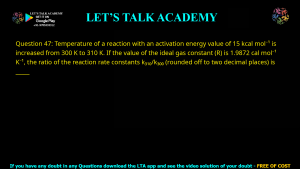
PRINCIPLES OF BIOPHYSICAL CHEMISTRY: REACTION KINETICS 1. Introduction to Reaction Kinetics Reaction kinetics is the branch of chemistry that deals with the rate of chemical reactions, the factors that influence […]
PRINCIPLES OF BIOPHYSICAL CHEMISTRY: BUFFERS 1. Introduction to Biophysical Chemistry Biophysical chemistry is an interdisciplinary area that applies the principles of physical chemistry, physics, and mathematics to biological systems. It […]
Principles of Biophysical Chemistry – pH 1. Introduction Biophysical chemistry applies the principles of physical chemistry to biological systems. It helps us understand how biomolecules such as proteins, nucleic acids, […]
Stabilizing Interactions — Hydrogen Bonding 1. Introduction to Hydrogen Bonding Hydrogen bonding is one of the most important non-covalent interactions involved in the structure, stability, recognition, and function of biological […]
Stabilizing Interactions – Hydrophobic Interaction 1. Introduction Biomolecules are maintained in their biologically functional structures by several types of interactions. These interactions may be covalent or non-covalent and include hydrogen […]