
Bioenergetics
Introduction
Life is possible only because living organisms can continuously acquire, transform, conserve, transfer, and utilize energy. Every living cell, from a simple bacterial cell to a highly specialized human neuron, requires energy to maintain its organization and carry out essential biological functions.
A cell is not a static structure. It is a highly dynamic system in which thousands of chemical reactions occur continuously. New molecules are synthesized, old molecules are degraded, ions are transported across membranes, proteins change their conformations, molecular motors move cellular components, and information is transmitted through signalling pathways. All of these activities require energy.
The study of energy transformations occurring in living organisms is known as bioenergetics.
Bioenergetics forms the thermodynamic foundation of biochemistry. It helps us understand why some biochemical reactions proceed spontaneously, why some reactions require an energy input, how ATP drives cellular processes, how electrons transfer energy from one molecule to another, and how cells conserve energy in the form of chemical bonds and electrochemical gradients.
An important point is that cells do not create energy. They transform energy obtained from their environment into forms that can be used for biological work.
For example, in an animal cell:
Food → Chemical energy → Reduced electron carriers → Proton gradient → ATP → Cellular work
In photosynthetic organisms, the initial energy source is different:
Light energy → Electron transport → Proton gradient → ATP + reducing power → Chemical energy
Thus, although different organisms use different energy sources, the fundamental principle of energy transformation and conservation remains universal.
- Glycolysis
- Citric acid cycle
- Oxidative phosphorylation
- Electron transport
- ATP synthesis
- Redox reactions
- Proton-motive force
- Membrane energetics
- Active transport
- Metabolic regulation
- Biological energy transduction
- Coupled biochemical reactions
A student who understands bioenergetics properly will find many later topics of metabolism much easier.
1. Meaning and Scope of Bioenergetics
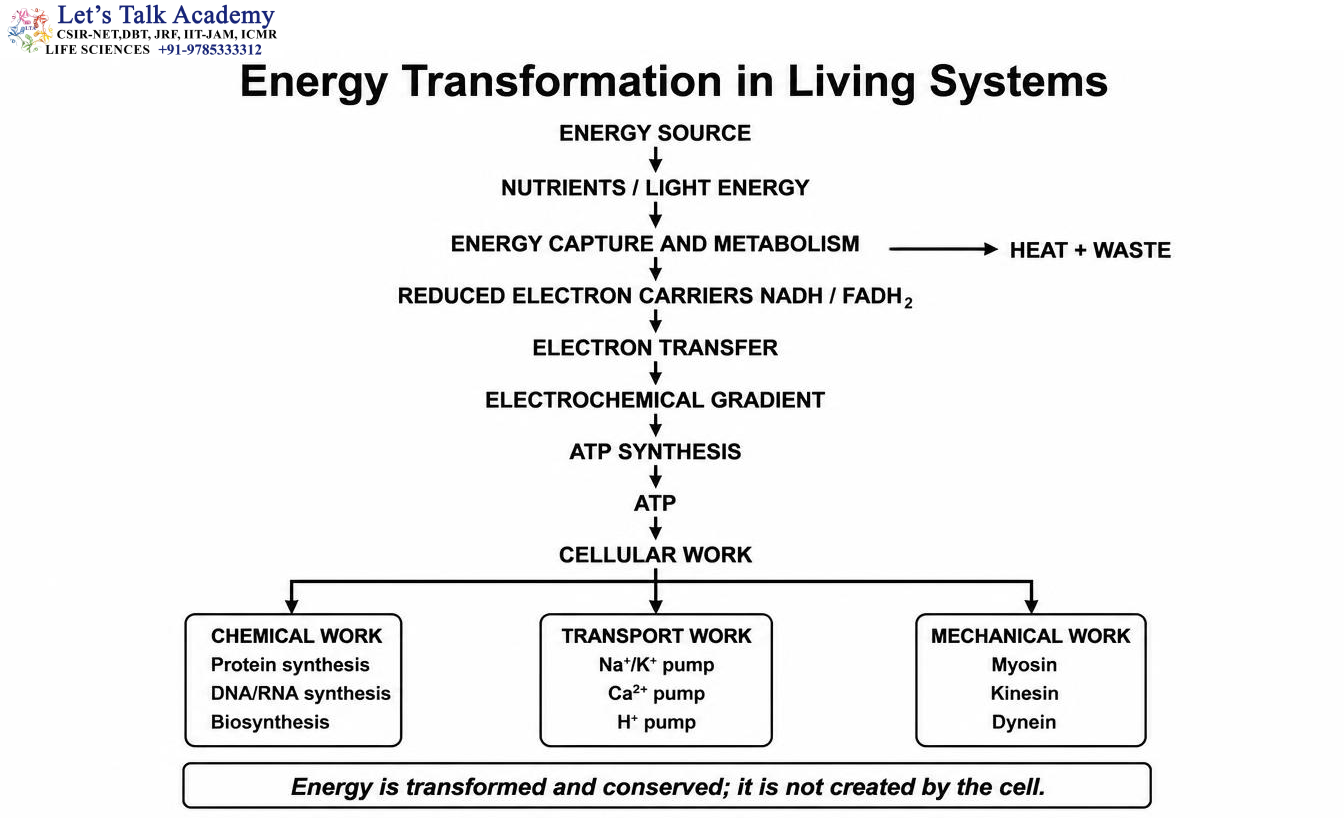
Concept Box: Living organisms continuously transform energy from one form into another. ATP, reduced electron carriers, and electrochemical gradients act as major intermediates in biological energy transfer.
1.1 Definition of Bioenergetics
Bioenergetics is the study of energy transformations and energy relationships in living biological systems.
The term can be understood by dividing it into two parts:
- Bio = life
- Energetics = study of energy
1.2 Why Is Bioenergetics Important?
Every cell needs energy because biological organization does not maintain itself automatically.
For example, a cell must continuously:
- Maintain membrane integrity.
- Maintain ion gradients.
- Synthesize proteins.
- Replicate DNA.
- Synthesize RNA.
- Transport molecules.
- Remove waste products.
- Repair damaged cellular components.
- Maintain intracellular pH.
- Move cellular structures.
- Respond to external signals.
- Grow and divide.
If energy production stops completely, these processes cannot continue indefinitely.
Therefore, energy metabolism is fundamental to cellular survival.
1.3 Scope of Bioenergetics
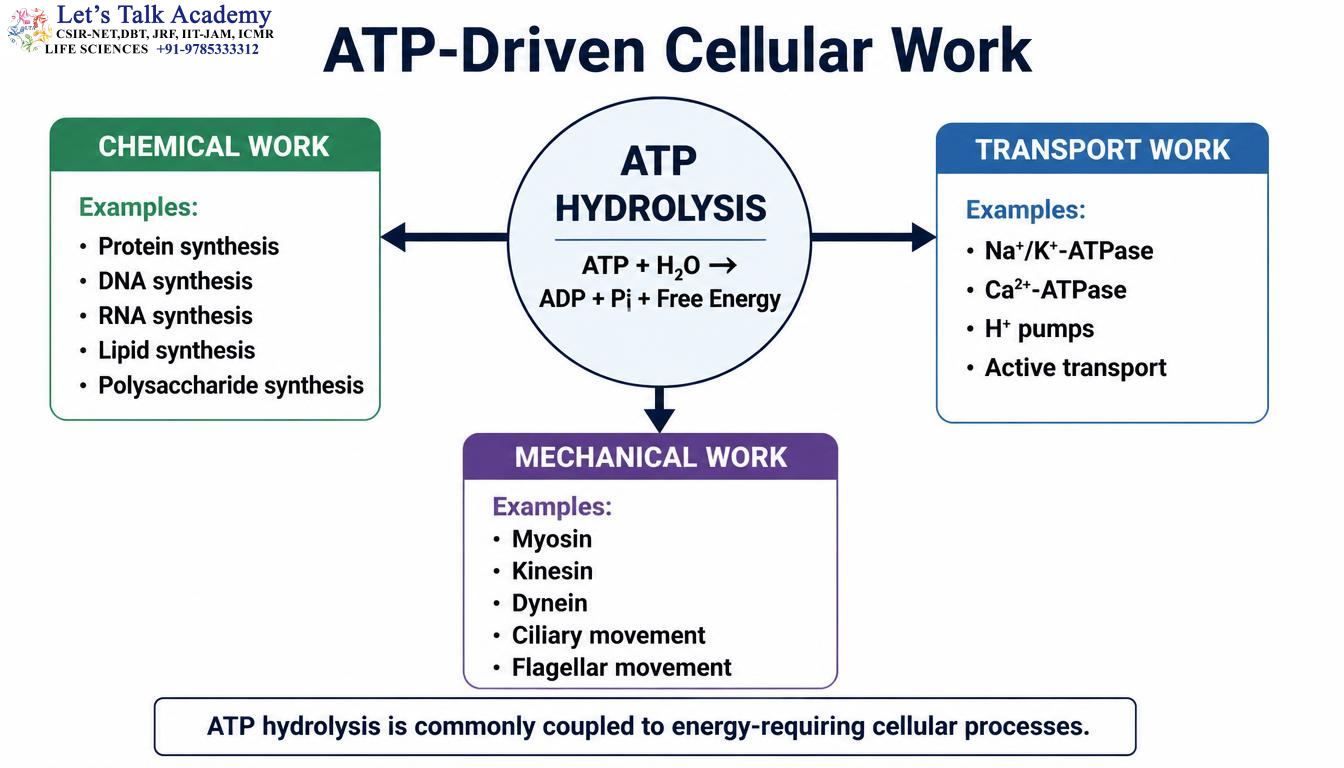
Concept Box: ATP hydrolysis provides usable free energy that can be coupled to chemical, transport, and mechanical work.
Bioenergetics covers several major areas of biology and biochemistry.
A. Energy Acquisition
Organisms obtain energy from different sources.
Photoautotrophs primarily capture light energy.
Chemoorganotrophs obtain energy by oxidizing organic compounds.
Chemolithotrophs can obtain energy by oxidizing inorganic compounds.
Thus, the original energy source may differ, but cells ultimately need to convert that energy into usable forms.
B. Energy Conversion
Energy is rarely used in the exact form in which it is initially obtained.
For example:
Glucose → NADH → Proton gradient → ATP
The chemical energy of glucose is therefore converted through several intermediate forms.
C. Energy Conservation
Cells conserve energy in several forms, including:
- ATP
- GTP
- NADH
- FADH₂
- Proton gradients
- Ion gradients
- Phosphorylated intermediates
D. Energy Utilization
The conserved energy is eventually used to perform:
- Chemical work
- Transport work
- Mechanical work
- Electrical work
- Biosynthetic work
1.4 Three Major Types of Cellular Work
Energy-consuming cellular activities can broadly be divided into three categories.
1. Chemical Work
Chemical work involves the synthesis of molecules.
Examples:
- Protein synthesis
- DNA synthesis
- RNA synthesis
- Lipid synthesis
- Polysaccharide synthesis
2. Transport Work
Transport work involves moving molecules or ions against their electrochemical gradients.
Examples:
- Na⁺/K⁺-ATPase
- Ca²⁺-ATPase
- H⁺ pumps
3. Mechanical Work
Mechanical work involves movement.
Examples:
- Muscle contraction
- Ciliary movement
- Flagellar movement
- Kinesin-mediated transport
- Dynein-mediated movement
- Myosin movement
2. Energy in Biological Systems
2.1 What Is Energy?
Energy can be broadly described as the capacity to perform work.
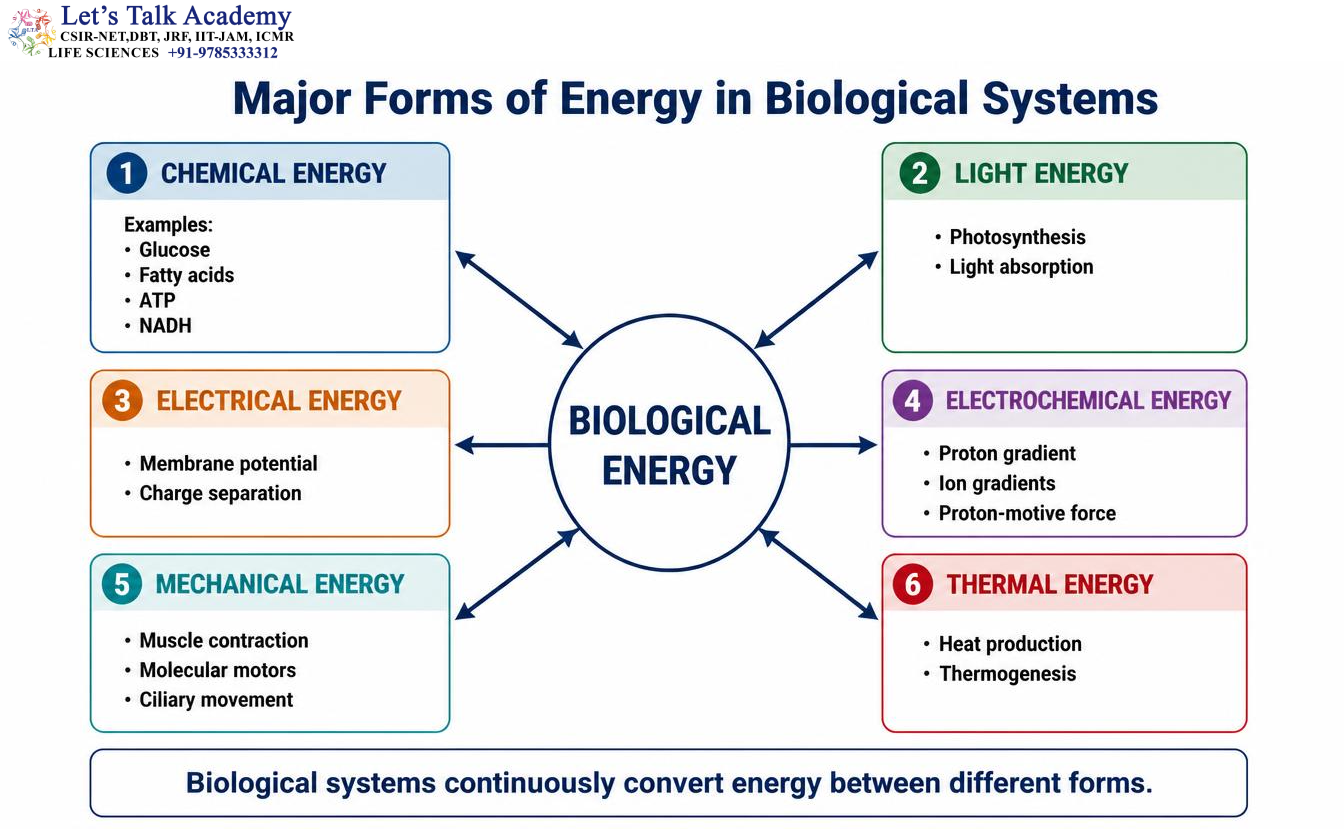
In biological systems, energy is not limited to one physical form. It can exist in different forms and can be transformed from one form into another.
The major forms relevant to biology include:
- Chemical energy
- Electrical energy
- Electrochemical energy
- Light energy
- Mechanical energy
- Thermal energy
2.2 Chemical Energy
Chemical energy is associated with the arrangement and interactions of atoms and molecules.
Biological molecules such as glucose, fatty acids, ATP, and reduced electron carriers participate in chemical energy transfer.
For example, glucose can undergo controlled oxidation.
Glucose → CO₂ + H₂O
The overall oxidation releases free energy.
Cells do not release all this energy in one uncontrolled step. Instead, metabolism breaks the overall process into multiple enzyme-catalyzed steps.
This controlled release allows cells to conserve a significant fraction of the available energy.
2.3 Why Is Controlled Energy Release Important?
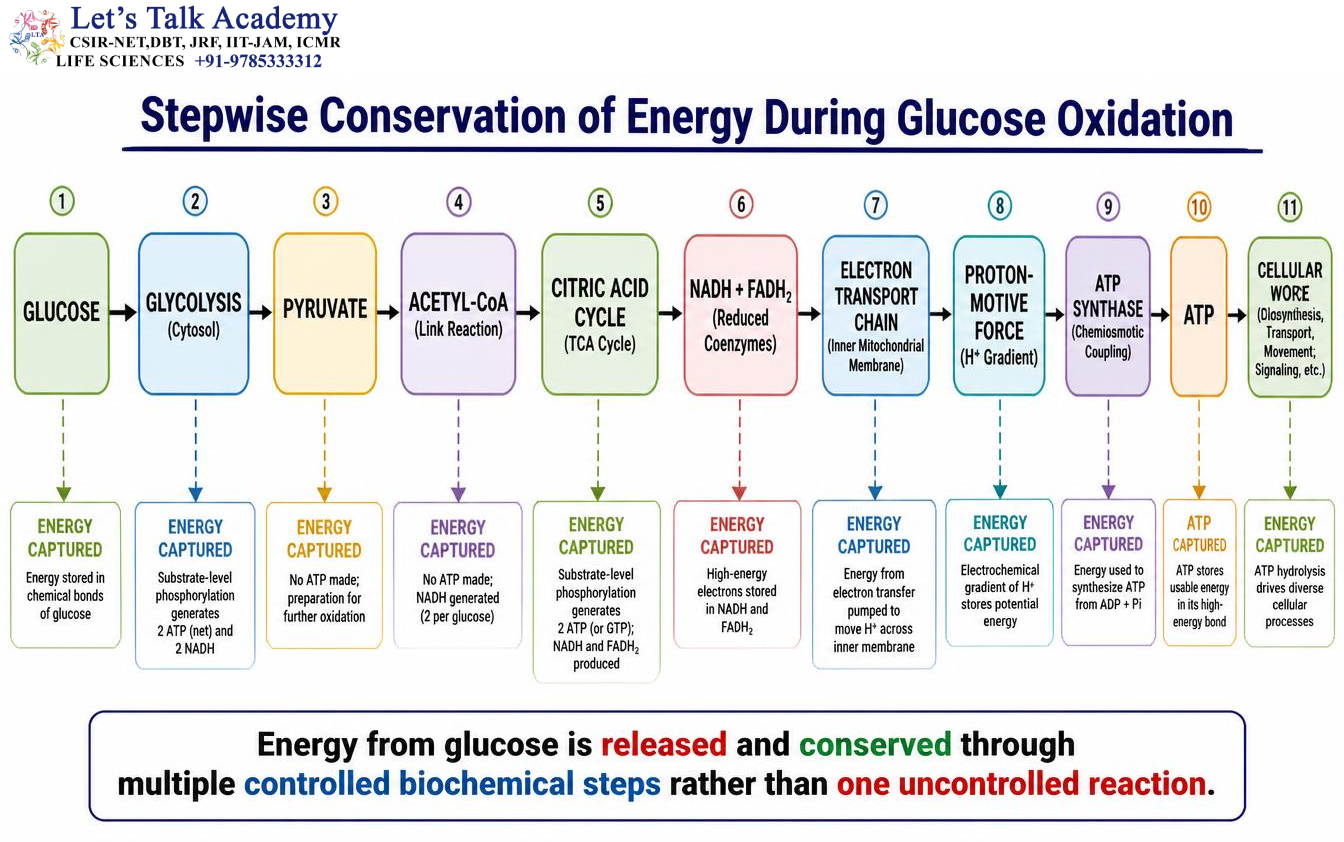
Imagine that all the energy stored in glucose were released in one uncontrolled chemical reaction.
Most of the energy would be dissipated rapidly as heat and could not be efficiently captured for cellular work.
Instead, cells use multiple metabolic steps.
For example:
Glucose
↓
Glycolysis
↓
Pyruvate
↓
Acetyl-CoA
↓
Citric acid cycle
↓
NADH/FADH₂
↓
Electron transport
↓
Proton gradient
↓
ATP
This stepwise process allows energy to be captured in manageable units.
2.4 Energy Coupling in Cells
Cells frequently connect an energy-releasing reaction to an energy-requiring reaction.
For example:
ATP hydrolysis → Energy release
is coupled to:
Biosynthetic reaction → Energy requirement
The combined process can become thermodynamically favorable.
This principle is known as energy coupling.
3. Laws of Thermodynamics
Thermodynamics provides the fundamental rules governing energy transformations.
Two laws are especially important in biological systems:
- First Law of Thermodynamics
- Second Law of Thermodynamics
A third law also exists, but the first and second laws are most directly relevant to biochemical energy transformations.
4. First Law of Thermodynamics
4.1 Statement
The First Law of Thermodynamics states:
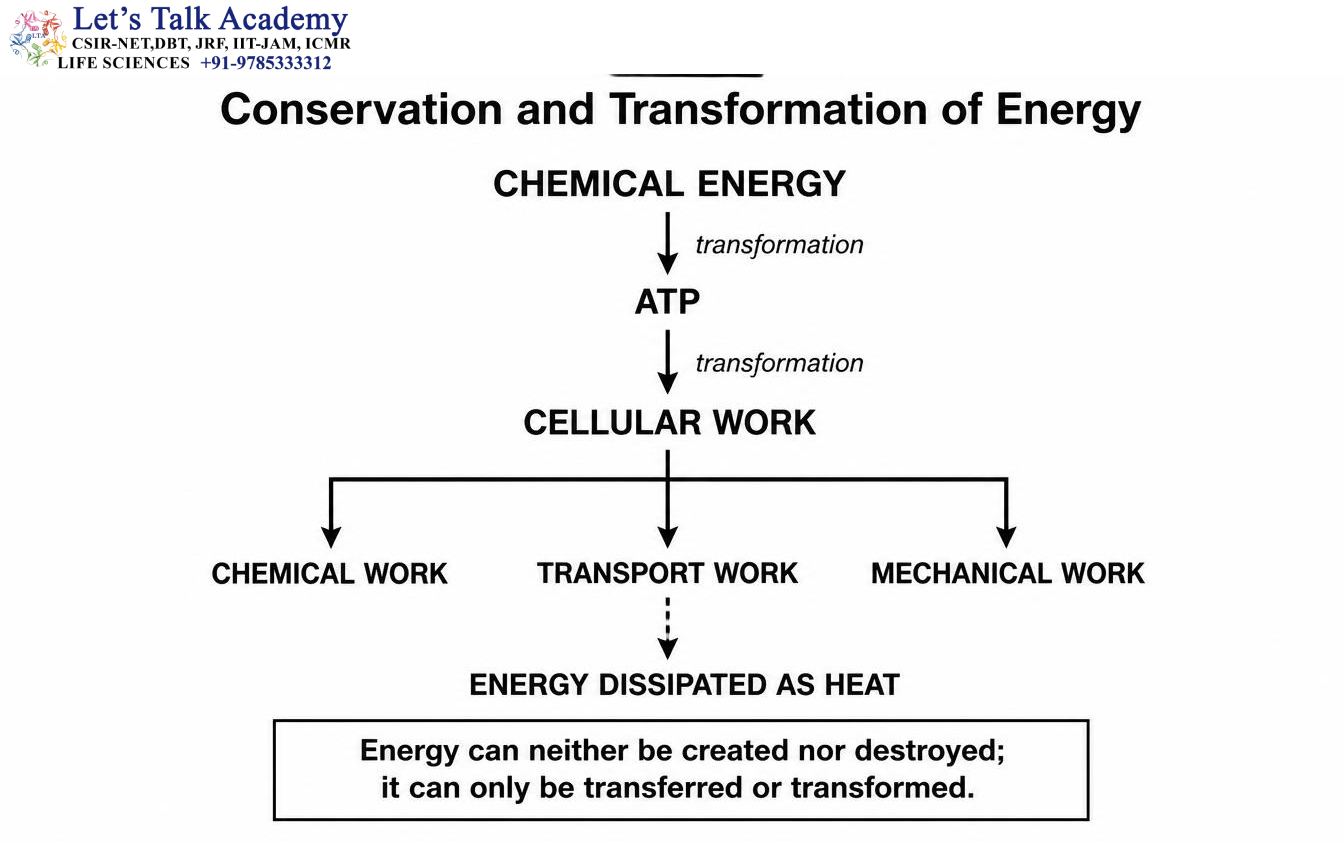
Energy can neither be created nor destroyed; it can only be transferred or transformed from one form into another.
This is known as the law of conservation of energy.
4.2 First Law in Biological Systems
Living organisms do not create energy.
They obtain energy from their environment and transform it.
For example, in an animal:
Chemical energy of food
↓
Reduced electron carriers
↓
ATP
↓
Cellular work + Heat
In a plant:
Light energy
↓
Chemical energy
↓
ATP and reducing equivalents
↓
Biosynthesis and cellular work
Thus, the first law explains why energy obtained from nutrients or sunlight can be transformed into other usable forms.
4.3 Internal Energy
The total energy contained within a thermodynamic system is called its internal energy, represented by:
E or U
The change in internal energy is represented as:
ΔE or ΔU
A general thermodynamic expression is:
ΔU = q − w
where:
- ΔU = change in internal energy
- q = heat supplied to the system
- w = work performed by the system
The sign convention can vary among textbooks, so the convention being used should always be kept in mind.
4.4 Important Biological Meaning
The first law tells us that energy is conserved, but it does not tell us whether a reaction will occur spontaneously.
For that, we need the second law and Gibbs free energy.
First law = conservation of energy
Second law = direction/spontaneity of processes
This distinction is extremely important.
5. Second Law of Thermodynamics
5.1 Statement
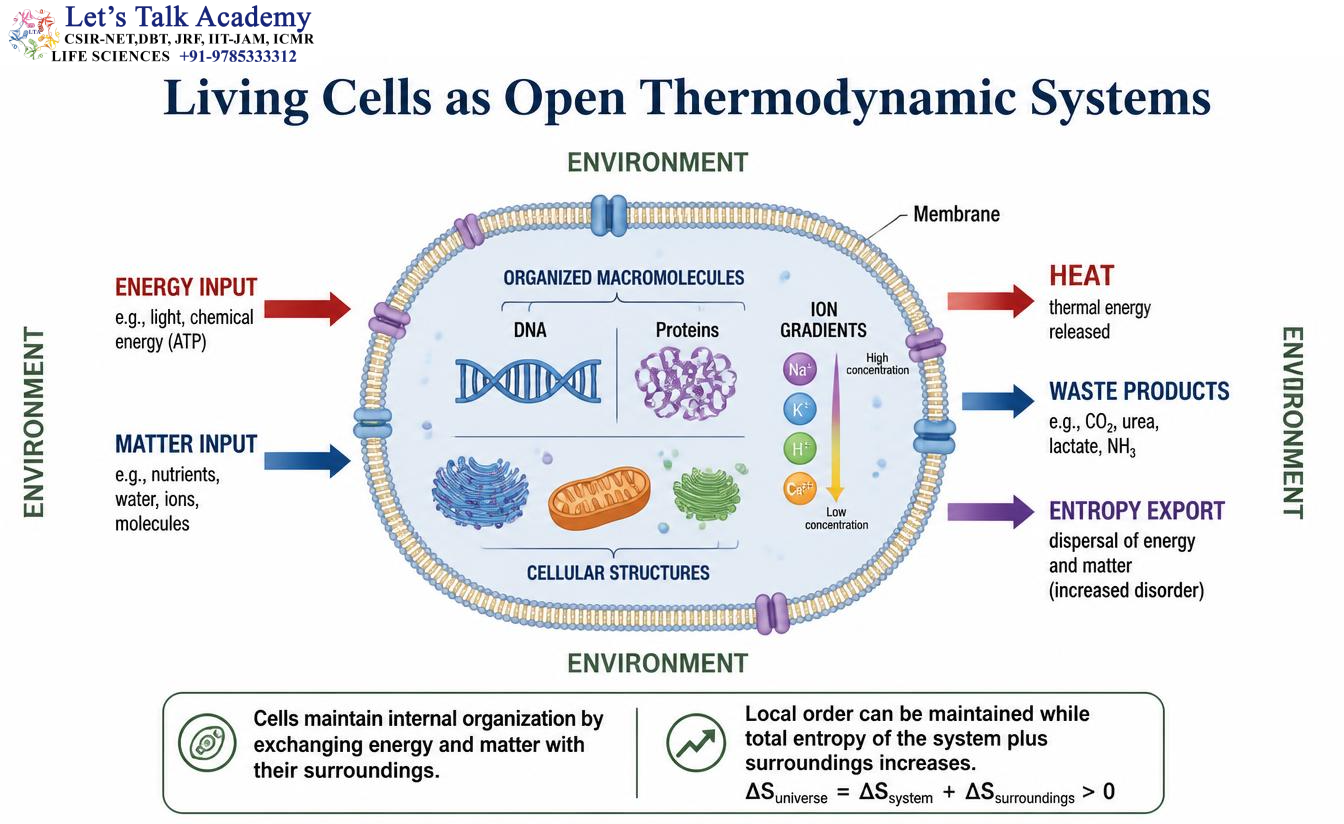
The Second Law of Thermodynamics states that for a spontaneous process, the total entropy of an isolated system and its surroundings increases.
Mathematically:
ΔS_universe > 0
for a spontaneous irreversible process.
At equilibrium:
ΔS_universe = 0
5.2 Meaning of the Second Law
The second law explains why energy transformations are not completely reversible or perfectly efficient.
Whenever energy is transformed, some energy becomes less available for useful work and is generally dissipated as heat.
For example:
Chemical energy → Mechanical work + Heat
The heat released contributes to the entropy of the surroundings.
5.3 Do Living Organisms Violate the Second Law?
No.
This is one of the most common conceptual questions.
Living organisms appear highly organized because they maintain:
- Ordered cellular structures
- Protein organization
- Membrane systems
- DNA organization
- Ion gradients
However, organisms are open systems.
They exchange:
- Matter
- Energy
- Heat
with their environment.
A cell can increase or maintain its internal order by causing a greater increase in entropy in its surroundings.
Therefore:
Local decrease in entropy does not violate the second law as long as the total entropy change is consistent with the second law.
6. Entropy and Biological Systems
6.1 Definition of Entropy
Entropy is represented by: S
and changes in entropy are represented by: ΔS
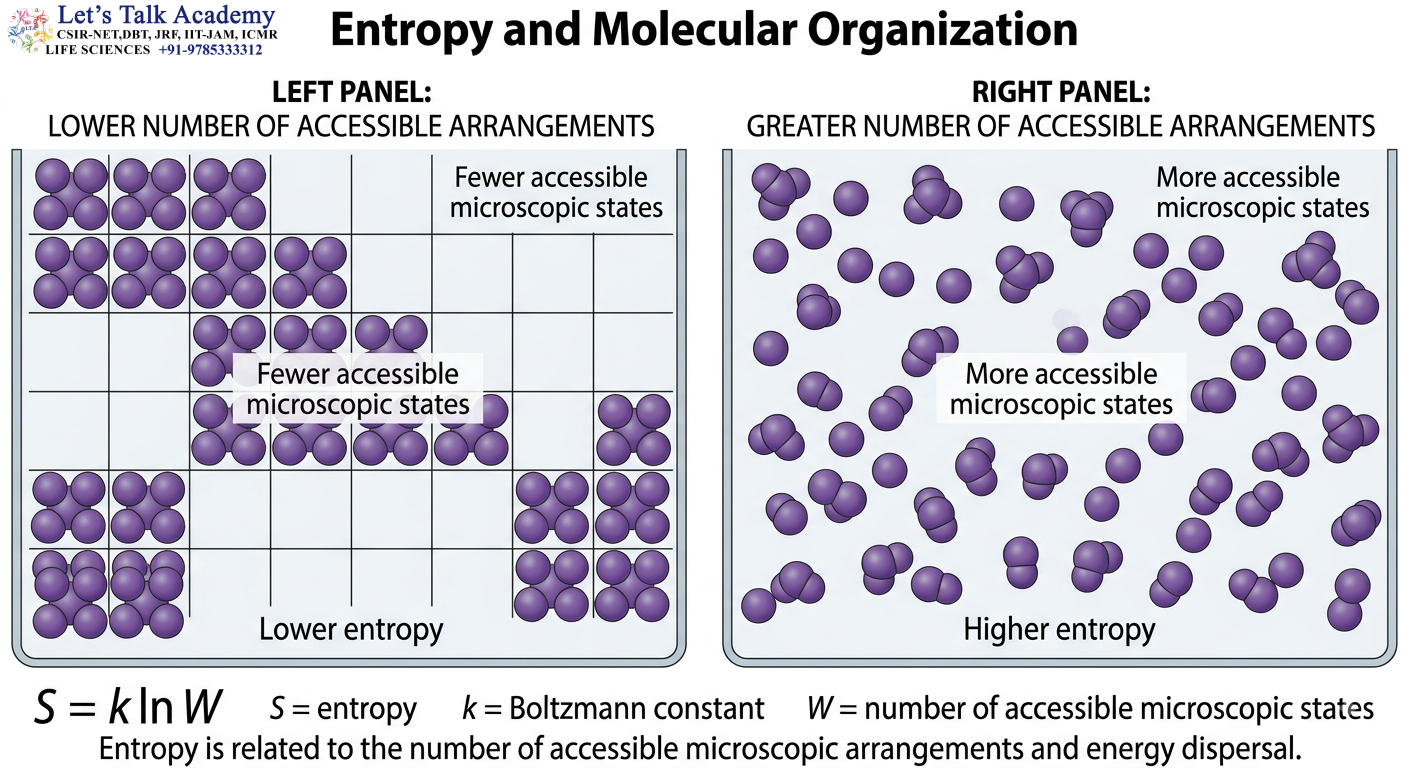
Entropy is related to the number of possible microscopic arrangements of a system and the dispersal of energy.
A statistical expression is:
S = k ln W
where:
- S = entropy
- k = Boltzmann constant
- W = number of possible microscopic states
6.2 Entropy and Molecular Disorder
A simplified interpretation often describes entropy as a measure of disorder.
However, for advanced biochemical understanding, it is better to think of entropy in terms of:
- Number of accessible microscopic states
- Distribution of energy
- Molecular arrangements
- Solvent organization
Therefore, simply equating entropy with “disorder” is useful for introductory understanding but is not a complete thermodynamic definition.
6.3 Entropy in Biochemical Reactions
Entropy can change because of:
- Association of molecules
- Dissociation of molecules
- Changes in solvent organization
- Release or absorption of gases
- Changes in molecular flexibility
- Changes in water structure
For example:
Large molecule → Several smaller molecules
may increase the number of possible molecular arrangements.
Therefore, the entropy contribution may favor such a reaction.
6.4 Entropy and Protein Folding
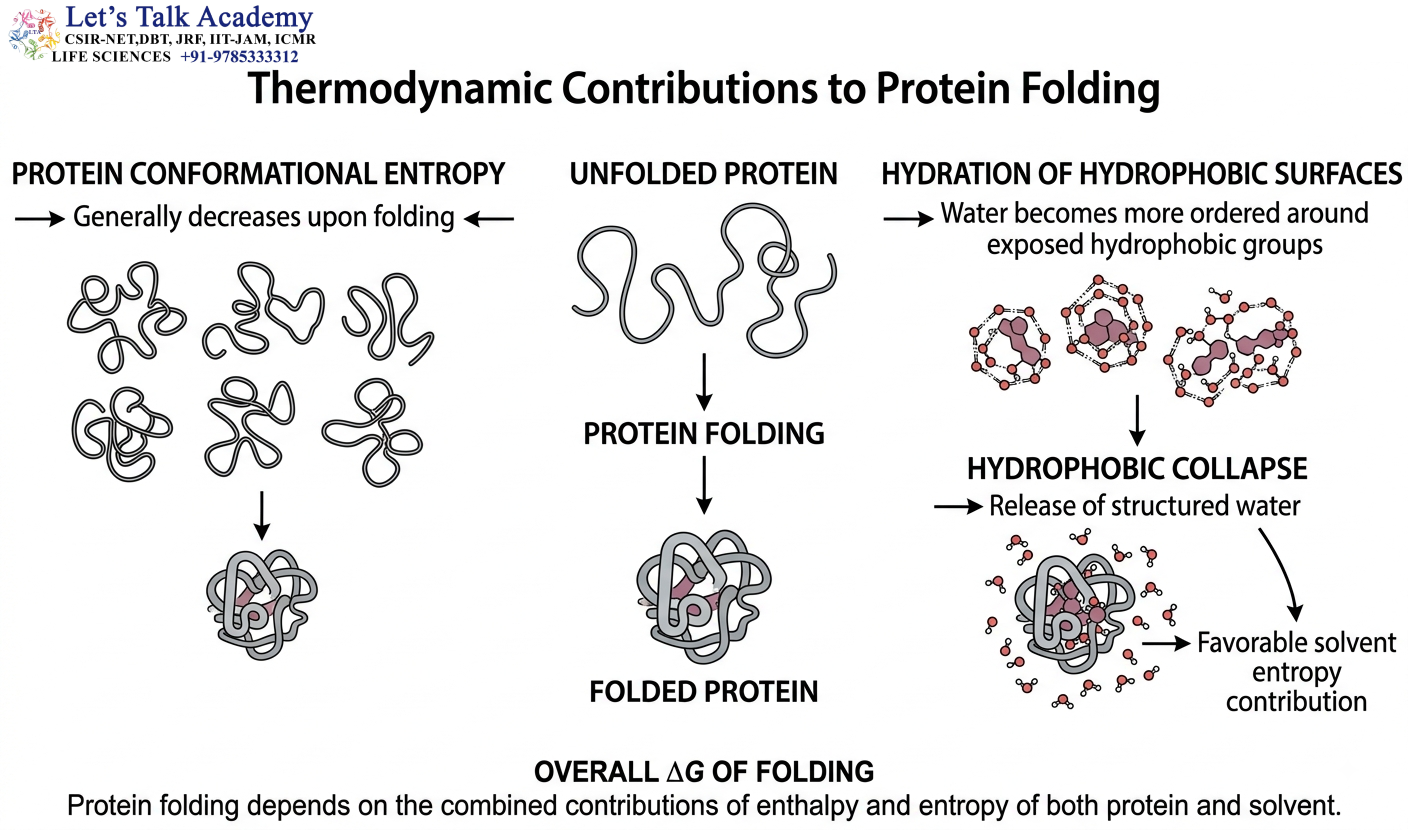
Protein folding provides an excellent biological example.
During folding:
Unfolded protein → Folded protein
The protein becomes more ordered.
However, hydrophobic residues become buried and water molecules that were previously organized around exposed hydrophobic surfaces may become less constrained.
Thus, protein folding depends on the combined thermodynamic effects involving:
- Protein conformational entropy
- Solvent entropy
- Enthalpic interactions
- Hydrophobic interactions
Therefore, biological thermodynamics cannot be understood by considering molecular disorder alone.
7. Enthalpy
7.1 Definition
Enthalpy (H) is a thermodynamic state function associated with the heat content of a system at constant pressure.
The change in enthalpy is:
ΔH = H_products − H_reactants
7.2 Exothermic Reaction
If:
ΔH < 0
the reaction releases heat.
Such a reaction is called exothermic.
7.3 Endothermic Reaction
If:
ΔH > 0
the reaction absorbs heat.
Such a reaction is called endothermic.
7.4 Enthalpy and Bond Breaking
Breaking chemical bonds generally requires energy.
Formation of chemical bonds generally releases energy.
The overall enthalpy change depends on the balance between:
- Energy required for bond breaking
- Energy released during bond formation
7.5 Enthalpy Does Not Alone Determine Spontaneity
A reaction with:
ΔH < 0
is not necessarily spontaneous.
The correct criterion involves Gibbs free energy:
ΔG = ΔH − TΔS
Thus, entropy must also be considered.
8. Gibbs Free Energy
8.1 Definition
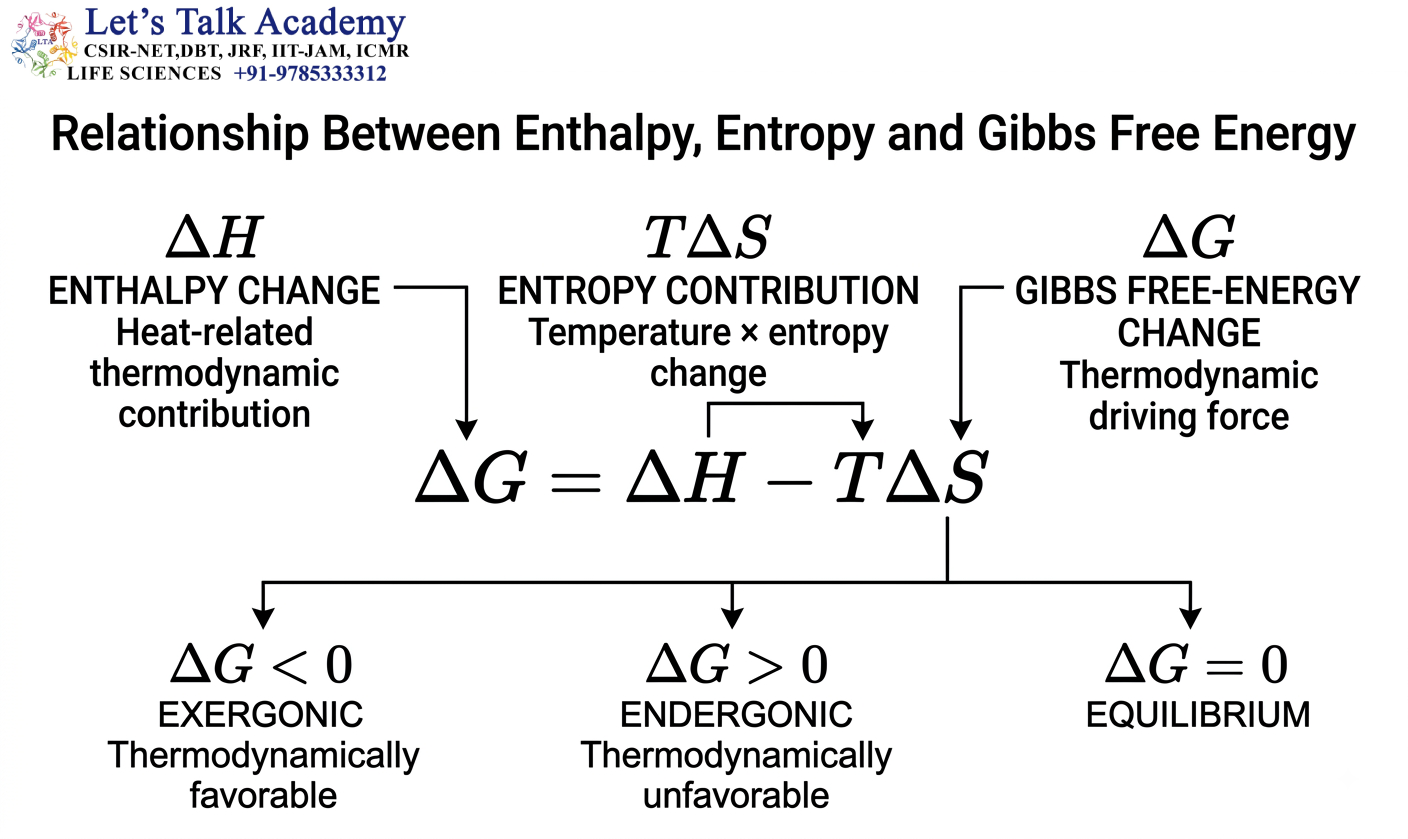
Gibbs free energy is the most important thermodynamic quantity for determining whether a process is thermodynamically favorable under specified conditions of temperature and pressure.
The equation is:
ΔG = ΔH − TΔS
where:
- ΔG = change in Gibbs free energy
- ΔH = change in enthalpy
- T = absolute temperature
- ΔS = change in entropy
8.2 Why Is Gibbs Free Energy Important in Biology?
Cells operate under approximately constant temperature and pressure.
Therefore, Gibbs free energy is particularly useful for studying biochemical reactions.
It allows us to determine whether a reaction has a thermodynamic driving force in a particular direction.
8.3 Negative ΔG
If: ΔG < 0
the reaction is thermodynamically favorable in the forward direction.
Such a reaction is called:
Exergonic
8.4 Positive ΔG
If: ΔG > 0
the reaction is thermodynamically unfavorable in the forward direction.
Such a reaction is called:
Endergonic
8.5 Zero ΔG
If: ΔG = 0
the system is at equilibrium.
There is no net thermodynamic driving force.
8.6 Important Statement
A negative ΔG means:
The reaction has a thermodynamic driving force.
It does not necessarily mean:
The reaction will occur rapidly.
This distinction between thermodynamics and kinetics is extremely important.
9. Standard Free-Energy Change
9.1 Definition
The free-energy change measured under defined standard conditions is called the standard free-energy change.
It is represented as: ΔG°
For biochemical reactions, the transformed biochemical standard free-energy change is commonly represented as: ΔG°′
9.2 Why Do Biochemists Use ΔG°′?
Biochemical reactions often involve protons.
Because biological systems operate near physiological pH rather than at extremely acidic standard conditions, biochemical thermodynamics uses a transformed standard state in which proton concentration is treated according to a defined biochemical convention.
Therefore, ΔG°′ is more useful than the ordinary chemical standard free energy for many biochemical calculations.
10. Biochemical Standard Free Energy, ΔG°′
10.1 Definition
ΔG°′ represents the standard transformed free-energy change for a biochemical reaction.
It allows different biochemical reactions to be compared under standardized conditions.
10.2 Relationship with Equilibrium Constant
The relationship is:
ΔG°′ = −RT ln K′eq
where:
- R = gas constant
- T = absolute temperature
- K′eq = biochemical equilibrium constant
10.3 Interpretation
If: K′eq > 1
then: ΔG°′ < 0
and products are favored under the standard biochemical conditions.
If: K′eq < 1
then: ΔG°′ > 0
and reactants are favored.
If: K′eq = 1
then: ΔG°′ = 0
11. Actual ΔG Inside Cells

The actual free-energy change of a reaction inside a cell is represented by: ΔG
It differs from the standard biochemical free-energy change because intracellular concentrations are different from standard-state concentrations.
The equation is:
ΔG = ΔG°′ + RT ln Q
where:
- ΔG = actual free-energy change
- ΔG°′ = standard biochemical free-energy change
- R = gas constant
- T = absolute temperature
- Q = reaction quotient
11.1 Why Is Actual ΔG Important?
Cellular metabolism is highly dependent on metabolite concentrations.
A reaction may have:
ΔG°′ > 0
but still have:
ΔG < 0
inside the cell.
This can happen if cellular concentrations make the reaction favorable.
This is one of the most important concepts in understanding metabolic pathways.
11.2 Example of Metabolic Pull
Suppose: A ⇌ B
If B is rapidly consumed by the next metabolic reaction, its concentration remains low.
Removal of B can favor the conversion: A → B
This is one way metabolic pathways can maintain directional flux even when individual reactions are near equilibrium.
12. Reaction Quotient
12.1 Definition
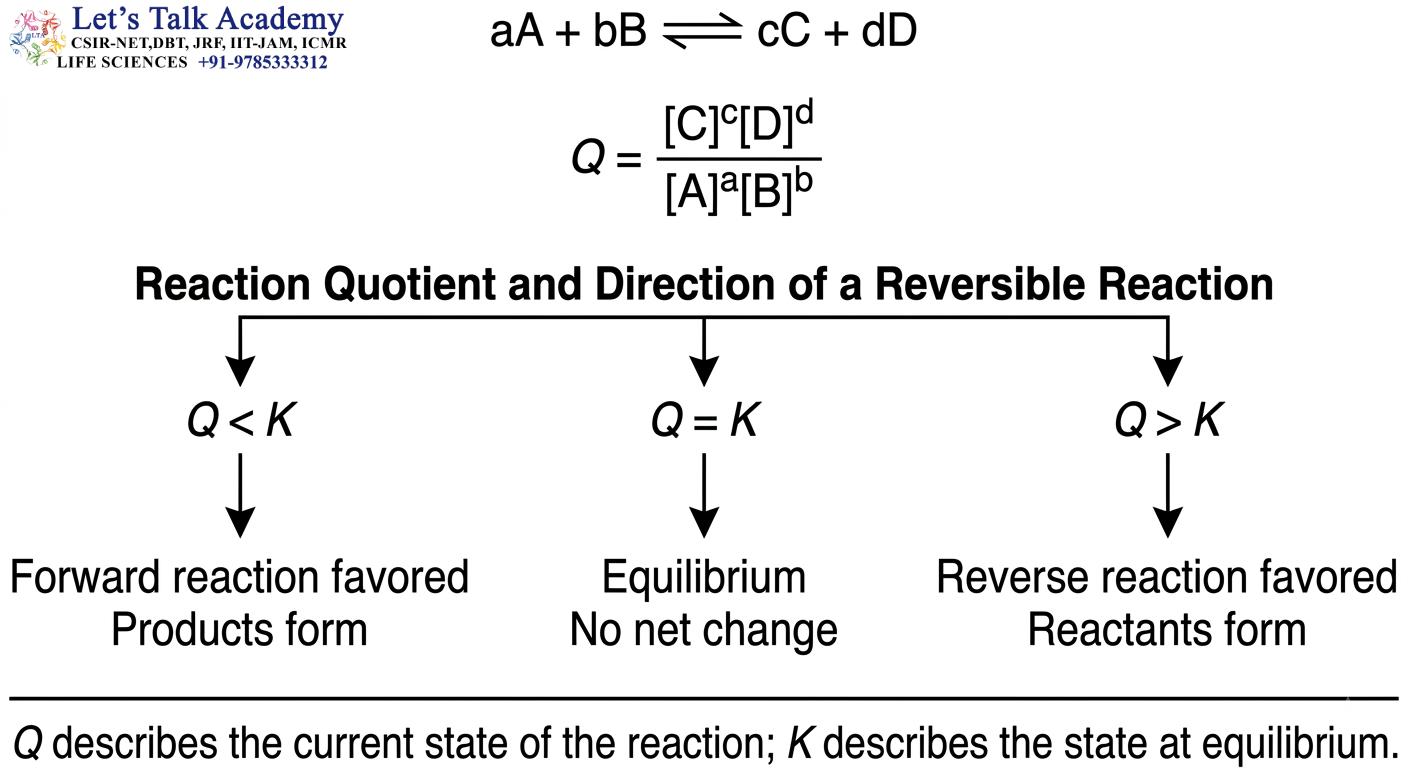
The reaction quotient (Q) represents the ratio of product activities to reactant activities at a particular moment.
For:
A + B ⇌ C + D
the reaction quotient is:
Q = [C][D] / [A][B]
For the general reaction:
aA + bB ⇌ cC + dD
the equation becomes:
Q = ([C]ᶜ[D]ᵈ) / ([A]ᵃ[B]ᵇ)
12.2 Q vs K
This distinction is important.
Q describes the system at its current state.
K describes the system specifically at equilibrium.
Therefore:
Q < K
The reaction tends to proceed toward products.
Q > K
The reaction tends to proceed toward reactants.
Q = K
The system is at equilibrium.
13. Exergonic and Endergonic Reactions
13.1 Exergonic Reactions
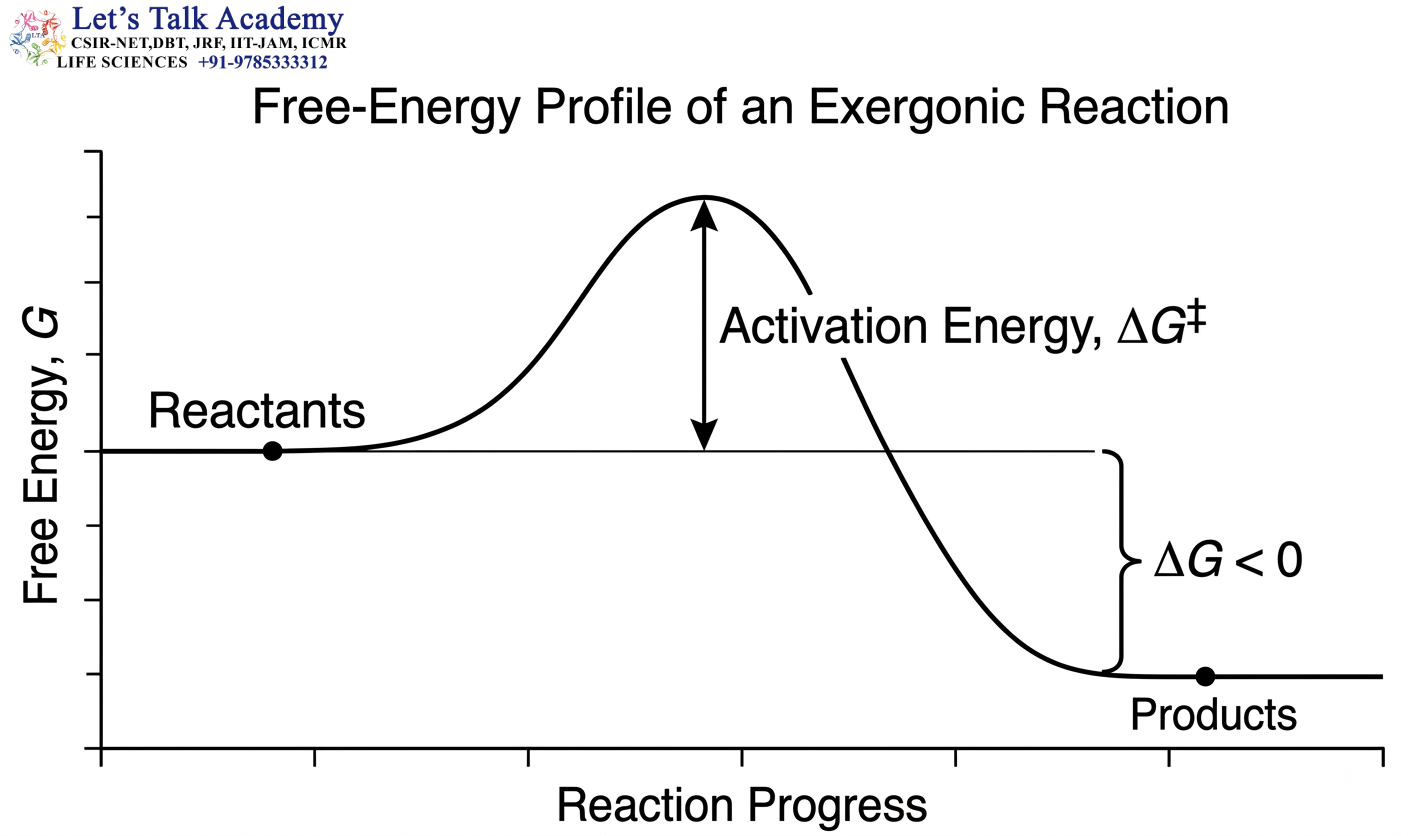
An exergonic reaction has:
ΔG < 0
The reaction releases free energy.
Examples include:
- ATP hydrolysis
- Many oxidation reactions
13.2 Endergonic Reactions
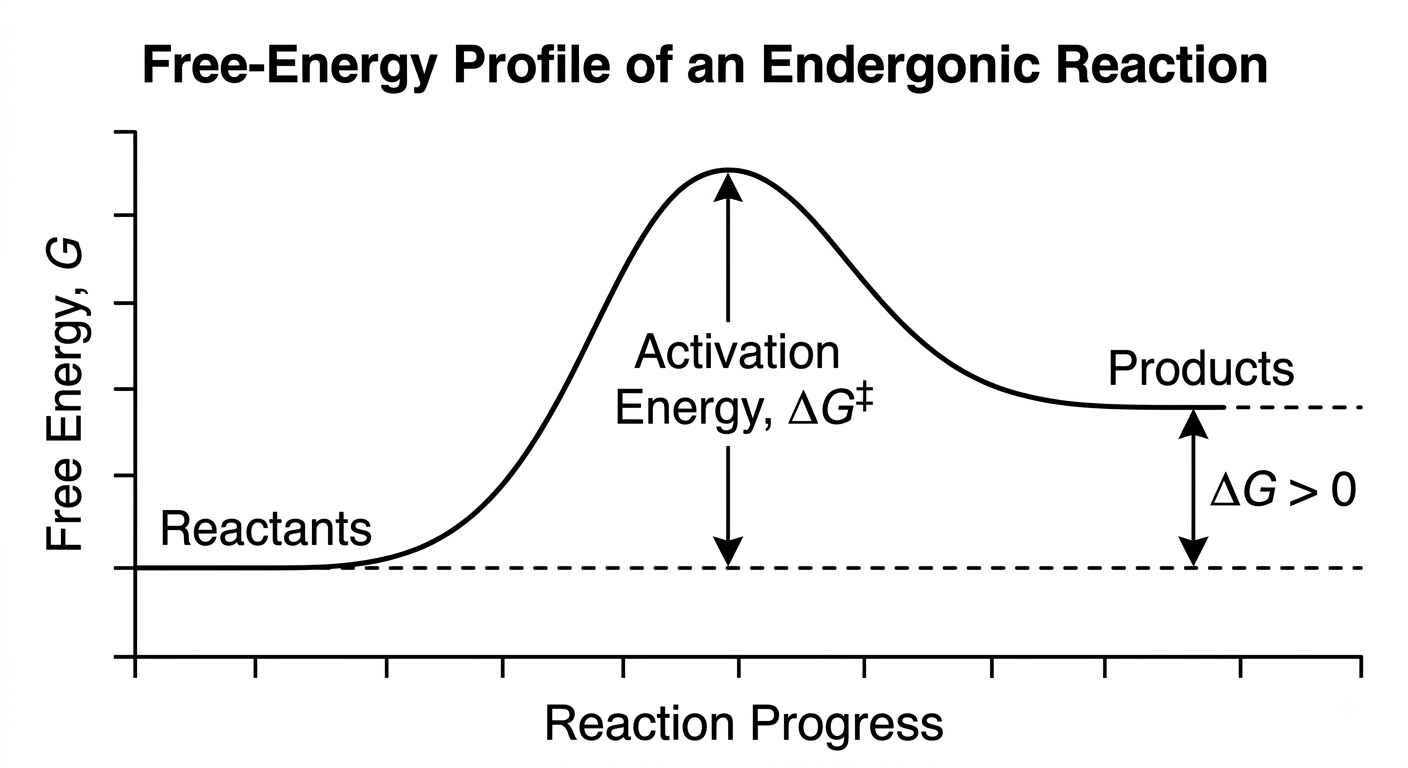
An endergonic reaction has:
ΔG > 0
The reaction requires free energy input.
Examples include:
- Many biosynthetic reactions
- Active transport
- Macromolecule synthesis
13.3 Comparison
Property |
Exergonic |
Endergonic |
|---|---|---|
| ΔG | < 0 | > 0 |
| Free energy | Released | Required |
| Thermodynamic direction | Favorable | Unfavorable |
| Cellular role | Can drive work | Requires energy input |
| Coupling | Can drive another reaction | Often coupled to exergonic reaction |
13.4 Exergonic Does Not Mean Exothermic
Exergonic → ΔG
Exothermic → ΔH
A reaction can be:
- Exergonic but endothermic
- Endergonic but exothermic
depending on the relationship between enthalpy and entropy.
14. Equilibrium
14.1 Definition
A chemical reaction is at equilibrium when the forward and reverse reactions occur at equal rates.
At equilibrium:
ΔG = 0
14.2 Dynamic Equilibrium
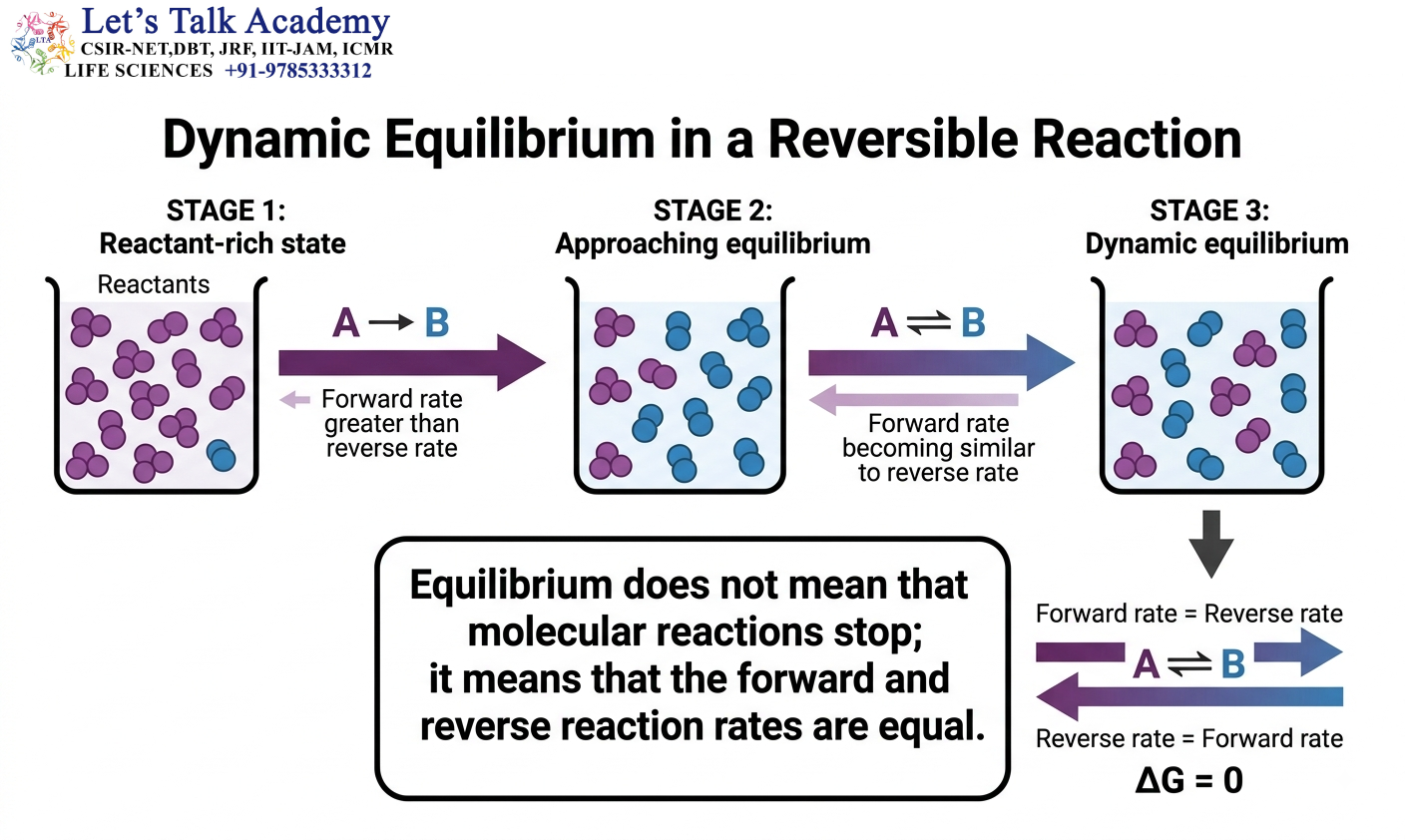
Equilibrium does not mean that molecular reactions stop.
Both directions continue:
Forward reaction ↔ Reverse reaction
but:
Rate_forward = Rate_reverse
Therefore, there is no net change in concentration.
14.3 Equilibrium and Metabolic Pathways
Many metabolic reactions operate close to equilibrium.
However, some reactions have strongly negative ΔG under cellular conditions and therefore operate far from equilibrium.
These strongly favorable steps are often important sites for metabolic regulation.
15. Thermodynamic Feasibility vs Reaction Rate
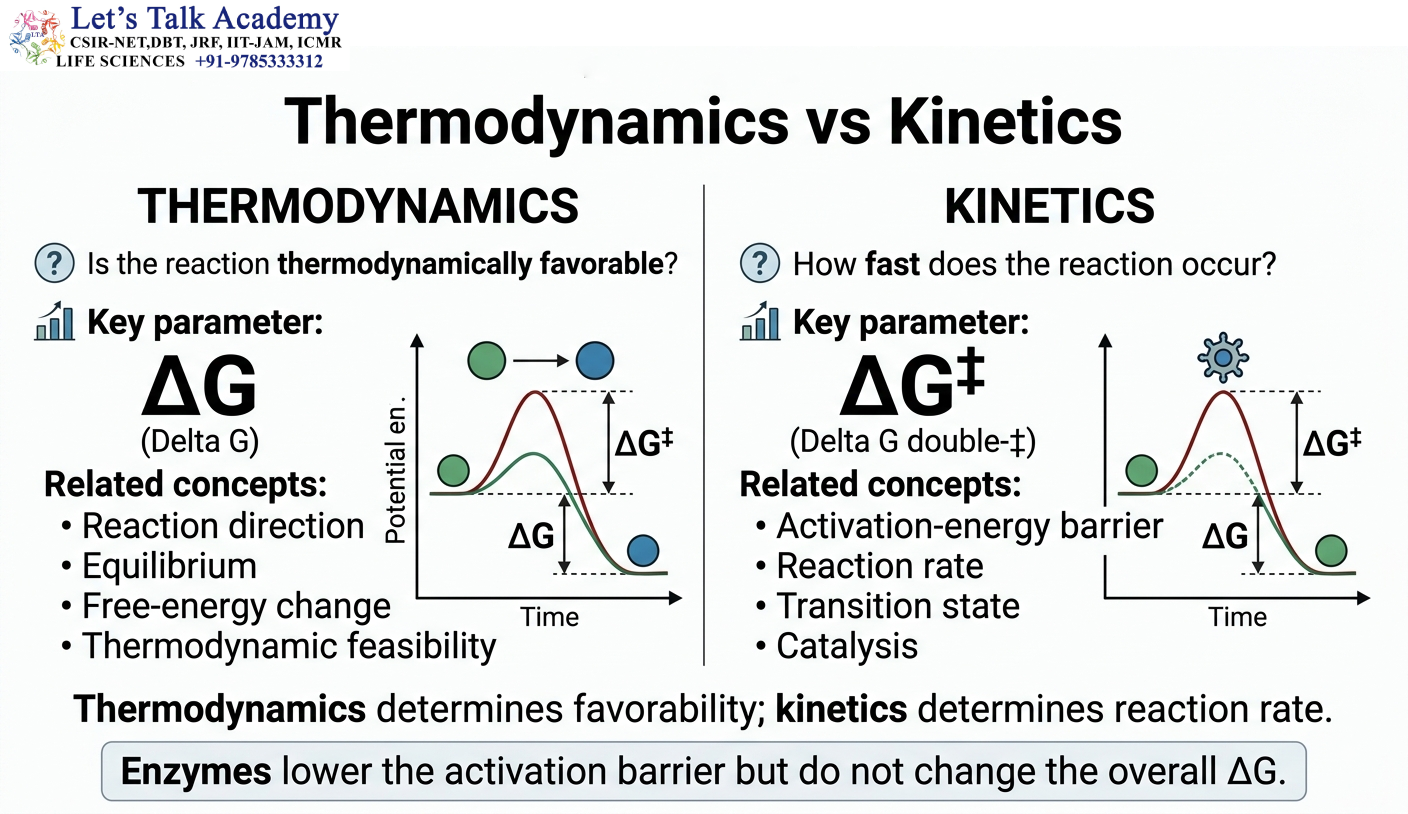
This is one of the most important conceptual distinctions in bioenergetics.
15.1 Thermodynamics
Thermodynamics asks:
Is the reaction energetically favorable?
This is related to: ΔG
15.2 Kinetics
Kinetics asks:
How quickly does the reaction occur?
This depends on the activation-energy barrier.
The activation free energy is commonly represented as: ΔG‡
15.3 Role of Enzymes

Enzymes increase reaction rates by lowering the activation-energy barrier.
They do not change:
- Overall ΔG
- ΔG°′
- Equilibrium constant
- Equilibrium position
Therefore: Enzymes affect kinetics, not the thermodynamic equilibrium.
16. Redox Potential and Free Energy
16.1 Oxidation-Reduction Reactions
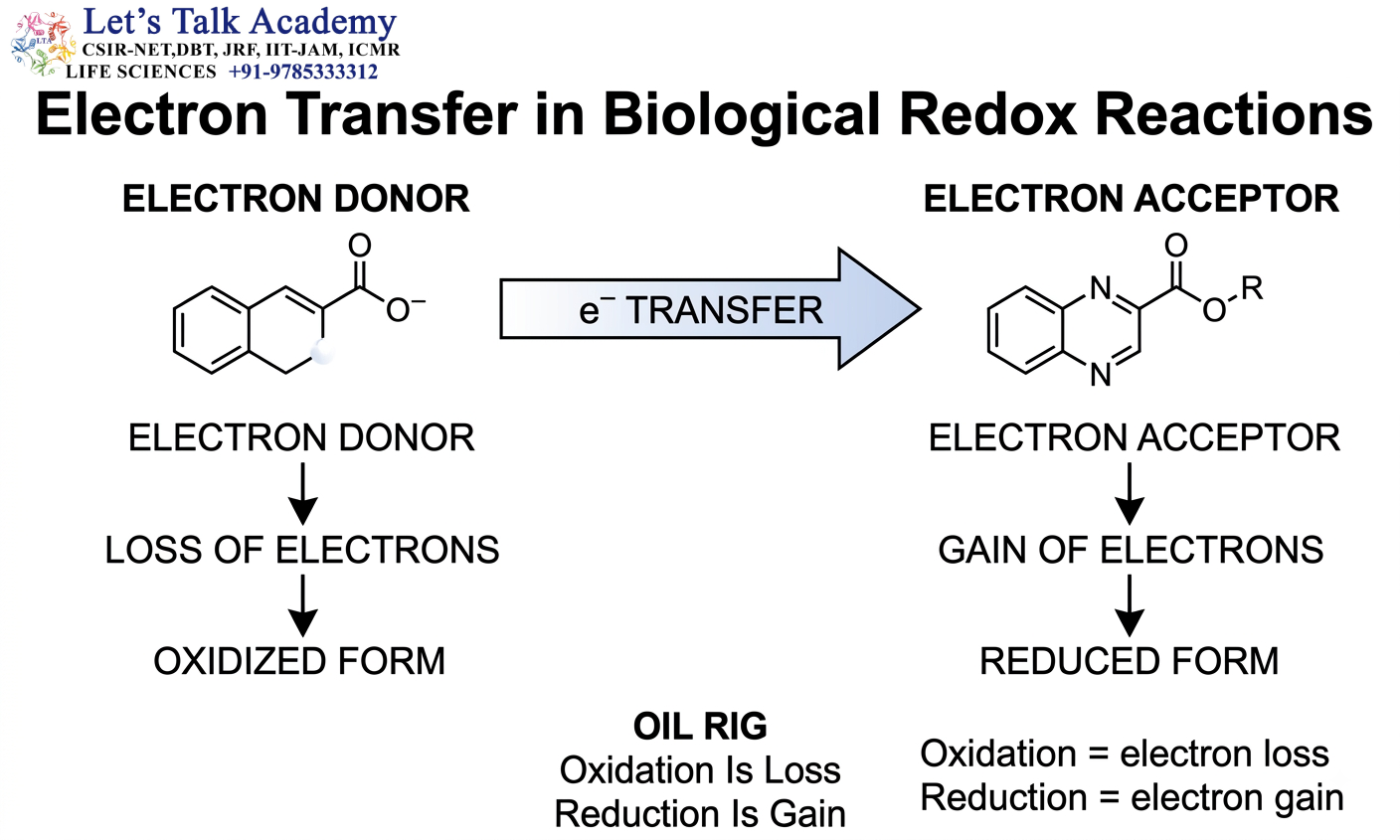
Energy metabolism is strongly dependent on electron-transfer reactions.
Oxidation
Loss of electrons.
Reduction
Gain of electrons.
The mnemonic:
OIL RIG
means:
Oxidation Is Loss
Reduction Is Gain
16.2 Reduction Potential
The tendency of a substance to accept electrons is described by its reduction potential.
It is represented as: E
or, under standard conditions: E°′
16.3 Electron Flow
Electrons tend to move from a donor with lower reduction potential toward an acceptor with higher reduction potential under favorable conditions.
In aerobic respiration:
NADH → Electron transport chain → O₂
The overall electron transfer is favorable because oxygen has a strong tendency to accept electrons.
16.4 Relationship Between Redox Potential and Free Energy
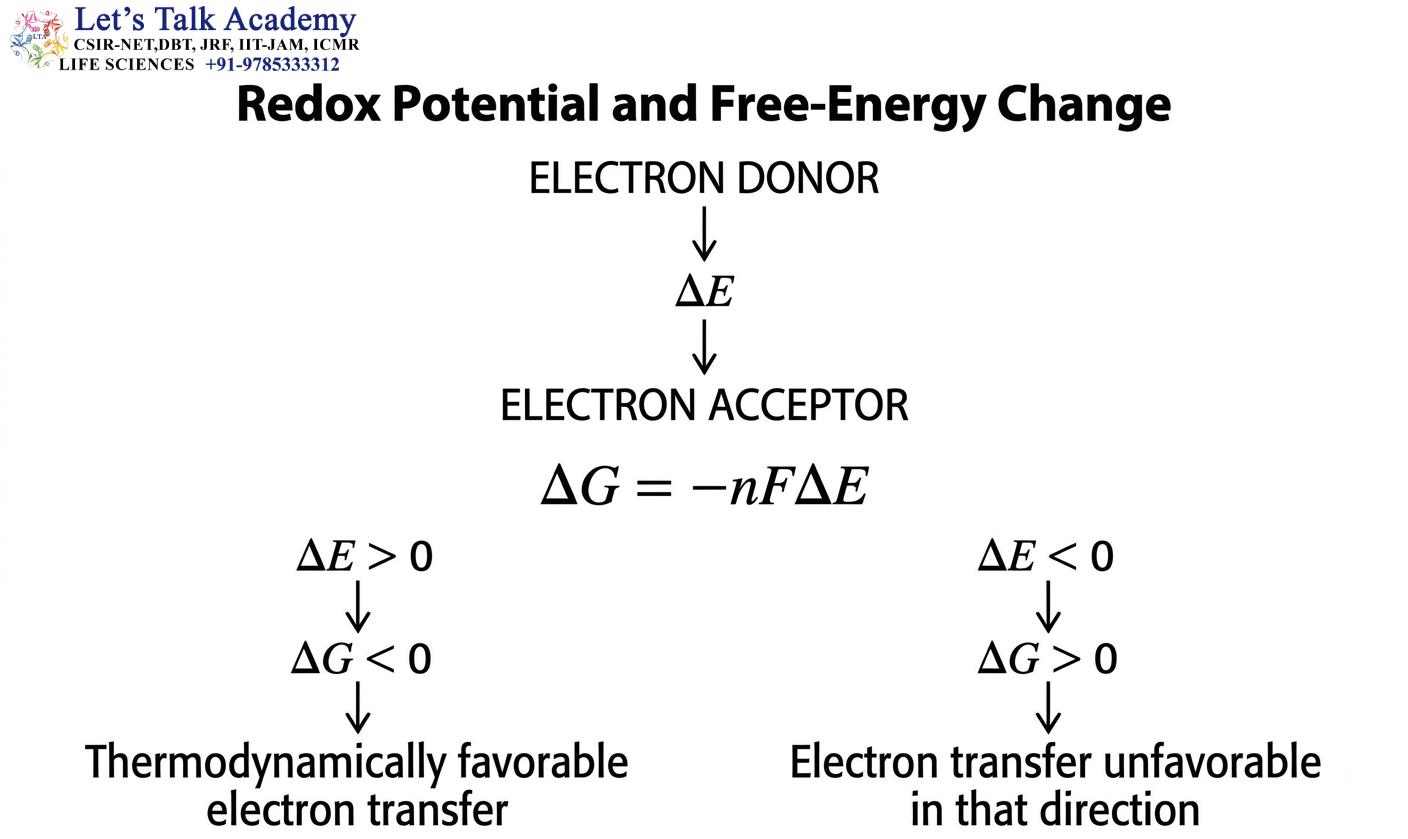
The relationship is:
ΔG = −nFΔE
where:
- n = number of electrons transferred
- F = Faraday constant
- ΔE = difference in reduction potentials
16.5 Interpretation
If:
ΔE > 0
then:
ΔG < 0
Therefore, the reaction is thermodynamically favorable.
This equation provides the thermodynamic basis for energy conservation during electron transport.
17. ATP as an Energy Currency
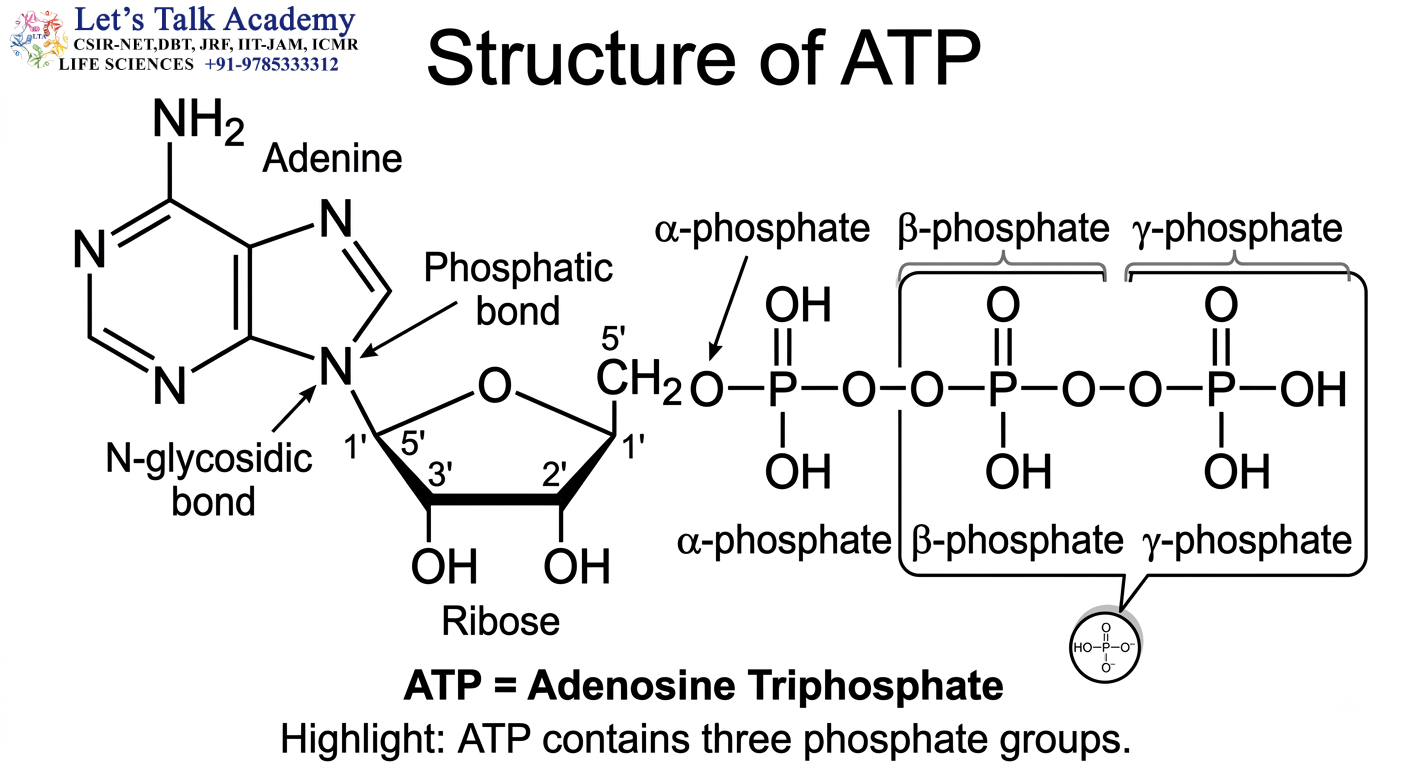
17.1 ATP Structure
ATP stands for:
Adenosine triphosphate
It consists of:
- Adenine
- Ribose
- Three phosphate groups
The three phosphate groups are:
- α-phosphate
- β-phosphate
- γ-phosphate
17.2 Why Is ATP Called the Energy Currency?
ATP acts as a common energy-transfer intermediate between energy-producing and energy-consuming processes.
For example:
Catabolic reactions
↓
ATP generation
↓
ATP hydrolysis
↓
Anabolic and cellular work
Therefore, ATP connects catabolism with cellular work.
17.3 ATP Is an Energy-Transfer Molecule
It is important not to interpret ATP as the main long-term energy-storage molecule.
ATP has a high turnover rate.
Cells continuously:
ATP → ADP
and:
ADP → ATP
The ATP pool is relatively small compared with the total energy stored in body fat or glycogen, but it is rapidly regenerated.
18. ATP Hydrolysis
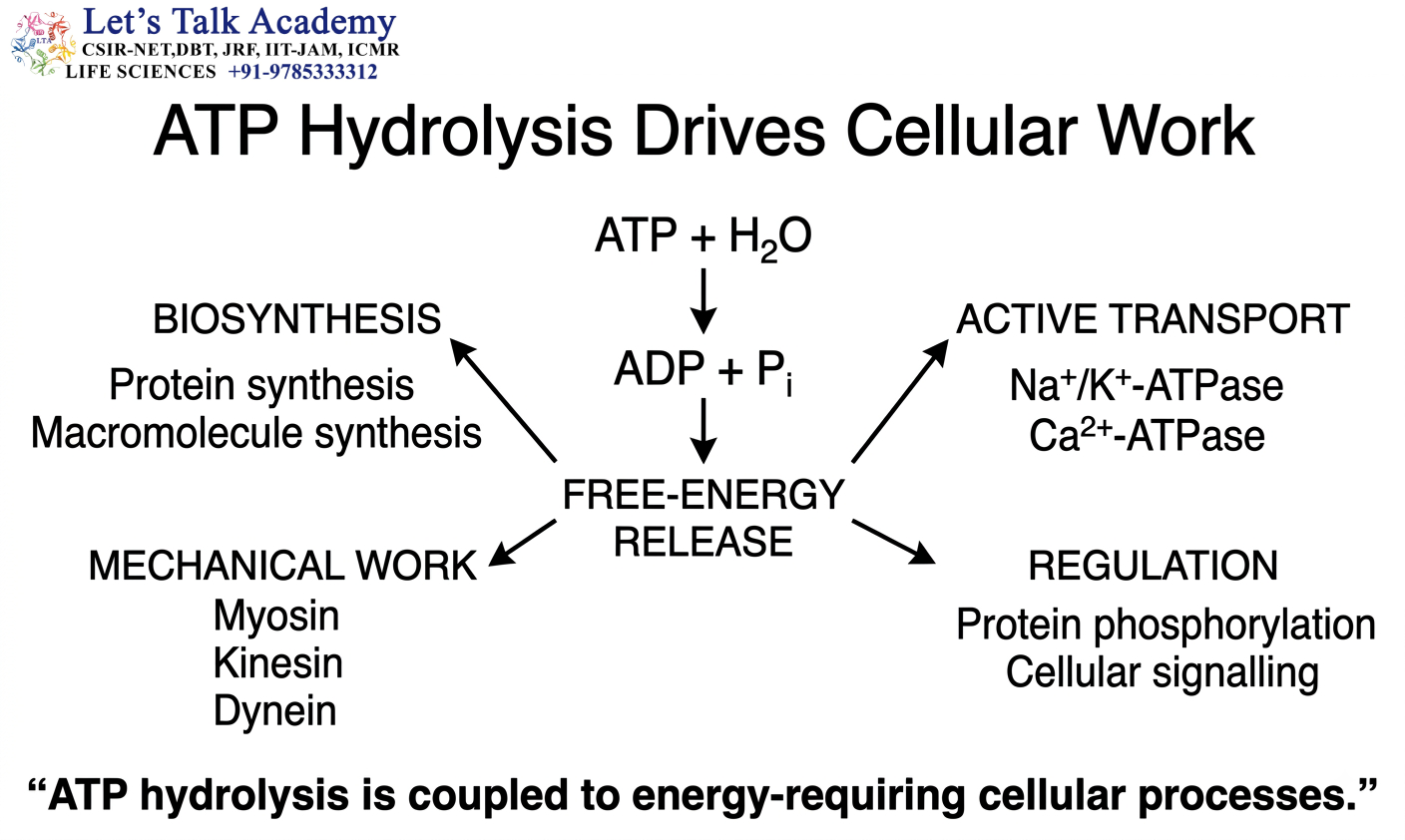
The most common ATP hydrolysis reaction is:
ATP + H₂O → ADP + Pi
Another possible reaction is:
ATP + H₂O → AMP + PPi
The latter is particularly important in biosynthetic reactions because pyrophosphate hydrolysis can provide additional thermodynamic driving force.
18.1 Why ATP Hydrolysis Releases Free Energy
Several factors contribute.
1. Electrostatic Repulsion
The phosphate groups of ATP carry substantial negative charge and repel one another.
Hydrolysis reduces this unfavorable interaction.
2. Resonance Stabilization
The inorganic phosphate product has substantial resonance stabilization.
3. Solvation
ADP and inorganic phosphate interact favorably with water.
4. Product Stability
The products are thermodynamically more stable than ATP under cellular conditions.
18.2 ATP Hydrolysis and Cellular Work
ATP hydrolysis can be coupled to:
Biosynthesis
ATP hydrolysis → Protein synthesis and other biosynthetic processes
Transport
ATP hydrolysis → Ion pumping
Mechanical work
ATP hydrolysis → Molecular motor movement
Signalling
ATP-dependent phosphorylation can regulate proteins involved in signal transduction.
19. High-Energy Compounds
19.1 Definition
High-energy compounds are molecules whose hydrolysis is associated with a large negative free-energy change.
The phrase “high-energy bond” is commonly used, but it can be misleading.
The bond itself should not be thought of as simply containing a special packet of energy.
Instead, the important point is: Hydrolysis produces products that are thermodynamically more stable than the reactant.
19.2 Important High-Energy Phosphate Compounds
Important examples include:
- Phosphoenolpyruvate
- 1,3-Bisphosphoglycerate
- ATP
- Creatine phosphate
19.3 Phosphoenolpyruvate
PEP has a very high phosphoryl-transfer potential.
Its conversion to pyruvate is highly favorable.
This drives ATP synthesis:
PEP + ADP → Pyruvate + ATP
Enzyme: Pyruvate kinase
This is an example of substrate-level phosphorylation.
19.4 1,3-Bisphosphoglycerate
1,3-BPG is an important high-energy intermediate in glycolysis.
It can transfer a phosphoryl group to ADP:
1,3-BPG + ADP → 3-Phosphoglycerate + ATP
Enzyme: Phosphoglycerate kinase
19.5 Creatine Phosphate
Creatine phosphate acts as a rapid phosphate reservoir.
It is particularly important in tissues with high and rapidly changing ATP demands.
The creatine kinase reaction can be represented as:
Creatine phosphate + ADP ⇌ Creatine + ATP
This reaction helps maintain ATP levels during sudden increases in energy demand.
20. Phosphoryl-Transfer Potential
20.1 Definition
Phosphoryl-transfer potential refers to the thermodynamic tendency of a phosphorylated compound to transfer its phosphoryl group to another molecule.
It is related to the free-energy change associated with hydrolysis.
A compound with a more favorable phosphoryl-transfer reaction can transfer its phosphoryl group to a compound with lower phosphoryl-transfer potential under appropriate conditions.
20.2 Why Is This Important?
Phosphoryl-transfer potential explains how ATP can function as a central energy-transfer molecule.
ATP is not the compound with the highest phosphoryl-transfer potential.
For example:
PEP > ATP
in terms of phosphoryl-transfer potential under standard biochemical conditions.
Therefore, PEP can transfer its phosphoryl group to ADP to form ATP.
21. Energy Charge
21.1 Definition
The energy charge describes the energetic state of the adenylate pool.
It is calculated using:
Energy charge = ([ATP] + ½[ADP]) / ([ATP] + [ADP] + [AMP])
21.2 Range
Energy charge ranges between:
0 and 1
If all adenylate is AMP:
Energy charge = 0
If all adenylate is ATP:
Energy charge = 1
Real cells generally maintain an intermediate but relatively high energy charge.
21.3 Biological Significance
Energy charge provides a useful measure of cellular energy status.
When ATP is abundant:
Energy charge increases
When ATP is consumed and ADP/AMP increase:
Energy charge decreases
A low-energy state can stimulate ATP-producing pathways.
A high-energy state can inhibit several catabolic pathways.
21.4 ATP, ADP and AMP
The adenylate pool consists of:
ATP + ADP + AMP
These molecules are interconverted through cellular metabolic reactions.
The adenylate kinase reaction is:
2 ADP ⇌ ATP + AMP
This reaction allows cells to buffer changes in ATP demand.
22. NAD⁺/NADH and FAD/FADH₂
Electron carriers are essential components of biological energy metabolism.
22.1 NAD⁺
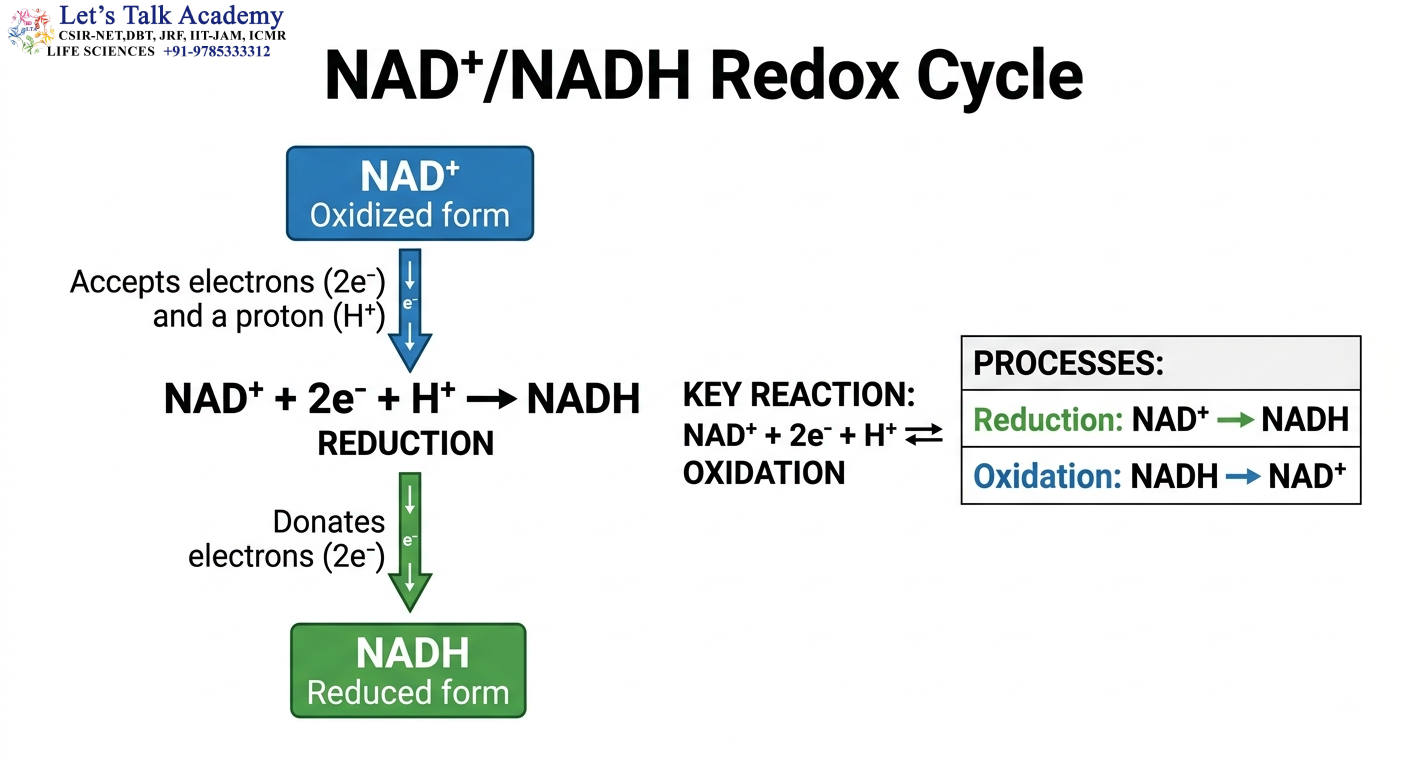
NAD⁺ stands for:
Nicotinamide adenine dinucleotide
It acts as an electron acceptor in many oxidation reactions.
A simplified reaction is:
NAD⁺ + 2e⁻ + H⁺ → NADH
22.2 NADH
NADH is the reduced form of NAD⁺.
It contains high-energy electrons that can be transferred to the electron transport chain.
Important sources of NADH include:
- Glycolysis
- Pyruvate oxidation
- Citric acid cycle
- β-oxidation
22.3 FAD
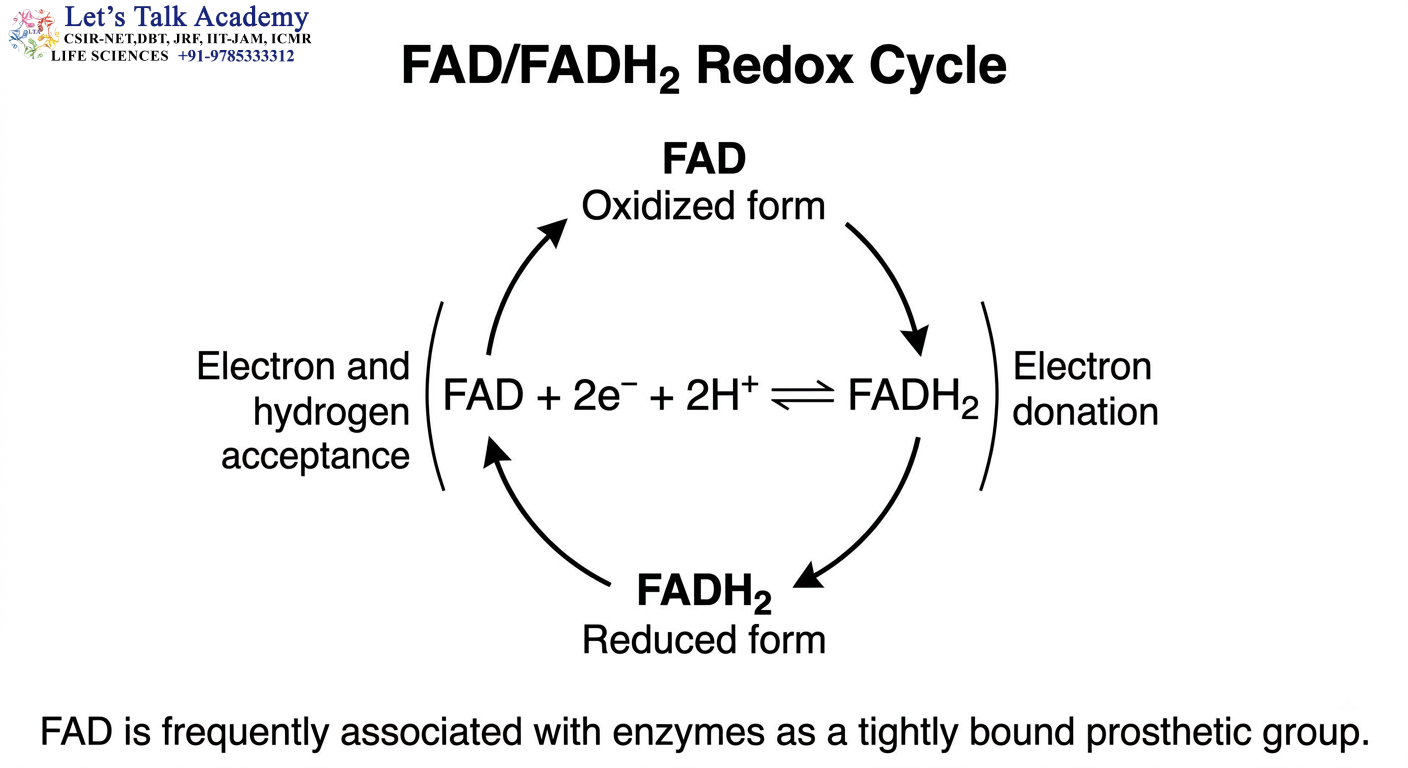
FAD stands for:
Flavin adenine dinucleotide
FAD can accept electrons and hydrogen atoms to form FADH₂.
FAD is often tightly associated with enzymes.
22.4 FADH₂
FADH₂ transfers electrons to the respiratory chain through pathways associated with Complex II.
Because these electrons enter the respiratory chain downstream of Complex I, their associated ATP yield is lower than that of NADH.
Approximate modern mitochondrial values are:
NADH → ~2.5 ATP
FADH₂ → ~1.5 ATP
These are approximate values and depend on cellular conditions and transport costs.
23. NADH vs FADH₂

Feature |
NADH |
FADH₂ |
|---|---|---|
| Oxidized form | NAD⁺ | FAD |
| Reduced form | NADH | FADH₂ |
| Typical entry point | Complex I | Complex II |
| Proton pumping downstream | Greater | Lower |
| Approximate ATP yield | ~2.5 | ~1.5 |
| Common association | Soluble electron carrier | Often enzyme-bound |
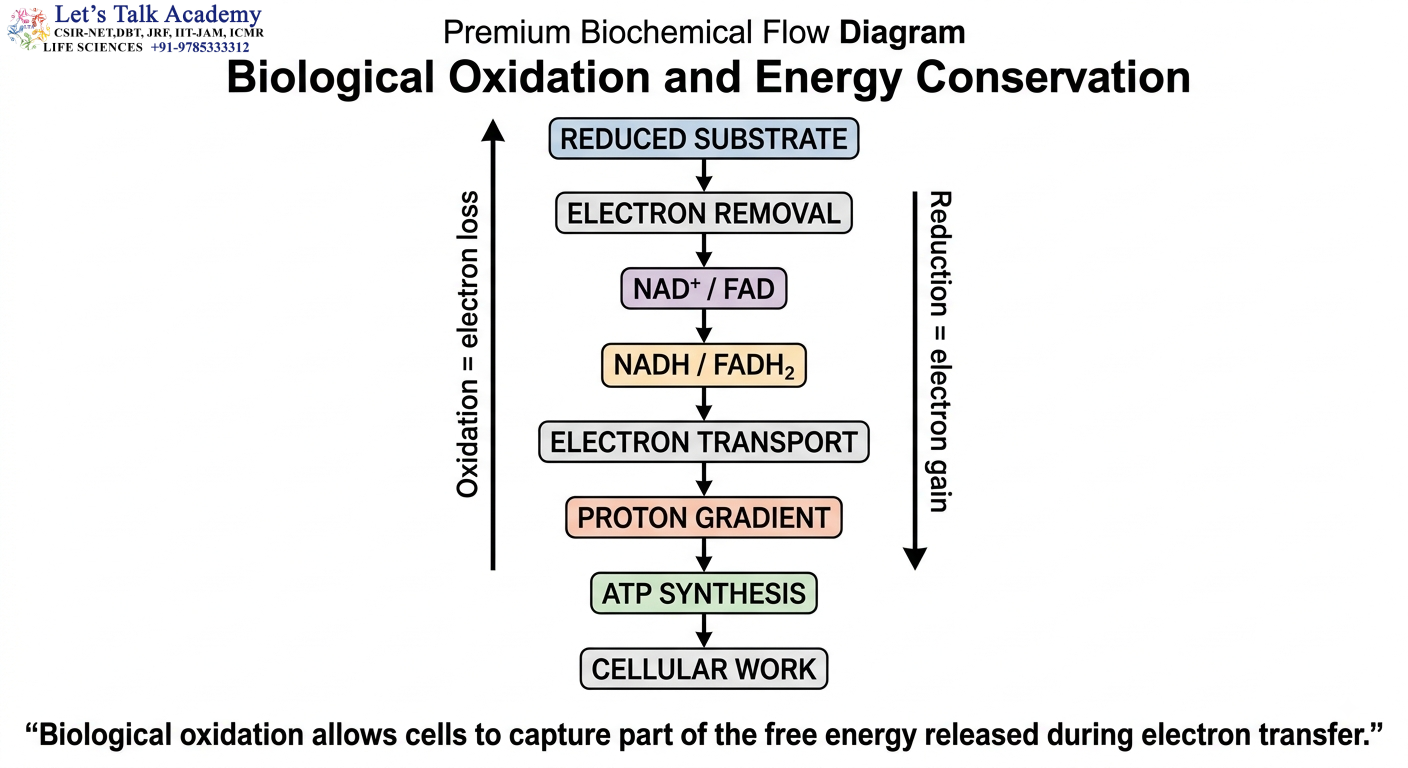
24. Biological Oxidation
24.1 Definition
Biological oxidation refers to oxidation-reduction reactions occurring in living organisms in which electrons are transferred between molecules.
Oxidation does not necessarily mean direct reaction with oxygen.
A molecule is oxidized when it loses electrons.
Another molecule is reduced when it gains those electrons.
24.2 Biological Oxidation and Hydrogen Transfer
Many biochemical oxidation reactions involve removal of hydrogen atoms.
For example:
Substrate-H₂ + NAD⁺ → Oxidized substrate + NADH + H⁺
Thus, dehydrogenases frequently participate in biological oxidation.
24.3 Electron Carriers in Biological Oxidation
Important electron carriers include:
- NAD⁺/NADH
- FAD/FADH₂
- FMN/FMNH₂
- Coenzyme Q
- Cytochromes
- Iron-sulfur proteins
These carriers allow electrons to move through controlled pathways.
25. Energy Conservation
25.1 Definition
Energy conservation in biological systems means capturing part of the free energy released during favorable reactions in a form that can later be utilized.
Cells conserve energy through:
- ATP formation
- Reduced electron carriers
- Phosphorylated intermediates
- Proton gradients
- Ion gradients
25.2 Energy Conservation During Respiration
A simplified sequence is:
Nutrients
↓
Oxidation
↓
NADH/FADH₂
↓
Electron transport
↓
Proton gradient
↓
ATP synthesis
This is a major example of energy conservation.
25.3 Why Is a Proton Gradient Important?
A proton gradient represents stored electrochemical potential energy.
The gradient has two components:
- Difference in proton concentration
- Difference in electrical charge
Together these create the proton-motive force.
ATP synthase can use this gradient to synthesize ATP.
26. Thermodynamic Coupling
26.1 Definition
Thermodynamic coupling is the linking of two or more reactions such that the favorable free-energy change of one reaction drives an unfavorable reaction.
The free-energy changes are additive.
For example:
Reaction 1: ΔG = +20 kJ/mol
Reaction 2: ΔG = −35 kJ/mol
Therefore:
ΔG_total = +20 − 35
ΔG_total = −15 kJ/mol
The overall coupled reaction is favorable.
26.2 ATP-Dependent Coupling
ATP hydrolysis is one of the most common mechanisms of biological coupling.
For example:
ATP → ADP + Pi
is coupled to:
Substrate → Phosphorylated substrate
The overall reaction can become favorable.
26.3 Example: Glucose Phosphorylation
The phosphorylation of glucose is coupled to ATP hydrolysis.
Overall:
Glucose + ATP → Glucose-6-phosphate + ADP
Enzyme: Hexokinase
This is an excellent example of thermodynamic coupling.
26.4 Coupling Does Not Mean Two Reactions Merely Occur Together
For true biochemical coupling, the reactions must be mechanistically connected.
The free energy released by the favorable reaction must be transferred through an appropriate mechanism to drive the unfavorable reaction.
This may occur through:
- A shared intermediate
- Protein conformational changes
- Phosphoryl transfer
- Ion gradients
- Chemical intermediates
27. Thermodynamic Coupling and Cellular Work
Cells use coupling to perform different types of work.
Chemical Work
ATP hydrolysis → Biosynthesis
Transport Work
ATP hydrolysis → Ion pumping
Mechanical Work
ATP hydrolysis → Molecular motor movement
Electrical Work
Ion gradients → Membrane potential and signalling
Thus, energy coupling is central to nearly every aspect of cellular physiology.


