








































































3. Which among the following belongs to the family “Retroviridae”? (A) Human Immunodeficiency virus (B) Ebola virus (C) Dengue virus (D) Influenza virus Retroviridae Family Explained: Human Immunodeficiency Virus (HIV) […]
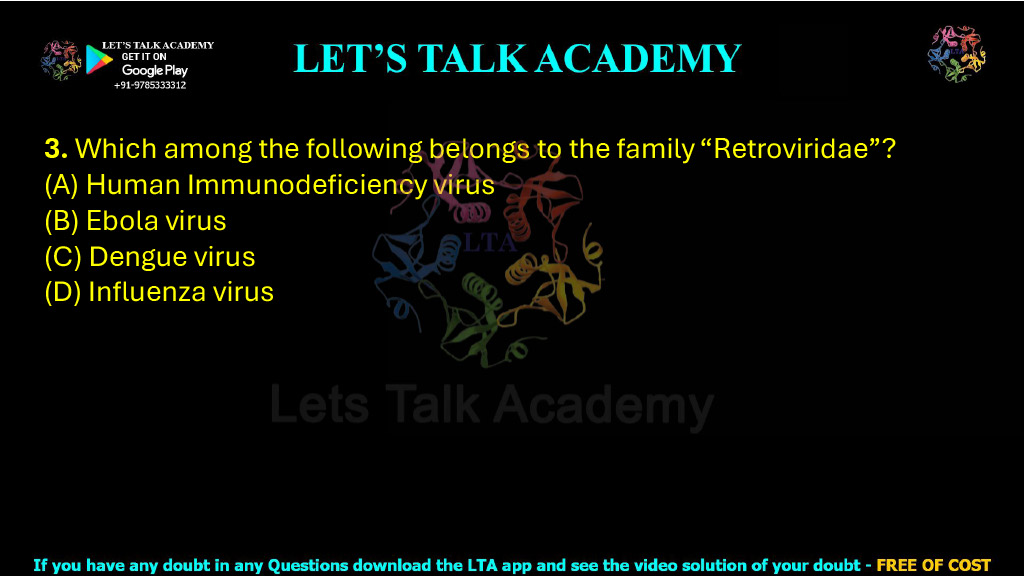

3. Which among the following belongs to the family “Retroviridae”? (A) Human Immunodeficiency virus (B) Ebola virus (C) Dengue virus (D) Influenza virus Retroviridae Family Explained: Human Immunodeficiency Virus (HIV) […]
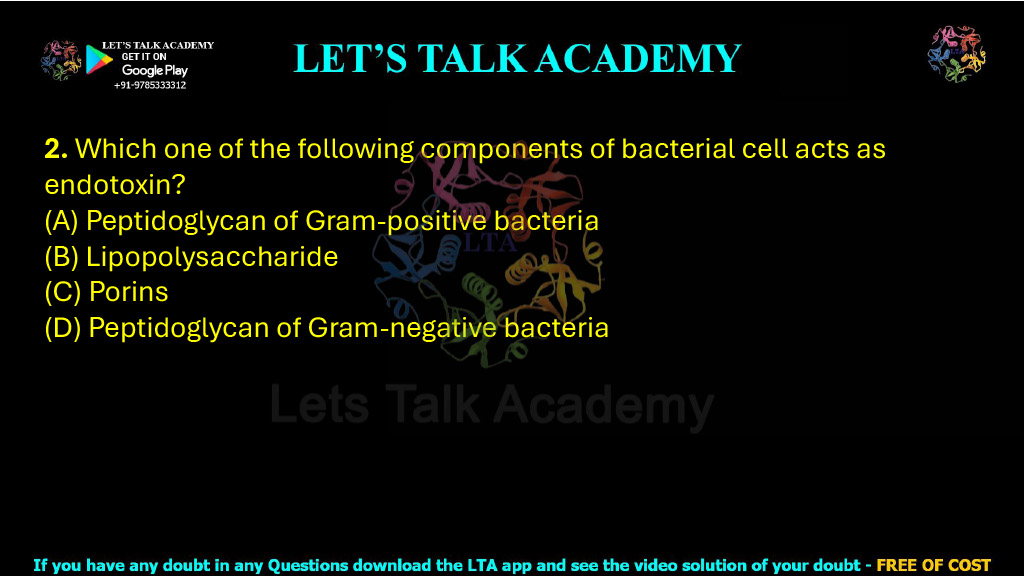
2. Which one of the following components of bacterial cell acts as endotoxin? (A) Peptidoglycan of Gram-positive bacteria (B) Lipopolysaccharide (C) Porins (D) Peptidoglycan of Gram-negative bacteria Bacterial Endotoxin Explained: […]
1. Bacterial strains that do not grow in the absence of a specific nutrient are called (A) Heterotrophs (B) Chemotrophs (C) Autotrophs (D) Auxotrophs Auxotrophs Explained: Bacterial Strains Requiring Specific […]
25. Which of the following is(are) auxins? (A) 1-Naphthaleneacetic acid (NAA) (B) Indole-3-butyric acid (IBA) (C) 2,4-Dichlorophenoxyacetic acid (2,4-D) (D) Indole-3-acetic acid (IAA) Auxins in Plants Explained: IAA, IBA, NAA, […]
24.Which one of the following statements regarding plant Photosystems is NOT true? (A) Photosystem I is present in unstacked thylakoid membrane (B) […]
23. Which one of the following is NOT an auxin? (A) Indole-3-acetic acid (B) Abscisic acid (C) Phenylacetic acid (D) Indole-3-butyric acid Which Compound is NOT an Auxin? Abscisic Acid […]
22. C3 plants utilize 18 molecules of ATP to synthesize one molecule of glucose from CO2. How many molecules of ATP equivalents are used by C4 plants to synthesize one […]
21. Indole acetic acid (IAA) is involved in _____. (A) gravitropism (B) flowering (C) ripening (D) senescence Indole Acetic Acid (IAA) Function Explained | Role of Auxin in Gravitropism Introduction […]
20. Which of the following statement(s) is/are CORRECT in the classical ‘ABC model’ for genetic control of flower development? (A) ‘Class A’ genes solely determine sepal identity (B) ‘Class B’ […]
19. Which one of the following statements is CORRECT about Agrobacterium tumefaciens mediated plant transformation? (A) The marker gene for the selection of plant transformant is located outside the T-DNA […]


