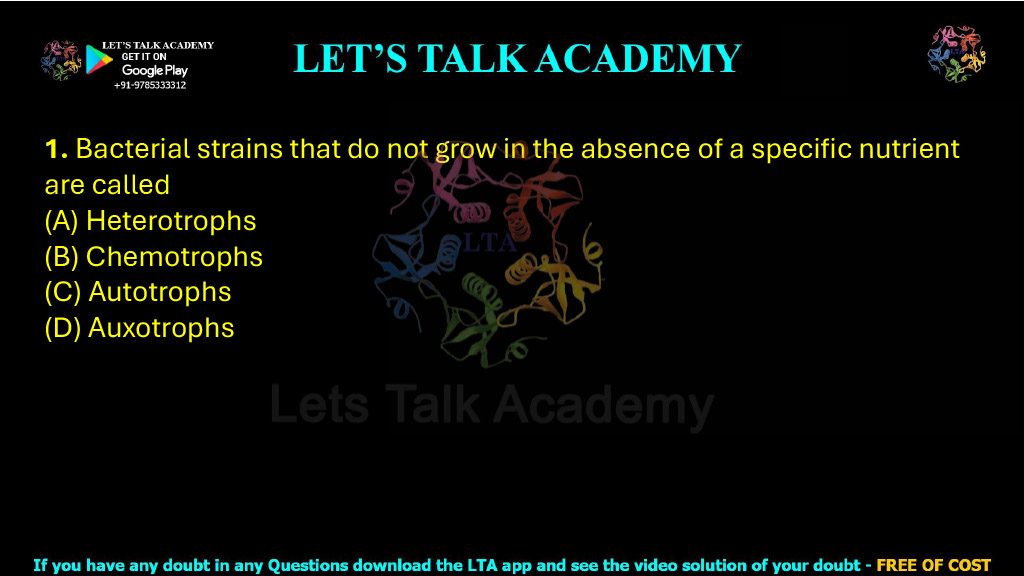
1. Bacterial strains that do not grow in the absence of a specific nutrient are called
(A) Heterotrophs
(B) Chemotrophs
(C) Autotrophs
(D) Auxotrophs
Auxotrophs Explained: Bacterial Strains Requiring Specific Nutrients
Introduction
Microorganisms require a variety of nutrients to grow, divide, and carry out essential metabolic processes. While many bacterial species can synthesize all of their required amino acids, vitamins, nucleotides, and cofactors from simple inorganic or organic compounds, some bacteria lose this ability because of mutations in genes involved in biosynthetic pathways. These mutant strains become dependent on external sources of specific nutrients for survival and growth. Such microorganisms are known as auxotrophs.
The study of auxotrophic mutants has played a fundamental role in the development of microbial genetics and molecular biology. Classic experiments by George Beadle and Edward Tatum used nutritional mutants to establish the famous One Gene-One Enzyme Hypothesis, demonstrating that genes control specific biochemical reactions. Auxotrophic mutants continue to be widely used in microbial genetics, recombinant DNA technology, metabolic engineering, and laboratory strain selection.
Correct Answer
Correct Option: (D) Auxotrophs
Detailed Explanation
An auxotroph is a mutant microorganism that has lost the ability to synthesize an essential metabolite because of a mutation in one of its biosynthetic genes. As a result, the organism cannot grow on minimal medium unless the missing nutrient is supplied externally. The required nutrient may be an amino acid, vitamin, nucleotide, purine, pyrimidine, or another essential metabolite.
For example, a bacterial strain carrying a mutation in the pathway responsible for synthesizing tryptophan cannot produce this amino acid on its own. Such a strain will grow only when tryptophan is added to the culture medium. This bacterium is therefore described as a tryptophan auxotroph.
Auxotrophic mutants are routinely isolated and identified using techniques such as replica plating, where colonies growing on complete medium are transferred to minimal medium. Colonies that fail to grow on minimal medium but grow on supplemented medium are identified as auxotrophs.
In contrast, the original wild-type strain capable of synthesizing all essential metabolites is called a prototroph. Prototrophs grow successfully on minimal medium because they possess intact biosynthetic pathways.
Explanation of Each Option
Option (A): Heterotrophs
This option is incorrect. Heterotrophs obtain carbon from organic compounds but are not necessarily unable to synthesize essential nutrients. A heterotrophic bacterium may be either prototrophic or auxotrophic.
Option (B): Chemotrophs
This option is incorrect. Chemotrophs obtain energy from chemical compounds rather than sunlight. This classification refers to the energy source of an organism and has no relationship with nutritional mutations.
Option (C): Autotrophs
This option is incorrect. Autotrophs synthesize organic molecules from carbon dioxide using either light or chemical energy. Their classification is based on carbon source rather than nutritional requirements.
Option (D): Auxotrophs
This option is correct. Auxotrophs are mutant strains that require one or more externally supplied nutrients because they cannot synthesize those compounds themselves.
Why Option (D) is Correct
Auxotrophic bacteria possess mutations in genes encoding enzymes required for biosynthetic pathways. Consequently, they become dependent on externally supplied nutrients and fail to grow on minimal medium lacking those specific compounds.
Why the Other Options are Incorrect
Why Option (A) is Incorrect
Heterotrophy refers only to the carbon source used for growth and does not indicate the presence of nutritional mutations.
Why Option (B) is Incorrect
Chemotrophy describes how organisms obtain energy rather than whether they require nutritional supplements.
Why Option (C) is Incorrect
Autotrophs produce organic compounds from carbon dioxide and are classified according to carbon metabolism rather than nutritional deficiencies.
Comparison of All Options
| Option | Definition | Correct or Incorrect |
|---|---|---|
| A | Uses organic compounds as carbon source | Incorrect |
| B | Obtains energy from chemical compounds | Incorrect |
| C | Uses carbon dioxide as carbon source | Incorrect |
| D | Requires a specific nutrient for growth because of mutation | Correct |
Auxotroph vs Prototroph
| Feature | Auxotroph | Prototroph |
|---|---|---|
| Biosynthetic Ability | Defective | Complete |
| Growth on Minimal Medium | No | Yes |
| Nutrient Requirement | Requires supplementation | No supplementation required |
| Origin | Usually mutant strain | Wild-type strain |
Types of Nutritional Mutants
| Auxotroph Type | Required Nutrient |
|---|---|
| Tryptophan Auxotroph | Tryptophan |
| Histidine Auxotroph | Histidine |
| Leucine Auxotroph | Leucine |
| Adenine Auxotroph | Adenine |
| Vitamin Auxotroph | Specific vitamin |
Applications of Auxotrophic Mutants
| Application | Importance |
|---|---|
| Genetic Mapping | Identification of mutated genes |
| Replica Plating | Screening nutritional mutants |
| Recombinant DNA Technology | Selection of transformed microorganisms |
| Metabolic Engineering | Analysis of biosynthetic pathways |
| Functional Genomics | Determining gene function |
Biological Significance
Auxotrophic mutants have transformed our understanding of genetics, metabolism, and molecular biology. Their use has enabled scientists to identify metabolic pathways, assign functions to genes, develop recombinant microorganisms, and investigate gene regulation. These mutants remain indispensable tools in microbial genetics, industrial biotechnology, pharmaceutical production, and synthetic biology.
Final Answer
Correct Option: (D) Auxotrophs
Auxotrophs are bacterial mutant strains that cannot grow in the absence of a specific nutrient because they have lost the ability to synthesize that compound due to a mutation in a biosynthetic gene. They require supplementation of the missing nutrient for normal growth.


