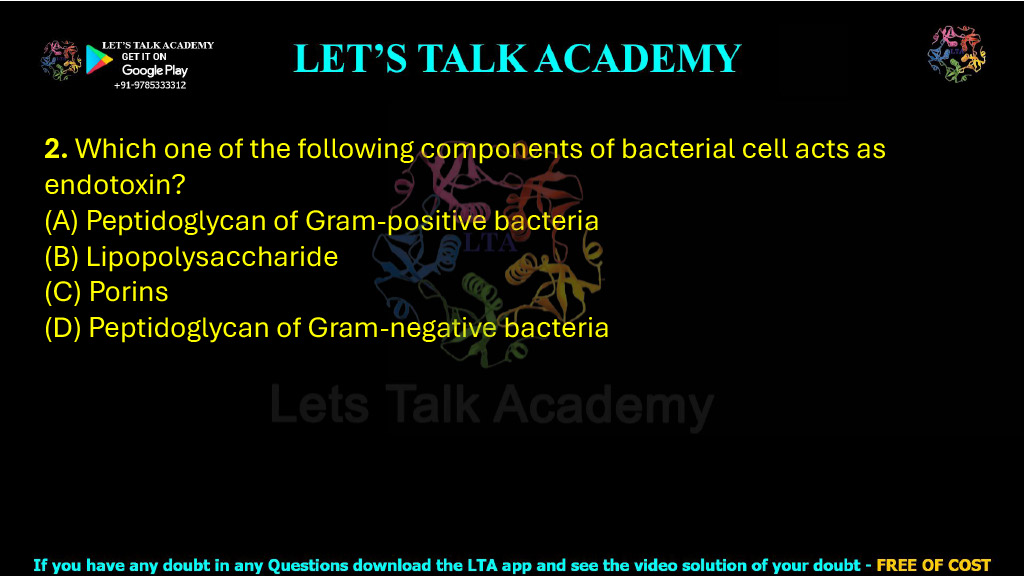
2. Which one of the following components of bacterial cell acts as endotoxin?
(A) Peptidoglycan of Gram-positive bacteria
(B) Lipopolysaccharide
(C) Porins
(D) Peptidoglycan of Gram-negative bacteria
Bacterial Endotoxin Explained: Lipopolysaccharide (LPS) as the Endotoxin
Introduction
Bacteria possess several structural components that contribute to their survival, pathogenicity, and interaction with the host immune system. Among these components, endotoxins are particularly important because they can trigger strong inflammatory responses, fever, septic shock, and multiple organ failure in infected individuals. Unlike exotoxins, which are secreted proteins, endotoxins are structural components of the bacterial outer membrane and are released mainly when bacterial cells are damaged or undergo lysis.
The endotoxin of Gram-negative bacteria is lipopolysaccharide (LPS), a complex molecule located in the outer leaflet of the outer membrane. The toxic activity of LPS resides in its Lipid A component, which stimulates immune cells to produce inflammatory cytokines. Understanding the structure and biological significance of LPS is fundamental in microbiology, immunology, and infectious diseases.
Correct Answer
Correct Option: (B) Lipopolysaccharide
Detailed Explanation
Lipopolysaccharide (LPS) is the characteristic component of the outer membrane of Gram-negative bacteria and functions as the bacterial endotoxin. LPS consists of three major regions: Lipid A, the core polysaccharide, and the O-antigen. Among these components, Lipid A is responsible for the toxic biological effects observed during Gram-negative bacterial infections.
When Gram-negative bacteria are destroyed by the immune system or antibiotics, LPS is released into the surrounding environment. The Lipid A portion binds to receptors such as TLR4 (Toll-like receptor 4) on macrophages and other immune cells, activating intracellular signaling pathways that stimulate the release of cytokines including tumor necrosis factor-alpha (TNF-α), interleukin-1 (IL-1), and interleukin-6 (IL-6). Excessive cytokine production can result in fever, hypotension, disseminated intravascular coagulation, septic shock, and multiple organ dysfunction.
Unlike endotoxins, exotoxins are secreted proteins produced by both Gram-positive and Gram-negative bacteria. Exotoxins are generally more potent, highly specific, heat-labile, and can often be converted into toxoids for vaccine production. Endotoxins cannot be converted into toxoids because they are structural lipopolysaccharides rather than proteins.
Explanation of Each Option
Option (A): Peptidoglycan of Gram-positive Bacteria
This option is incorrect. Peptidoglycan provides structural rigidity to the bacterial cell wall but does not function as the classical bacterial endotoxin. Although it can stimulate immune responses, it is not classified as an endotoxin.
Option (B): Lipopolysaccharide
This option is correct. Lipopolysaccharide is the endotoxin of Gram-negative bacteria, and its toxic activity resides in the Lipid A component.
Option (C): Porins
This option is incorrect. Porins are membrane proteins that form channels allowing the passive diffusion of small molecules across the outer membrane of Gram-negative bacteria. They do not possess endotoxin activity.
Option (D): Peptidoglycan of Gram-negative Bacteria
This option is incorrect. Gram-negative bacteria contain only a thin peptidoglycan layer that provides structural support but does not serve as the bacterial endotoxin.
Why Option (B) is Correct
Only Lipopolysaccharide (LPS), specifically its Lipid A region, acts as the classical endotoxin responsible for fever, inflammation, septic shock, and activation of the innate immune response in Gram-negative bacterial infections.
Why the Other Options are Incorrect
Why Option (A) is Incorrect
Peptidoglycan is an important structural component of Gram-positive bacteria but lacks the biochemical properties of endotoxin.
Why Option (C) is Incorrect
Porins function as transport proteins and are unrelated to bacterial toxin activity.
Why Option (D) is Incorrect
The thin peptidoglycan layer of Gram-negative bacteria contributes to cell wall strength but is not responsible for endotoxin-mediated toxicity.
Comparison of All Options
| Option | Component | Function | Correct or Incorrect |
|---|---|---|---|
| A | Peptidoglycan (Gram-positive) | Cell wall support | Incorrect |
| B | Lipopolysaccharide (LPS) | Endotoxin | Correct |
| C | Porins | Transport channels | Incorrect |
| D | Peptidoglycan (Gram-negative) | Cell wall support | Incorrect |
Structure of Lipopolysaccharide (LPS)
| Component | Function |
|---|---|
| Lipid A | Toxic component responsible for endotoxin activity |
| Core Polysaccharide | Connects Lipid A with O-antigen and provides structural stability |
| O-Antigen | Surface antigen responsible for antigenic variation and serotyping |
Endotoxin vs Exotoxin
| Feature | Endotoxin | Exotoxin |
|---|---|---|
| Chemical Nature | Lipopolysaccharide | Protein |
| Produced By | Gram-negative bacteria | Gram-positive and Gram-negative bacteria |
| Released | During bacterial lysis | Actively secreted |
| Heat Stability | Heat stable | Usually heat labile |
| Can Form Toxoid | No | Yes |
| Main Toxic Component | Lipid A | Entire protein molecule |
Comparison Between Gram-Positive and Gram-Negative Cell Walls
| Feature | Gram-Positive | Gram-Negative |
|---|---|---|
| Peptidoglycan Layer | Thick | Thin |
| Outer Membrane | Absent | Present |
| Lipopolysaccharide | Absent | Present |
| Endotoxin | Absent | Present |
Clinical Effects of Endotoxin
| Effect | Mechanism |
|---|---|
| Fever | Cytokine release from macrophages |
| Inflammation | Activation of innate immune response |
| Hypotension | Systemic vasodilation |
| Septic Shock | Excessive inflammatory response |
| Disseminated Intravascular Coagulation | Activation of coagulation pathways |
Biological Significance
Lipopolysaccharide is essential for maintaining the structural integrity of the Gram-negative bacterial outer membrane and protecting bacteria against environmental stress. However, when released into the host, its Lipid A component triggers powerful innate immune responses that can be beneficial for pathogen clearance but may become life-threatening if excessive cytokine production results in septic shock. Understanding LPS has been crucial for developing therapies against Gram-negative bacterial infections and improving vaccine adjuvants.
Final Answer
Correct Option: (B) Lipopolysaccharide
Lipopolysaccharide (LPS), specifically its Lipid A component, functions as the endotoxin of Gram-negative bacteria. It is released mainly during bacterial lysis and induces fever, inflammation, cytokine production, and septic shock by activating the host innate immune system.


