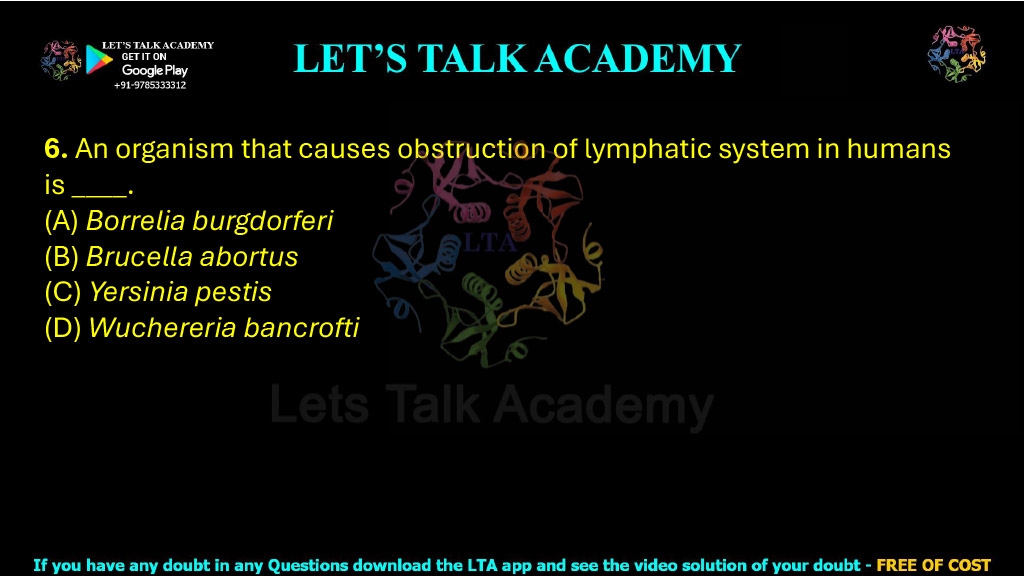
6. An organism that causes obstruction of lymphatic system in humans is ____.
(A) Borrelia burgdorferi
(B) Brucella abortus
(C) Yersinia pestis
(D) Wuchereria bancrofti
Wuchereria bancrofti Explained: Cause of Lymphatic Filariasis
Introduction
Lymphatic filariasis is one of the most important neglected tropical diseases affecting millions of people worldwide. The disease results from infection with thread-like parasitic nematodes that invade the human lymphatic vessels and lymph nodes. Over time, these parasites cause inflammation, blockage of lymphatic drainage, tissue swelling, and permanent enlargement of affected body parts, a condition commonly known as elephantiasis.
The principal causative organism of lymphatic filariasis is Wuchereria bancrofti, which accounts for the vast majority of human infections globally. The parasite is transmitted through the bite of infected mosquitoes and completes its life cycle between humans and mosquito vectors.
Correct Answer
Correct Option: (D) Wuchereria bancrofti
Detailed Explanation
Wuchereria bancrofti is a filarial nematode (roundworm) that infects the lymphatic system of humans. Adult worms reside within lymphatic vessels and lymph nodes, where they produce chronic inflammation, fibrosis, and progressive obstruction of lymph flow. The resulting accumulation of lymphatic fluid causes severe swelling of the limbs, scrotum, breasts, or other body parts, producing the characteristic condition known as lymphatic filariasis or elephantiasis.
The parasite is transmitted by mosquitoes belonging mainly to the genera Culex, Anopheles, Aedes, and Mansonia. During a mosquito bite, infective third-stage larvae enter the human body and migrate to the lymphatic vessels, where they mature into adult worms over several months. Adult females release microfilariae into the bloodstream, which are subsequently taken up by another mosquito, thereby completing the life cycle.
The pathology associated with Wuchereria bancrofti results primarily from chronic damage to lymphatic vessels rather than direct tissue invasion. Repeated inflammation leads to impaired lymphatic drainage, resulting in lymphedema, hydrocele, and permanent tissue enlargement. The disease has significant medical, social, and economic consequences in endemic tropical and subtropical regions.
Explanation of Each Option
Option (A): Borrelia burgdorferi
This option is incorrect. Borrelia burgdorferi is a spirochete bacterium that causes Lyme disease, a tick-borne illness characterized by erythema migrans, arthritis, neurological complications, and cardiac manifestations. It does not cause lymphatic obstruction.
Option (B): Brucella abortus
This option is incorrect. Brucella abortus is a Gram-negative bacterium that causes brucellosis, a zoonotic disease associated with prolonged fever, fatigue, and musculoskeletal symptoms. It is unrelated to lymphatic filariasis.
Option (C): Yersinia pestis
This option is incorrect. Yersinia pestis is the causative agent of plague, including bubonic, septicemic, and pneumonic forms. Although bubonic plague causes swollen lymph nodes (buboes), it does not produce chronic lymphatic obstruction characteristic of elephantiasis.
Option (D): Wuchereria bancrofti
This option is correct. Wuchereria bancrofti is the principal causative organism of lymphatic filariasis and chronic obstruction of the human lymphatic system.
Why Option (D) is Correct
Adult Wuchereria bancrofti worms inhabit lymphatic vessels, where prolonged infection causes inflammation, fibrosis, blockage of lymphatic drainage, and elephantiasis. This is the classical cause of lymphatic obstruction in humans.
Why the Other Options are Incorrect
Why Option (A) is Incorrect
Borrelia burgdorferi causes Lyme disease and is transmitted by ticks rather than mosquitoes.
Why Option (B) is Incorrect
Brucella abortus produces brucellosis, a bacterial zoonosis that primarily affects the reticuloendothelial system rather than the lymphatic vessels.
Why Option (C) is Incorrect
Yersinia pestis infects lymph nodes during bubonic plague but does not produce chronic lymphatic blockage or elephantiasis.
Comparison of All Options
| Option | Organism | Disease | Correct or Incorrect |
|---|---|---|---|
| A | Borrelia burgdorferi | Lyme disease | Incorrect |
| B | Brucella abortus | Brucellosis | Incorrect |
| C | Yersinia pestis | Plague | Incorrect |
| D | Wuchereria bancrofti | Lymphatic filariasis (Elephantiasis) | Correct |
Life Cycle of Wuchereria bancrofti
| Stage | Event |
|---|---|
| 1 | Infected mosquito injects L3 larvae into human skin |
| 2 | Larvae migrate to lymphatic vessels |
| 3 | Larvae mature into adult worms |
| 4 | Adult worms release microfilariae into bloodstream |
| 5 | Mosquito ingests microfilariae during blood meal |
| 6 | Larvae develop inside mosquito and become infective |
Clinical Manifestations of Lymphatic Filariasis
| Manifestation | Description |
|---|---|
| Lymphedema | Persistent swelling of limbs |
| Elephantiasis | Massive enlargement of affected tissues |
| Hydrocele | Fluid accumulation around the testes |
| Lymphangitis | Inflammation of lymphatic vessels |
| Lymphadenitis | Inflammation of lymph nodes |
Comparison of the Organisms Mentioned
| Organism | Type | Transmission | Disease |
|---|---|---|---|
| Borrelia burgdorferi | Spirochete bacterium | Tick bite | Lyme disease |
| Brucella abortus | Gram-negative bacterium | Animals and contaminated dairy products | Brucellosis |
| Yersinia pestis | Gram-negative bacterium | Rat flea | Plague |
| Wuchereria bancrofti | Parasitic nematode | Mosquito bite | Lymphatic filariasis |
Biological Significance
Wuchereria bancrofti has evolved to survive within the human lymphatic system, where it can persist for many years. Chronic infection gradually damages lymphatic vessels, leading to irreversible swelling and disability. Global public health programs focus on mass drug administration, mosquito control, early diagnosis, and improved sanitation to reduce transmission and ultimately eliminate lymphatic filariasis as a public health problem.
Final Answer
Correct Option: (D) Wuchereria bancrofti
Wuchereria bancrofti is a mosquito-transmitted filarial nematode that inhabits the human lymphatic system. Chronic infection causes inflammation and obstruction of lymphatic vessels, leading to lymphatic filariasis (elephantiasis), characterized by severe swelling of the limbs and other affected tissues.


