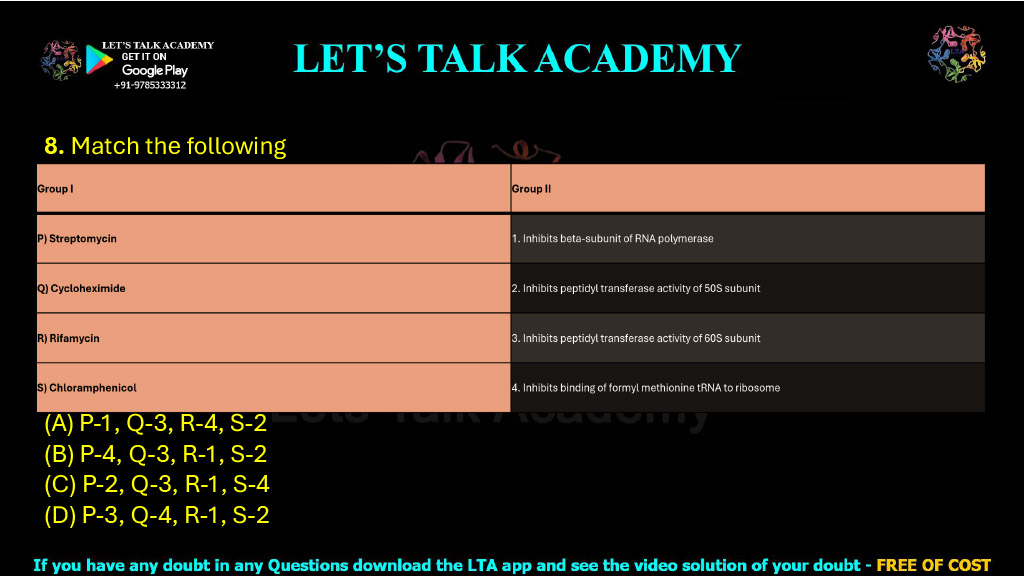
8. Match the following
| Group I | Group II |
| P) Streptomycin | 1. Inhibits beta-subunit of RNA polymerase |
| Q) Cycloheximide | 2. Inhibits peptidyl transferase activity of 50S subunit |
| R) Rifamycin | 3. Inhibits peptidyl transferase activity of 60S subunit |
| S) Chloramphenicol | 4. Inhibits binding of formyl methionine tRNA to ribosome |
(A) P-1, Q-3, R-4, S-2
(B) P-4, Q-3, R-1, S-2
(C) P-2, Q-3, R-1, S-4
(D) P-3, Q-4, R-1, S-2
Mechanism of Action of Streptomycin, Cycloheximide, Rifamycin, and Chloramphenicol
Introduction
Antibiotics and translation inhibitors are among the most frequently tested topics in Microbiology, Molecular Biology, and Biochemistry. Different antimicrobial agents inhibit specific stages of transcription or translation by targeting bacterial or eukaryotic ribosomes, RNA polymerase, or initiation factors. Since bacterial ribosomes (70S) differ structurally from eukaryotic ribosomes (80S), many antibiotics selectively inhibit bacterial protein synthesis without significantly affecting eukaryotic cells.
Understanding the exact molecular target of each antibiotic is essential for competitive examinations because many questions ask students to match antibiotics with their mechanisms of action. Drugs such as Streptomycin, Cycloheximide, Rifamycin, and Chloramphenicol each inhibit different components of transcription or translation. Their mechanisms are not only important in microbiology but are also widely applied in molecular biology laboratories for studying gene expression and protein synthesis.
Correct Answer
Correct Option: (B)
P → 4
Q → 3
R → 1
S → 2
Detailed Explanation
Each antibiotic listed in this question targets a distinct stage of transcription or translation. Their specificity depends on differences between bacterial and eukaryotic ribosomes or RNA polymerases.
Streptomycin is an aminoglycoside antibiotic that binds to the 30S ribosomal subunit of bacteria. It interferes with the initiation of protein synthesis by preventing proper binding of the initiator formyl methionine tRNA (fMet-tRNA) and also causes misreading of mRNA during translation.
Cycloheximide specifically inhibits eukaryotic protein synthesis. It binds to the 60S ribosomal subunit and blocks the peptidyl transferase reaction, preventing peptide bond formation. Because of its specificity, cycloheximide is commonly used in research laboratories to inhibit protein synthesis in eukaryotic cells.
Rifamycin inhibits bacterial transcription by binding to the β-subunit of DNA-dependent RNA polymerase. This prevents initiation of RNA synthesis, making Rifamycin an effective antibacterial drug against organisms such as Mycobacterium tuberculosis.
Chloramphenicol binds to the bacterial 50S ribosomal subunit and inhibits the peptidyl transferase enzyme, thereby preventing peptide bond formation during protein synthesis.
Therefore, the correct matching is:
- P → 4
- Q → 3
- R → 1
- S → 2
Explanation of Each Match
P. Streptomycin → 4. Inhibits Binding of Formyl Methionine tRNA to Ribosome
This match is correct. Streptomycin acts on the bacterial 30S ribosomal subunit, preventing initiation complex formation and interfering with binding of initiator fMet-tRNA.
Q. Cycloheximide → 3. Inhibits Peptidyl Transferase Activity of 60S Subunit
This match is correct. Cycloheximide selectively inhibits eukaryotic translation by blocking peptidyl transferase activity of the 60S ribosomal subunit.
R. Rifamycin → 1. Inhibits β-Subunit of RNA Polymerase
This match is correct. Rifamycin binds bacterial RNA polymerase and prevents transcription initiation.
S. Chloramphenicol → 2. Inhibits Peptidyl Transferase Activity of 50S Subunit
This match is correct. Chloramphenicol blocks peptide bond formation by inhibiting the peptidyl transferase center of the bacterial 50S ribosomal subunit.
Why Option (B) is Correct
Option (B) correctly matches every antibiotic with its molecular target and mechanism of action.
| Antibiotic | Target |
|---|---|
| Streptomycin | Initiator fMet-tRNA binding (30S) |
| Cycloheximide | Peptidyl transferase of 60S ribosome |
| Rifamycin | β-subunit of RNA polymerase |
| Chloramphenicol | Peptidyl transferase of 50S ribosome |
Why the Other Options are Incorrect
Option (A)
Incorrect because Streptomycin does not inhibit RNA polymerase, and Rifamycin does not inhibit initiator tRNA binding.
Option (C)
Incorrect because Streptomycin does not inhibit the 50S peptidyl transferase enzyme, and Chloramphenicol does not block fMet-tRNA binding.
Option (D)
Incorrect because Streptomycin does not inhibit the eukaryotic 60S ribosome, and Cycloheximide does not interfere with bacterial initiation.
Comparison of These Antibiotics
| Drug | Target | Organism | Mechanism |
|---|---|---|---|
| Streptomycin | 30S Ribosome | Bacteria | Blocks initiation and causes mRNA misreading |
| Cycloheximide | 60S Ribosome | Eukaryotes | Inhibits peptidyl transferase |
| Rifamycin | RNA Polymerase | Bacteria | Blocks transcription initiation |
| Chloramphenicol | 50S Ribosome | Bacteria | Inhibits peptidyl transferase |
Protein Synthesis Inhibitors Frequently Asked in Competitive Exams
| Antibiotic | Ribosomal Target | Primary Action |
|---|---|---|
| Streptomycin | 30S | Blocks initiation and causes misreading |
| Tetracycline | 30S | Blocks aminoacyl-tRNA binding |
| Chloramphenicol | 50S | Blocks peptidyl transferase |
| Erythromycin | 50S | Blocks translocation |
| Cycloheximide | 60S | Blocks eukaryotic translation |
| Puromycin | 70S and 80S | Causes premature chain termination |
Biological Significance
Knowledge of antibiotic targets has revolutionized medicine, biotechnology, and molecular biology. Many antibiotics selectively inhibit bacterial translation because bacterial ribosomes differ structurally from eukaryotic ribosomes. Laboratory inhibitors such as cycloheximide and chloramphenicol are also invaluable tools for studying transcription, translation, ribosome function, and regulation of gene expression. Understanding these mechanisms is fundamental for antibiotic development and combating antimicrobial resistance.
Final Answer
Correct Option: (B)
P → 4, Q → 3, R → 1, S → 2
The correct matching is:
- Streptomycin → Inhibits binding of formyl methionine tRNA to ribosome
- Cycloheximide → Inhibits peptidyl transferase activity of the 60S ribosomal subunit
- Rifamycin → Inhibits the β-subunit of bacterial RNA polymerase
- Chloramphenicol → Inhibits peptidyl transferase activity of the bacterial 50S ribosomal subunit


