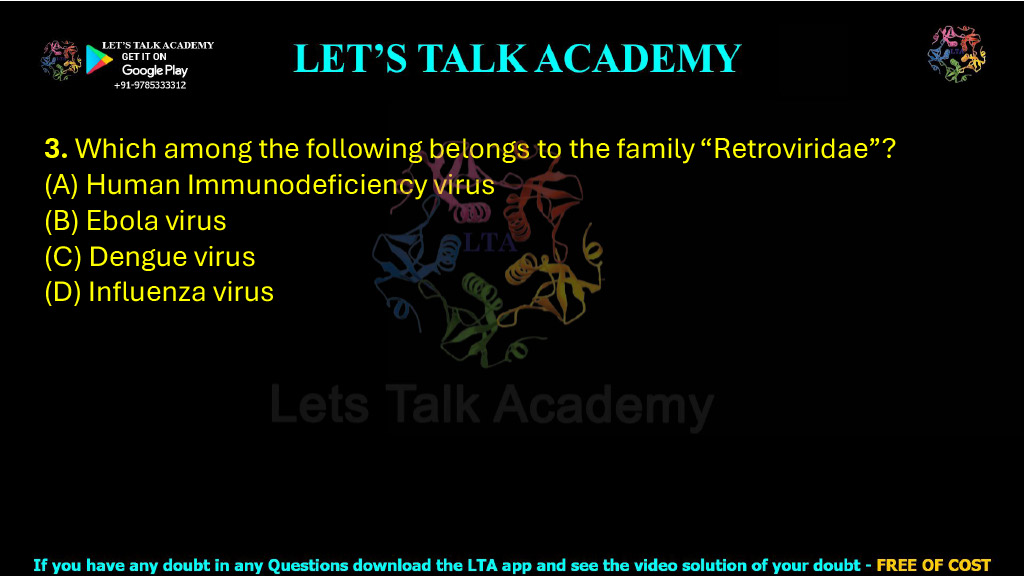
3. Which among the following belongs to the family “Retroviridae”?
(A) Human Immunodeficiency virus
(B) Ebola virus
(C) Dengue virus
(D) Influenza virus
Retroviridae Family Explained: Human Immunodeficiency Virus (HIV)
Introduction
Viruses are classified into different families based on their genome type, replication strategy, morphology, and evolutionary relationships. One of the most important viral families in medical microbiology is the Retroviridae family, whose members possess a unique replication mechanism involving the enzyme reverse transcriptase. Unlike most RNA viruses, retroviruses convert their single-stranded RNA genome into DNA, which integrates into the host chromosome and becomes a permanent part of the host cell genome. This remarkable replication strategy distinguishes Retroviridae from all other medically important RNA virus families.
The best-known member of the Retroviridae family is the Human Immunodeficiency Virus (HIV), the causative agent of Acquired Immunodeficiency Syndrome (AIDS). HIV primarily infects CD4+ T-helper lymphocytes, macrophages, and dendritic cells, progressively weakening the immune system and increasing susceptibility to opportunistic infections. In contrast, viruses such as Ebola virus, Dengue virus, and Influenza virus belong to entirely different viral families and replicate through different mechanisms.
Correct Answer
Correct Option: (A) Human Immunodeficiency Virus (HIV)
Detailed Explanation
Human Immunodeficiency Virus (HIV) belongs to the family Retroviridae and the genus Lentivirus. It is an enveloped, positive-sense single-stranded RNA virus that carries two identical RNA molecules along with the enzyme reverse transcriptase. After entering the host cell, reverse transcriptase synthesizes complementary DNA (cDNA) from the viral RNA genome. This viral DNA is subsequently integrated into the host chromosome by another viral enzyme known as integrase, allowing the virus to persist for the lifetime of the infected cell.
The integrated viral DNA, called a provirus, serves as a template for producing new viral RNA genomes and viral proteins. Because HIV integrates into host DNA, complete elimination of the virus from infected individuals remains extremely difficult. This unique replication strategy is the defining characteristic of retroviruses and distinguishes them from all other RNA virus families.
The other viruses listed in the question belong to different viral families. Ebola virus belongs to the family Filoviridae, Dengue virus belongs to the family Flaviviridae, and Influenza virus belongs to the family Orthomyxoviridae. None of these viruses replicate through reverse transcription.
Explanation of Each Option
Option (A): Human Immunodeficiency Virus
This option is correct. HIV belongs to the family Retroviridae and is characterized by the presence of reverse transcriptase and integration of viral DNA into the host genome.
Option (B): Ebola Virus
This option is incorrect. Ebola virus belongs to the family Filoviridae. It is a filamentous, negative-sense single-stranded RNA virus that causes severe hemorrhagic fever.
Option (C): Dengue Virus
This option is incorrect. Dengue virus belongs to the family Flaviviridae. It is transmitted by Aedes mosquitoes and causes dengue fever, dengue hemorrhagic fever, and dengue shock syndrome.
Option (D): Influenza Virus
This option is incorrect. Influenza virus belongs to the family Orthomyxoviridae. It possesses a segmented negative-sense RNA genome and is responsible for seasonal influenza epidemics.
Why Option (A) is Correct
HIV is the only virus among the given options that belongs to the Retroviridae family. Its defining characteristic is replication through reverse transcription followed by integration of viral DNA into the host genome.
Why the Other Options are Incorrect
Why Option (B) is Incorrect
Ebola virus belongs to Filoviridae and lacks reverse transcriptase.
Why Option (C) is Incorrect
Dengue virus belongs to Flaviviridae and replicates entirely in the cytoplasm without forming a DNA intermediate.
Why Option (D) is Incorrect
Influenza virus belongs to Orthomyxoviridae and possesses a segmented RNA genome that replicates without reverse transcription.
Comparison of All Options
| Option | Virus | Family | Correct or Incorrect |
|---|---|---|---|
| A | Human Immunodeficiency Virus | Retroviridae | Correct |
| B | Ebola Virus | Filoviridae | Incorrect |
| C | Dengue Virus | Flaviviridae | Incorrect |
| D | Influenza Virus | Orthomyxoviridae | Incorrect |
Comparison of Major Human RNA Virus Families
| Virus | Family | Genome | Unique Feature |
|---|---|---|---|
| HIV | Retroviridae | Positive-sense ssRNA | Reverse transcriptase and genome integration |
| Ebola Virus | Filoviridae | Negative-sense ssRNA | Filamentous morphology |
| Dengue Virus | Flaviviridae | Positive-sense ssRNA | Mosquito-borne arbovirus |
| Influenza Virus | Orthomyxoviridae | Segmented negative-sense ssRNA | Antigenic drift and antigenic shift |
Characteristics of Retroviridae
| Characteristic | Description |
|---|---|
| Genome | Two copies of positive-sense single-stranded RNA |
| Envelope | Present |
| Key Enzyme | Reverse Transcriptase |
| DNA Intermediate | Present |
| Integration into Host Genome | Occurs through Integrase |
| Representative Virus | Human Immunodeficiency Virus (HIV) |
Replication Cycle of HIV
| Step | Event |
|---|---|
| 1 | Attachment to CD4 receptor and co-receptors |
| 2 | Fusion and entry into host cell |
| 3 | Reverse transcription of RNA into DNA |
| 4 | Integration of viral DNA into host chromosome |
| 5 | Transcription and translation of viral genes |
| 6 | Assembly, budding, and maturation of new virions |
Biological Significance
The Retroviridae family is unique because its members permanently integrate their genetic material into the host genome. This strategy enables lifelong persistence of infection and contributes to the chronic nature of diseases such as AIDS. Understanding retroviral biology has also revolutionized molecular biology by providing important tools such as reverse transcriptase, retroviral vectors, and gene therapy systems. These discoveries have had a profound impact on biotechnology, medicine, and genetic engineering.
Final Answer
Correct Option: (A) Human Immunodeficiency Virus (HIV)
Human Immunodeficiency Virus (HIV) belongs to the family Retroviridae. It is an enveloped positive-sense RNA virus that uses reverse transcriptase to synthesize DNA from its RNA genome, followed by integration into the host chromosome, a defining feature of all retroviruses.


