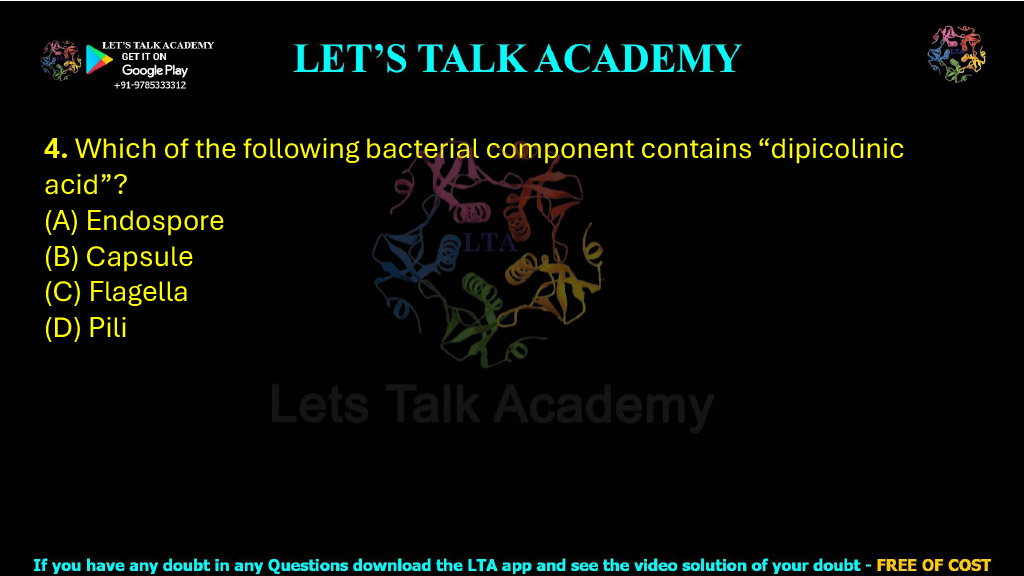
4. Which of the following bacterial component contains “dipicolinic acid”?
(A) Endospore
(B) Capsule
(C) Flagella
(D) Pili
Dipicolinic Acid in Bacterial Endospores Explained
Introduction
Bacteria possess several specialized cellular structures that help them survive under diverse environmental conditions. While structures such as capsules, flagella, and pili contribute to protection, motility, and attachment, certain bacterial species have evolved an extraordinary survival strategy by producing endospores. Endospores are highly resistant dormant structures that enable bacteria to withstand extreme heat, radiation, desiccation, toxic chemicals, and nutrient deprivation for prolonged periods.
One of the most distinctive chemical components responsible for the remarkable resistance of bacterial endospores is dipicolinic acid (DPA). Present mainly as calcium dipicolinate, this molecule constitutes approximately 5–15% of the dry weight of an endospore. Together with specialized spore proteins, dipicolinic acid stabilizes DNA, reduces the water content of the spore core, and provides exceptional resistance to environmental stress.
Correct Answer
Correct Option: (A) Endospore
Detailed Explanation
Dipicolinic acid (DPA) is a unique chemical compound found almost exclusively in the core of bacterial endospores. During sporulation, bacteria such as Bacillus and Clostridium accumulate large quantities of dipicolinic acid, which combines with calcium ions to form calcium dipicolinate. This complex contributes significantly to the extraordinary resistance of endospores against harsh environmental conditions.
The calcium-dipicolinate complex lowers the water content of the spore core, creating a highly dehydrated environment that protects cellular macromolecules from heat and chemical damage. Dipicolinic acid also stabilizes DNA by interacting with small acid-soluble spore proteins (SASPs), thereby protecting the genetic material from ultraviolet radiation, oxidation, and enzymatic degradation. These adaptations allow bacterial endospores to remain viable for years or even centuries under unfavorable conditions.
In contrast, other bacterial structures such as capsules, flagella, and pili do not contain dipicolinic acid. Capsules are mainly composed of polysaccharides or polypeptides, flagella are composed of the protein flagellin, and pili are composed of the protein pilin. Therefore, dipicolinic acid is a unique biochemical marker of bacterial endospores.
Explanation of Each Option
Option (A): Endospore
This option is correct. Endospores contain high concentrations of calcium dipicolinate, which contributes to heat resistance, dehydration, DNA stabilization, and long-term survival.
Option (B): Capsule
This option is incorrect. Capsules consist mainly of polysaccharides or, in some bacteria, polypeptides. They protect bacteria from phagocytosis and desiccation but do not contain dipicolinic acid.
Option (C): Flagella
This option is incorrect. Flagella are long protein filaments composed primarily of flagellin and function in bacterial motility.
Option (D): Pili
This option is incorrect. Pili are protein appendages composed of pilin that facilitate bacterial attachment, biofilm formation, and conjugation. They do not contain dipicolinic acid.
Why Option (A) is Correct
Dipicolinic acid is synthesized specifically during sporulation and accumulates within the spore core as calcium dipicolinate. It is responsible for many of the exceptional resistance properties that characterize bacterial endospores.
Why the Other Options are Incorrect
Why Option (B) is Incorrect
Capsules are protective extracellular layers composed mainly of polysaccharides and lack dipicolinic acid.
Why Option (C) is Incorrect
Flagella are locomotory organelles made of flagellin protein and have no role in spore formation or dipicolinic acid storage.
Why Option (D) is Incorrect
Pili are involved in adhesion and genetic exchange but do not contain calcium dipicolinate or participate in sporulation.
Comparison of All Options
| Option | Bacterial Component | Main Function | Contains Dipicolinic Acid? |
|---|---|---|---|
| A | Endospore | Survival under adverse conditions | Yes |
| B | Capsule | Protection against phagocytosis | No |
| C | Flagella | Motility | No |
| D | Pili | Attachment and conjugation | No |
Structure of a Bacterial Endospore
| Layer | Major Function |
|---|---|
| Exosporium | Outermost protective covering |
| Spore Coat | Resistance to chemicals and enzymes |
| Cortex | Maintains dehydration of the core |
| Core Wall | Surrounds the spore core |
| Core | Contains DNA, ribosomes, enzymes, calcium dipicolinate, and SASPs |
Functions of Dipicolinic Acid
| Function | Importance |
|---|---|
| DNA Stabilization | Protects genetic material during dormancy |
| Heat Resistance | Increases thermal stability |
| Dehydration of Core | Reduces water content and metabolic activity |
| Chemical Resistance | Protects against toxic compounds |
| Long-Term Survival | Allows spores to remain viable for many years |
Comparison of Important Bacterial Structures
| Structure | Major Component | Primary Function |
|---|---|---|
| Endospore | Calcium dipicolinate | Survival under extreme conditions |
| Capsule | Polysaccharides or polypeptides | Protection from host defenses |
| Flagella | Flagellin protein | Bacterial motility |
| Pili | Pilin protein | Attachment and DNA transfer |
Examples of Endospore-Forming Bacteria
| Genus | Representative Species | Disease |
|---|---|---|
| Bacillus | Bacillus anthracis | Anthrax |
| Bacillus | Bacillus cereus | Food poisoning |
| Clostridium | Clostridium tetani | Tetanus |
| Clostridium | Clostridium botulinum | Botulism |
| Clostridium | Clostridium difficile | Antibiotic-associated diarrhea |
Biological Significance
Endospore formation is one of the most effective survival strategies in the microbial world. The presence of calcium dipicolinate, together with specialized spore proteins and multiple protective layers, enables bacteria to survive conditions that would rapidly destroy vegetative cells. This remarkable resistance contributes to the persistence of medically important pathogens, complicates sterilization procedures, and has significant implications for food preservation, clinical microbiology, and industrial sterilization.
Final Answer
Correct Option: (A) Endospore
Dipicolinic acid, present mainly as calcium dipicolinate, is a characteristic component of bacterial endospores. It plays a crucial role in protecting DNA, reducing water content, and providing exceptional resistance to heat, chemicals, radiation, and desiccation.


