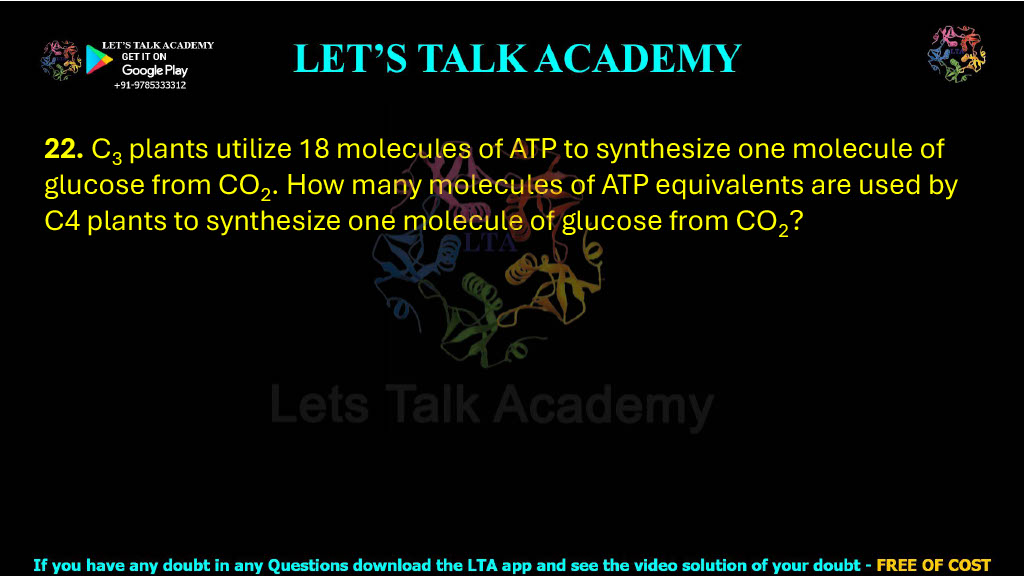
22. C3 plants utilize 18 molecules of ATP to synthesize one molecule of glucose from CO2. How many molecules of ATP equivalents are used by C4 plants to synthesize one molecule of glucose from CO2?
ATP Requirement in C4 Photosynthesis Explained | Energy Cost of C3 vs C4 Pathway |
Introduction
Photosynthesis is the primary biological process through which plants convert solar energy into chemical energy. During this process, atmospheric carbon dioxide is fixed into carbohydrates that serve as the major source of energy for nearly all living organisms. Although the Calvin cycle is common to both C3 and C4 plants, the mechanism of carbon fixation differs significantly between these two groups, resulting in differences in their overall energy requirement.
C3 plants fix carbon dioxide directly through the Calvin cycle using the enzyme RuBisCO, whereas C4 plants first concentrate carbon dioxide in mesophyll cells through the Hatch-Slack pathway before delivering it to bundle sheath cells where the Calvin cycle operates. This additional carbon-concentrating mechanism minimizes photorespiration and greatly improves photosynthetic efficiency under conditions of high temperature, intense light, and low atmospheric CO2. However, this advantage comes with an additional ATP cost because regeneration of phosphoenolpyruvate (PEP) requires extra energy.
Correct Answer
Correct Answer: 30 ATP equivalents
Detailed Explanation
In C3 plants, synthesis of one molecule of glucose requires the fixation of six molecules of carbon dioxide through the Calvin cycle. Each CO2 molecule consumes 3 ATP and 2 NADPH. Therefore, fixation of six CO2 molecules requires:
- ATP = 6 × 3 = 18 ATP
- NADPH = 6 × 2 = 12 NADPH
Since the question specifically states that C3 plants require 18 ATP, this represents only the ATP consumed directly by the Calvin cycle.
In C4 plants, the Calvin cycle still requires the same 18 ATP. However, before carbon dioxide enters the Calvin cycle, it is initially fixed by the enzyme PEP carboxylase to form oxaloacetate. After decarboxylation in the bundle sheath cells, phosphoenolpyruvate (PEP) must be regenerated. This regeneration requires 2 additional ATP equivalents per CO2.
Since one glucose molecule is synthesized from six molecules of CO2, the additional ATP requirement becomes:
Additional ATP = 6 × 2 = 12 ATP equivalents
Therefore, the total ATP requirement is:
Total ATP = 18 + 12 = 30 ATP equivalents
Thus, C4 photosynthesis requires 30 ATP equivalents for the synthesis of one molecule of glucose.
Step-by-Step Calculation
ATP Requirement in C3 Plants
ATP required by Calvin cycle = 18 ATP
Additional ATP in C4 Plants
Extra ATP required for regeneration of phosphoenolpyruvate:
6 CO2 × 2 ATP = 12 ATP
Total ATP Requirement
18 ATP + 12 ATP = 30 ATP equivalents
Final Numerical Answer
ATP required by C4 plants = 30 ATP equivalents
Why C4 Plants Require More ATP
C4 plants possess an additional carbon-concentrating mechanism that efficiently suppresses photorespiration. Carbon dioxide is first fixed into four-carbon compounds in mesophyll cells, transported to bundle sheath cells, and then released for the Calvin cycle. Although this mechanism significantly increases photosynthetic efficiency under stressful environmental conditions, regeneration of phosphoenolpyruvate requires additional ATP, increasing the overall energy demand.
Comparison Between C3 and C4 Photosynthesis
| Feature | C3 Plants | C4 Plants |
|---|---|---|
| Primary CO2 Acceptor | RuBP | PEP |
| First Stable Product | 3-PGA | Oxaloacetate |
| Primary Enzyme | RuBisCO | PEP Carboxylase |
| Photorespiration | High | Negligible |
| ATP Required per Glucose | 18 ATP | 30 ATP Equivalents |
Energy Requirement of C3 and C4 Photosynthesis
| Photosynthetic Pathway | ATP Required | Additional ATP | Total ATP |
|---|---|---|---|
| C3 Pathway | 18 | 0 | 18 |
| C4 Pathway | 18 | 12 | 30 |
Advantages of C4 Photosynthesis
| Advantage | Benefit |
|---|---|
| Reduced Photorespiration | Improves carbon fixation efficiency |
| High Water Use Efficiency | Suitable for arid environments |
| High Temperature Adaptation | Maintains photosynthesis under heat stress |
| Efficient CO2 Concentration | Enhances RuBisCO efficiency |
Examples of C3 and C4 Plants
| C3 Plants | C4 Plants |
|---|---|
| Rice | Maize |
| Wheat | Sugarcane |
| Barley | Sorghum |
| Soybean | Pearl Millet |
Biological Significance
Although C4 plants require more ATP than C3 plants, this additional energy investment provides a major evolutionary advantage by minimizing photorespiration. As a result, C4 plants exhibit higher photosynthetic efficiency, greater productivity, and improved water-use efficiency under hot, dry, and high-light environments. This explains why crops such as maize, sugarcane, and sorghum dominate tropical and subtropical regions where environmental conditions strongly favor the C4 pathway.
Final Answer
Correct Answer: 30 ATP equivalents
C4 plants require 30 ATP equivalents to synthesize one molecule of glucose from six molecules of CO2. While the Calvin cycle consumes 18 ATP, an additional 12 ATP are required for regeneration of phosphoenolpyruvate (PEP), the primary CO2 acceptor in the C4 pathway.


