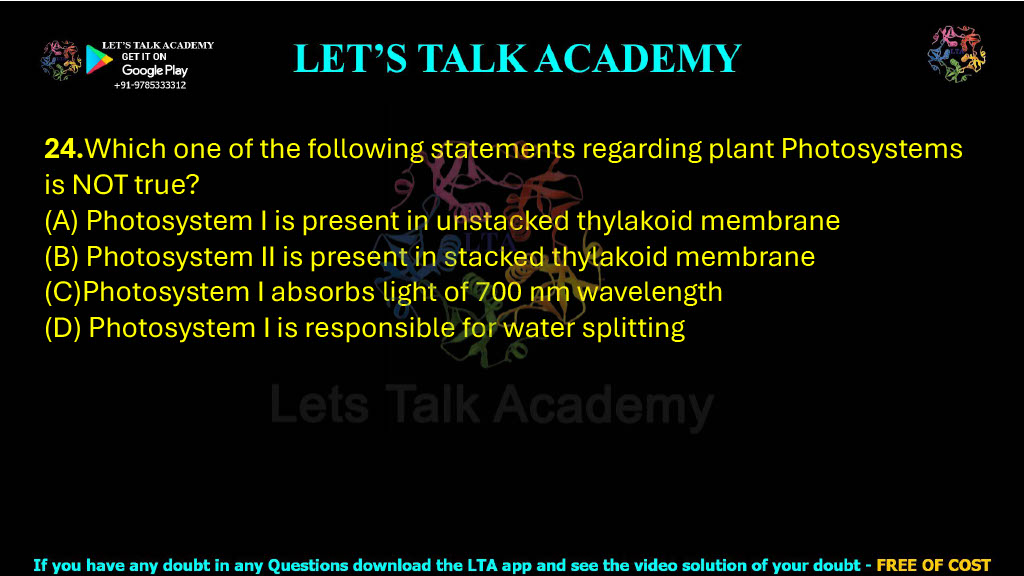
24.Which one of the following statements regarding plant Photosystems is NOT true?
(A) Photosystem I is present in unstacked thylakoid membrane
(B) Photosystem II is present in stacked thylakoid membrane
(C)Photosystem I absorbs light of 700 nm wavelength
(D) Photosystem I is responsible for water splitting
Plant Photosystems Explained: Photosystem I vs Photosystem II
Introduction
Photosynthesis is the fundamental biological process through which green plants convert solar energy into chemical energy. The light-dependent reactions of photosynthesis occur in the thylakoid membranes of chloroplasts, where two highly specialized pigment-protein complexes, known as Photosystem I (PSI) and Photosystem II (PSII), work together to capture light energy and drive electron transport. These photosystems are interconnected through the photosynthetic electron transport chain and are essential for ATP synthesis, NADPH formation, and oxygen evolution.
Although both photosystems participate in the light reactions, they perform distinct physiological functions and occupy different regions of the thylakoid membrane. Photosystem II initiates the electron transport chain by oxidizing water molecules, whereas Photosystem I ultimately reduces NADP+ to NADPH.
Correct Answer
Correct Option: (D) Photosystem I is responsible for water splitting
Detailed Explanation
During the light reactions of photosynthesis, the two photosystems perform different but complementary functions. Photosystem II (PSII) acts first in the electron transport chain. Its reaction center chlorophyll, known as P680, absorbs light most efficiently at approximately 680 nm. The energy absorbed by PSII is used to extract electrons from water molecules through the oxygen-evolving complex (OEC), also called the water-splitting complex. This reaction releases electrons, protons (H+), and molecular oxygen (O2).
The released electrons move through the electron transport chain toward Photosystem I (PSI). PSI contains the reaction center chlorophyll P700, which absorbs light most efficiently at approximately 700 nm. After absorbing light energy, PSI re-excites these electrons and transfers them to ferredoxin, ultimately reducing NADP+ into NADPH with the help of ferredoxin-NADP+ reductase.
The spatial distribution of these photosystems within the thylakoid membrane is also well organized. Photosystem II is predominantly located in the stacked grana thylakoids, whereas Photosystem I is primarily found in the unstacked stroma lamellae. Since water splitting occurs exclusively in Photosystem II, the statement that Photosystem I is responsible for water splitting is incorrect.
Explanation of Each Option
Option (A): Photosystem I is Present in Unstacked Thylakoid Membrane
This statement is correct. Photosystem I is mainly located in the unstacked regions of the thylakoid membrane, also called the stroma lamellae.
Option (B): Photosystem II is Present in Stacked Thylakoid Membrane
This statement is correct. Photosystem II is predominantly localized within the stacked grana thylakoid membranes, where the oxygen-evolving complex is also present.
Option (C): Photosystem I Absorbs Light of 700 nm Wavelength
This statement is correct. The reaction center chlorophyll of Photosystem I is designated P700 because it absorbs light most efficiently at a wavelength of approximately 700 nm.
Option (D): Photosystem I is Responsible for Water Splitting
This statement is incorrect. Water splitting occurs only in Photosystem II through the oxygen-evolving complex. Photosystem I functions in the reduction of NADP+ to NADPH and does not participate in photolysis of water.
Why Option (D) is Correct
The oxygen-evolving complex responsible for splitting water molecules is permanently associated with Photosystem II. Photosystem I receives electrons from the electron transport chain and transfers them to NADP+; it has no role in water oxidation.
Why the Other Options are Correct
Why Option (A) is Correct
Photosystem I is enriched in the unstacked stroma lamellae, facilitating efficient interaction with ferredoxin and ATP synthase.
Why Option (B) is Correct
Photosystem II is concentrated within grana membranes where the oxygen-evolving complex performs photolysis of water.
Why Option (C) is Correct
P700 is the specialized chlorophyll molecule that serves as the reaction center of Photosystem I and absorbs light at approximately 700 nm.
Comparison of All Options
| Option | Statement | Correct or Incorrect |
|---|---|---|
| A | Photosystem I is present in unstacked thylakoid membrane | Correct |
| B | Photosystem II is present in stacked thylakoid membrane | Correct |
| C | Photosystem I absorbs light of 700 nm wavelength | Correct |
| D | Photosystem I is responsible for water splitting | Incorrect (Correct Answer) |
Comparison Between Photosystem I and Photosystem II
| Feature | Photosystem I (PSI) | Photosystem II (PSII) |
|---|---|---|
| Reaction Center | P700 | P680 |
| Maximum Absorption | 700 nm | 680 nm |
| Main Location | Unstacked stroma lamellae | Stacked grana thylakoids |
| Primary Function | Reduction of NADP+ to NADPH | Water splitting and electron generation |
| Oxygen Evolution | No | Yes |
Major Events During the Light Reaction
| Step | Major Event |
|---|---|
| 1 | Light excites Photosystem II |
| 2 | Water molecules split into electrons, protons, and oxygen |
| 3 | Electrons move through the electron transport chain |
| 4 | ATP is synthesized through photophosphorylation |
| 5 | Photosystem I absorbs light and re-excites electrons |
| 6 | NADP+ is reduced to NADPH |
Functions of the Two Photosystems
| Photosystem | Primary Role |
|---|---|
| Photosystem II | Initiates electron transport by splitting water and releasing oxygen |
| Photosystem I | Produces NADPH for the Calvin cycle |
Biological Significance
The coordinated activity of Photosystem II and Photosystem I ensures efficient conversion of light energy into chemical energy. Photosystem II provides electrons by oxidizing water and releases oxygen as a by-product, making aerobic life possible on Earth. Photosystem I uses these electrons to generate NADPH, which together with ATP drives carbon fixation during the Calvin cycle. The functional separation of the two photosystems greatly enhances photosynthetic efficiency and energy conversion.
Final Answer
Correct Option: (D) Photosystem I is responsible for water splitting
Water splitting occurs exclusively in Photosystem II through the oxygen-evolving complex (OEC). Photosystem I is responsible for the reduction of NADP+ to NADPH and is not involved in the photolysis of water.


