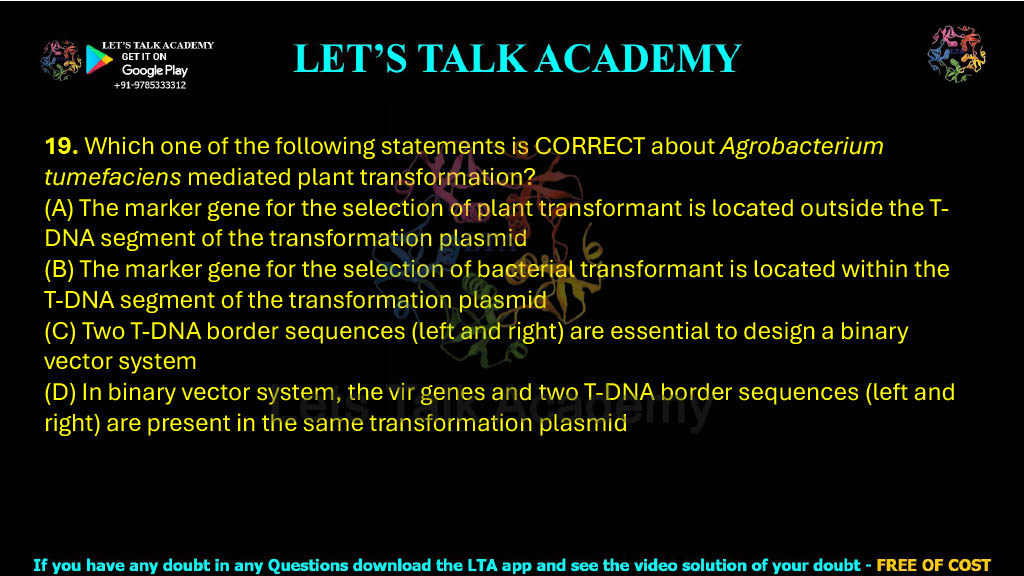
19. Which one of the following statements is CORRECT about Agrobacterium tumefaciens mediated plant transformation?
(A) The marker gene for the selection of plant transformant is located outside the T-DNA segment of the transformation plasmid
(B) The marker gene for the selection of bacterial transformant is located within the T-DNA segment of the transformation plasmid
(C) Two T-DNA border sequences (left and right) are essential to design a binary vector system
(D) In binary vector system, the vir genes and two T-DNA border sequences (left and right) are present in the same transformation plasmid
Agrobacterium tumefaciens-Mediated Plant Transformation Explained | Binary Vector System
Introduction
Agrobacterium tumefaciens is a soil bacterium that has become one of the most powerful tools in modern plant biotechnology. This bacterium naturally transfers a specific DNA segment called Transfer DNA (T-DNA) from its Tumor-inducing (Ti) plasmid into plant cells, where the transferred DNA becomes integrated into the plant genome. Scientists have exploited this natural gene transfer mechanism to introduce desirable genes into plants, making Agrobacterium-mediated transformation one of the most widely used methods for producing transgenic crops.
Modern plant transformation employs a binary vector system, in which the functions required for DNA transfer are divided between two separate plasmids. The T-DNA region, carrying the gene of interest and plant selectable marker, is located on a small binary vector, while the virulence (vir) genes, responsible for processing and transferring the T-DNA, remain on a separate helper plasmid within Agrobacterium. This design simplifies cloning while maintaining efficient DNA transfer into plant cells.
Correct Answer
Correct Option: (C) Two T-DNA border sequences (left and right) are essential to design a binary vector system.
Detailed Explanation
In an Agrobacterium-mediated binary vector system, the DNA segment that is transferred into the plant genome is known as the T-DNA. This T-DNA must be flanked by two specific sequences known as the Left Border (LB) and the Right Border (RB). These border sequences serve as recognition sites for the Vir proteins, which excise the T-DNA and mediate its transfer into the plant cell. Without both border sequences, efficient T-DNA transfer cannot occur.
The T-DNA region normally contains the gene of interest together with a plant selectable marker gene, such as resistance to kanamycin or hygromycin. These marker genes enable researchers to identify transformed plant cells after DNA transfer. In contrast, genes required only for bacterial selection, such as bacterial antibiotic resistance genes, remain outside the T-DNA because they are not intended to integrate into the plant genome.
The vir genes are not located within the binary vector carrying the T-DNA. Instead, they are located on a separate disarmed helper Ti plasmid inside Agrobacterium. These vir genes produce proteins that recognize the border sequences, process the T-DNA, and transport it into the plant nucleus.
Therefore, the statement that both left and right T-DNA border sequences are essential components of a binary vector is scientifically correct.
Explanation of Each Option
Option (A): Marker Gene for Plant Selection is Located Outside the T-DNA
This statement is incorrect. The plant selectable marker must be located inside the T-DNA because only the DNA enclosed between the left and right border sequences is transferred into the plant genome.
Option (B): Marker Gene for Bacterial Selection is Located Within the T-DNA
This statement is incorrect. Bacterial selectable markers remain outside the T-DNA because they are required only for bacterial cloning and plasmid maintenance, not for plant transformation.
Option (C): Two T-DNA Border Sequences are Essential for Binary Vector Design
This statement is correct. Both the left border (LB) and right border (RB) sequences are indispensable because they define the DNA region transferred into the plant genome.
Option (D): Vir Genes and T-DNA Borders are Present in the Same Transformation Plasmid
This statement is incorrect. In a binary vector system, the vir genes are located on a separate helper Ti plasmid, while the T-DNA borders are present on the binary vector carrying the gene of interest.
Why Option (C) is Correct
The binary vector functions only because the T-DNA is flanked by Left Border (LB) and Right Border (RB) sequences. These border sequences are recognized by Vir proteins, allowing precise excision and transfer of the T-DNA into plant cells. Their presence is therefore essential for successful genetic transformation.
Why the Other Options are Incorrect
Why Option (A) is Incorrect
The plant selectable marker must lie inside the T-DNA so that transformed plant cells acquire the selectable trait.
Why Option (B) is Incorrect
Bacterial selectable markers are useful only during plasmid cloning in bacteria and therefore remain outside the transferred T-DNA.
Why Option (D) is Incorrect
The defining feature of the binary vector system is the separation of vir genes and the T-DNA region onto two different plasmids.
Comparison of All Options
| Option | Statement | Correct or Incorrect |
|---|---|---|
| A | Plant selectable marker lies outside T-DNA | Incorrect |
| B | Bacterial selectable marker lies within T-DNA | Incorrect |
| C | Left and right T-DNA borders are essential | Correct |
| D | Vir genes and T-DNA borders are present on the same plasmid | Incorrect |
Components of a Binary Vector System
| Component | Function |
|---|---|
| Left Border (LB) | Marks one end of the transferable T-DNA |
| Right Border (RB) | Initiates T-DNA transfer |
| Gene of Interest | Desired trait introduced into the plant |
| Plant Selectable Marker | Selects transformed plant cells |
| Bacterial Selectable Marker | Selects transformed bacteria during cloning |
Location of Important Components
| Component | Location |
|---|---|
| T-DNA | Binary vector |
| Gene of Interest | Within T-DNA |
| Plant Marker Gene | Within T-DNA |
| Vir Genes | Helper Ti plasmid |
| Bacterial Marker Gene | Outside T-DNA |
Steps in Agrobacterium-Mediated Transformation
| Step | Process |
|---|---|
| 1 | Construction of binary vector |
| 2 | Introduction into Agrobacterium |
| 3 | Recognition of wounded plant tissue |
| 4 | Activation of vir genes |
| 5 | T-DNA excision and transfer |
| 6 | Integration into plant genome |
| 7 | Selection and regeneration of transformed plants |
Biological Significance
Agrobacterium-mediated transformation is one of the most efficient methods for producing genetically modified plants because it allows stable integration of foreign DNA with relatively low copy numbers and minimal genome disruption. The binary vector system simplifies genetic engineering by separating DNA transfer functions from cloning functions, making it easier to introduce disease resistance, insect resistance, herbicide tolerance, nutritional enhancement, and stress tolerance into crop plants.
Final Answer
Correct Option: (C) Two T-DNA border sequences (left and right) are essential to design a binary vector system.
The left border (LB) and right border (RB) sequences define the T-DNA region that is transferred into the plant genome. They are indispensable components of the binary vector because the Vir proteins recognize these border sequences during Agrobacterium-mediated DNA transfer.


