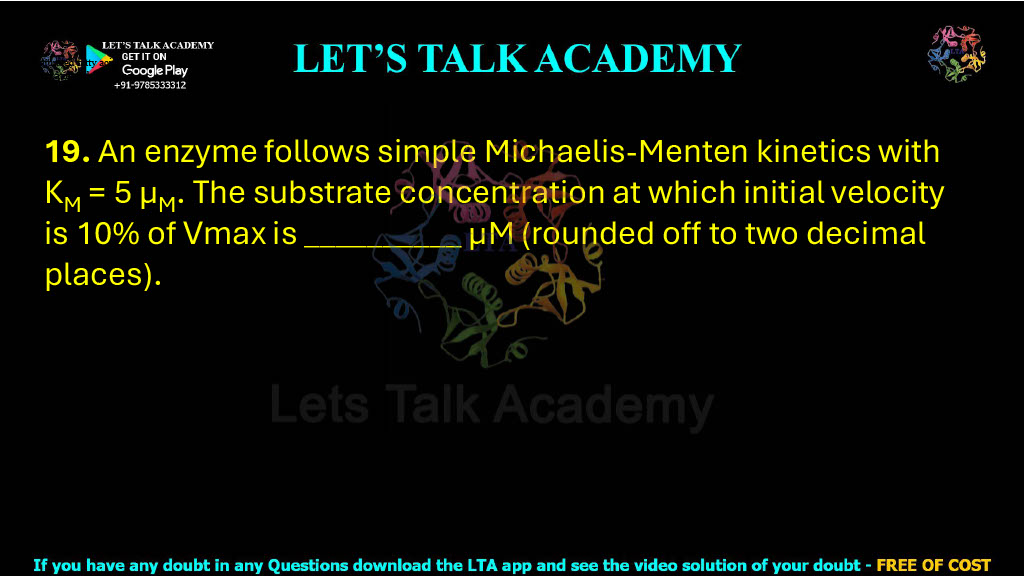
19. An enzyme follows simple Michaelis-Menten kinetics with KM = 5 μM. The substrate concentration at which initial velocity is 10% of Vmax is __________ μM (rounded off to two decimal places).
Substrate Concentration When Initial Velocity Is 10% of Vmax | Complete Michaelis–Menten Numerical Solution
Correct Answer
0.56 μM
Introduction
Enzyme kinetics is one of the most fundamental topics in biochemistry because it explains how enzymes catalyze biochemical reactions and how reaction rates change with substrate concentration. The Michaelis–Menten equation provides a mathematical relationship between substrate concentration and reaction velocity, enabling scientists to determine important kinetic parameters such as Vmax and Kₘ.
Most students remember the special condition that when substrate concentration equals Kₘ, the reaction velocity becomes half of Vmax. However, competitive examinations often present different percentages of Vmax, such as 10%, 25%, or 90%, requiring direct application of the Michaelis–Menten equation. Understanding the derivation rather than memorizing formulas allows these problems to be solved quickly and accurately.
Understanding the Concept Behind the Question
The relationship between substrate concentration and reaction velocity is described by the Michaelis–Menten equation:
v = (Vmax × [S]) / (Kₘ + [S])
where:
- v = Initial reaction velocity
- Vmax = Maximum reaction velocity
- [S] = Substrate concentration
- Kₘ = Michaelis constant
The question states that the enzyme follows simple Michaelis–Menten kinetics, indicating that this equation can be applied directly. It also specifies that the reaction velocity is 10% of Vmax, which means:
v = 0.1 Vmax
The objective is to calculate the corresponding substrate concentration.
Step-by-Step Solution
Step 1: Write the Michaelis–Menten Equation
v = (Vmax × [S]) / (Kₘ + [S])
Step 2: Substitute the Given Values
Since the velocity is 10% of Vmax,
0.1 Vmax = (Vmax × [S]) / (Kₘ + [S])
Given:
Kₘ = 5 μM
Substitute Kₘ into the equation:
0.1 Vmax = (Vmax × [S]) / (5 + [S])
Step 3: Cancel Vmax from Both Sides
Since Vmax appears on both sides,
0.1 = [S] / (5 + [S])
This simplifies the equation considerably.
Step 4: Cross Multiply
Multiply both sides by (5 + [S])
0.1(5 + [S]) = [S]
Expand the left-hand side:
0.5 + 0.1[S] = [S]
Step 5: Rearrange the Equation
Move 0.1[S] to the right-hand side:
0.5 = [S] − 0.1[S]
0.5 = 0.9[S]
Step 6: Calculate the Substrate Concentration
[S] = 0.5 / 0.9
[S] = 0.5556 μM
Rounded to two decimal places,
[S] = 0.56 μM
Final Answer
Substrate Concentration = 0.56 μM
Why Is the Substrate Concentration Much Smaller Than Kₘ?
The Michaelis constant (Kₘ = 5 μM) represents the substrate concentration at which the reaction velocity reaches 50% of Vmax. In this question, the reaction velocity is only 10% of Vmax, which is much lower than half of the maximum velocity.
Since enzyme velocity is directly related to substrate concentration at low substrate levels, achieving only 10% of the maximum velocity requires a substrate concentration that is significantly lower than Kₘ. Therefore, obtaining a value of 0.56 μM, which is much smaller than 5 μM, is completely consistent with Michaelis–Menten kinetics.
Biological Significance of the Michaelis Constant (Kₘ)
The Michaelis constant is one of the most important parameters in enzyme kinetics because it reflects the substrate concentration required for an enzyme to operate at half of its maximum catalytic capacity. Although Kₘ is often interpreted as an indicator of enzyme-substrate affinity, this interpretation is most accurate for enzymes that obey classical Michaelis–Menten behavior.
Enzymes with a low Kₘ require only small amounts of substrate to achieve significant catalytic activity, whereas enzymes with a high Kₘ require much higher substrate concentrations. This characteristic allows cells to regulate metabolic pathways efficiently according to substrate availability.
Relationship Between Substrate Concentration and Reaction Velocity
The Michaelis–Menten equation demonstrates that reaction velocity increases rapidly at low substrate concentrations but gradually approaches a maximum value as enzyme active sites become saturated.
| Substrate Concentration | Initial Velocity |
|---|---|
| [S] << Kₘ | Nearly proportional to substrate concentration |
| [S] = 0.56 μM | 0.1 Vmax |
| [S] = Kₘ (5 μM) | 0.5 Vmax |
| [S] >> Kₘ | Approaches Vmax |
This relationship explains why relatively small increases in substrate concentration produce large changes in velocity when substrate levels are much lower than Kₘ.
Common Mistakes in Competitive Examinations
A common mistake is assuming that 10% of Vmax means 10% of Kₘ, leading students to calculate 0.5 μM directly. This approach is incorrect because the Michaelis–Menten relationship is non-linear.
Another frequent error is forgetting to cancel Vmax from both sides of the equation before solving. Retaining unnecessary terms often complicates the calculation and increases the likelihood of algebraic mistakes.
Some students also substitute 10 instead of 0.1 for 10% of Vmax. Percentages must always be converted into decimal form before using the Michaelis–Menten equation.
High-Yield Exam Points
-
Michaelis–Menten equation:
v = (Vmax × [S]) / (Kₘ + [S])
-
When [S] = Kₘ, then:
v = 0.5 Vmax
-
For this problem:
v = 0.1 Vmax
-
Given:
Kₘ = 5 μM
-
Calculated substrate concentration:
0.56 μM
Frequently Asked Questions
Why is the substrate concentration smaller than Kₘ?
Because the reaction velocity is only 10% of Vmax, which is much lower than the 50% of Vmax observed at [S] = Kₘ. Therefore, a much lower substrate concentration is required.
Can this problem be solved without memorizing formulas?
Yes. Simply substitute the given values into the Michaelis–Menten equation and solve step by step. No additional formulas are required.
Does every enzyme follow Michaelis–Menten kinetics?
No. Many allosteric enzymes display sigmoidal kinetics and do not obey the Michaelis–Menten equation. However, the question explicitly states that the enzyme follows simple Michaelis–Menten kinetics, making the equation applicable.
Key Takeaways
The Michaelis–Menten equation provides a direct relationship between substrate concentration and reaction velocity. In this problem, the enzyme has a Kₘ of 5 μM, and the initial velocity is 10% of Vmax. Substituting these values into the Michaelis–Menten equation and solving algebraically yields a substrate concentration of 0.56 μM. This result illustrates that enzyme velocity is highly sensitive to substrate concentration when substrate levels are much lower than Kₘ, a principle that forms the basis of enzyme kinetics and metabolic regulation.
Final Answer
Correct Answer: 0.56 μM
Explanation
For an enzyme following Michaelis–Menten kinetics, the reaction velocity is given by:
v = (Vmax × [S]) / (Kₘ + [S])
Since the initial velocity is 10% of Vmax, v = 0.1 Vmax. Substituting this value along with Kₘ = 5 μM into the equation gives:
0.1 = [S] / (5 + [S])
Solving the equation,
0.5 + 0.1[S] = [S] = 0.9[S]
[S] = 0.5556 μM
Rounded to two decimal places, the substrate concentration is 0.56 μM.


