
Stabilizing Interactions: Van der Waals Interactions
Introduction
Biological molecules do not maintain their three-dimensional structures through covalent bonds alone. A large part of the organization, folding, stability, recognition, and interaction of biomolecules depends on a variety of non-covalent interactions. These interactions are individually weaker than covalent bonds, but their combined effect can be extremely important in biological systems.
One of the most important stabilizing interactions found between atoms and molecules is the van der Waals interaction.
Van der Waals interactions are weak, short-range, non-covalent interactions that arise because of fluctuations or distributions of electrical charge around atoms and molecules. Although an individual van der Waals interaction contributes only a small amount of energy, thousands of such contacts can collectively make a significant contribution to the stability of proteins, nucleic acids, lipid assemblies, and biomolecular complexes.
In proteins, van der Waals interactions are particularly important because the folded structure brings many atoms into close proximity. Proper packing of atoms in the interior of a protein allows numerous favorable van der Waals contacts to form and contributes to the overall stability of the folded state.
It is important to understand not only the definition of van der Waals interactions but also their origin, types, distance dependence, attractive and repulsive components, role in protein folding, and relationship with molecular recognition.
1. What Are Van der Waals Interactions?
Van der Waals interactions are weak, non-covalent interactions that occur between atoms or molecules because of electrostatic interactions associated with permanent, induced, or instantaneous dipoles.
These interactions can occur even between atoms or molecules that do not possess a permanent charge.
A simple way to understand this is to imagine an electrically neutral atom. Although its total charge is zero, its electrons are continuously moving. At any particular instant, the electron distribution may become slightly uneven, producing a temporary separation of charge.
This temporary separation can influence a neighboring atom and induce a corresponding dipole. The two atoms can then experience an attractive interaction.
Thus, van der Waals interactions are closely associated with the behavior and distribution of electrons.
Key Features
Van der Waals interactions are:
- Non-covalent
- Relatively weak individually
- Short-range
- Distance-dependent
- Important between closely packed atoms
- Important in protein structure and molecular recognition
- Effective even between electrically neutral atoms
- Cumulative when many interactions occur simultaneously
The combined effect of many weak interactions can significantly influence biomolecular stability.
2. Origin of Van der Waals Interactions
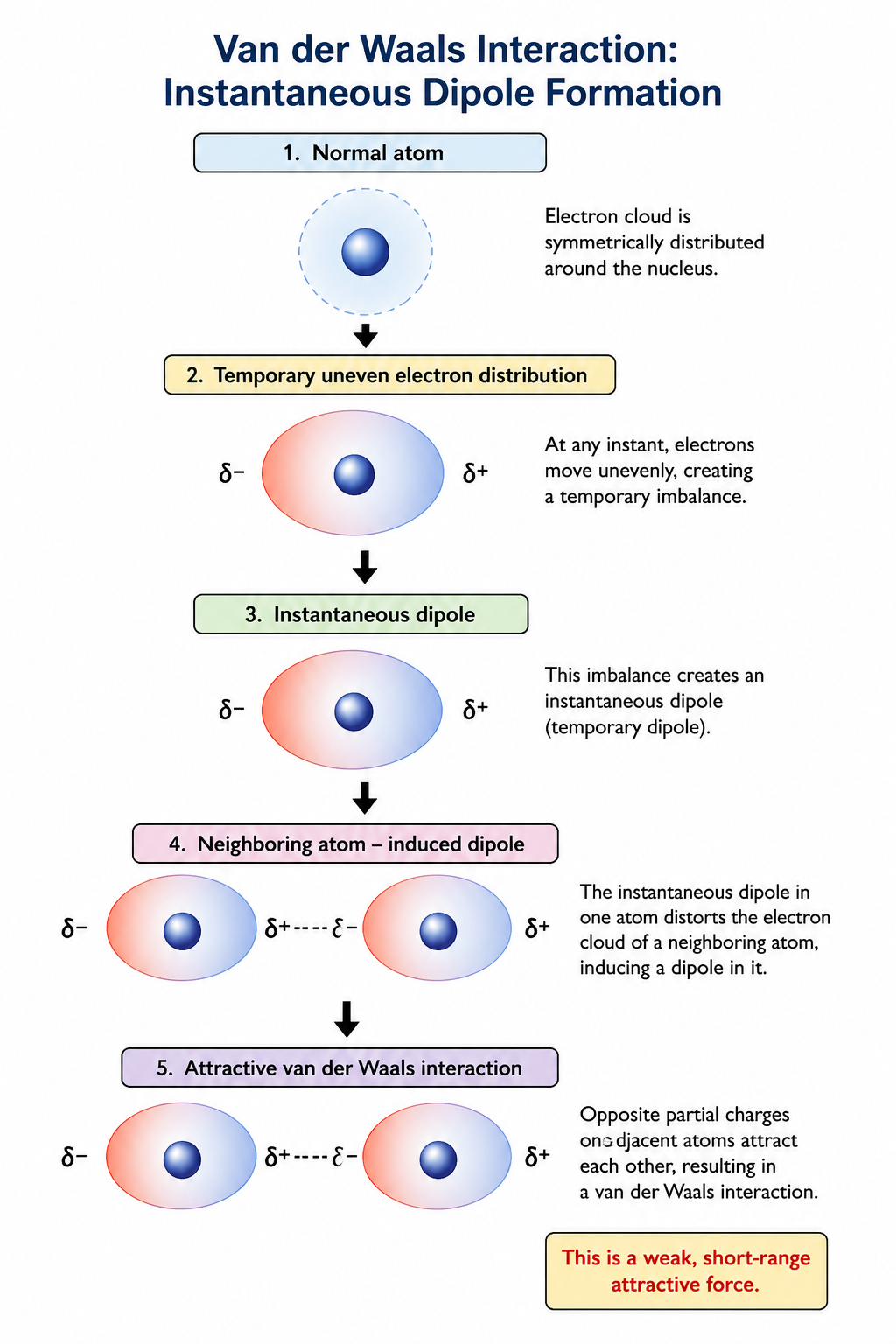
The origin of van der Waals interactions can be understood from the distribution of electrons around atoms.
An atom contains a positively charged nucleus surrounded by negatively charged electrons. In an isolated atom, the average electron distribution may be symmetrical. However, electrons are constantly moving.
At a particular instant, the electron cloud may become temporarily displaced relative to the nucleus.
This produces an instantaneous dipole.
The instantaneous dipole can then cause a neighboring atom to develop an induced dipole. The resulting attraction between the two atoms is called a London dispersion interaction.
Therefore:
Fluctuation in electron distribution
↓
Instantaneous dipole formation
↓
Induction of dipole in neighboring atom
↓
Attractive interaction
↓
Van der Waals stabilization
This phenomenon is especially important for atoms that are close to one another.
3. Major Types of Van der Waals Interactions
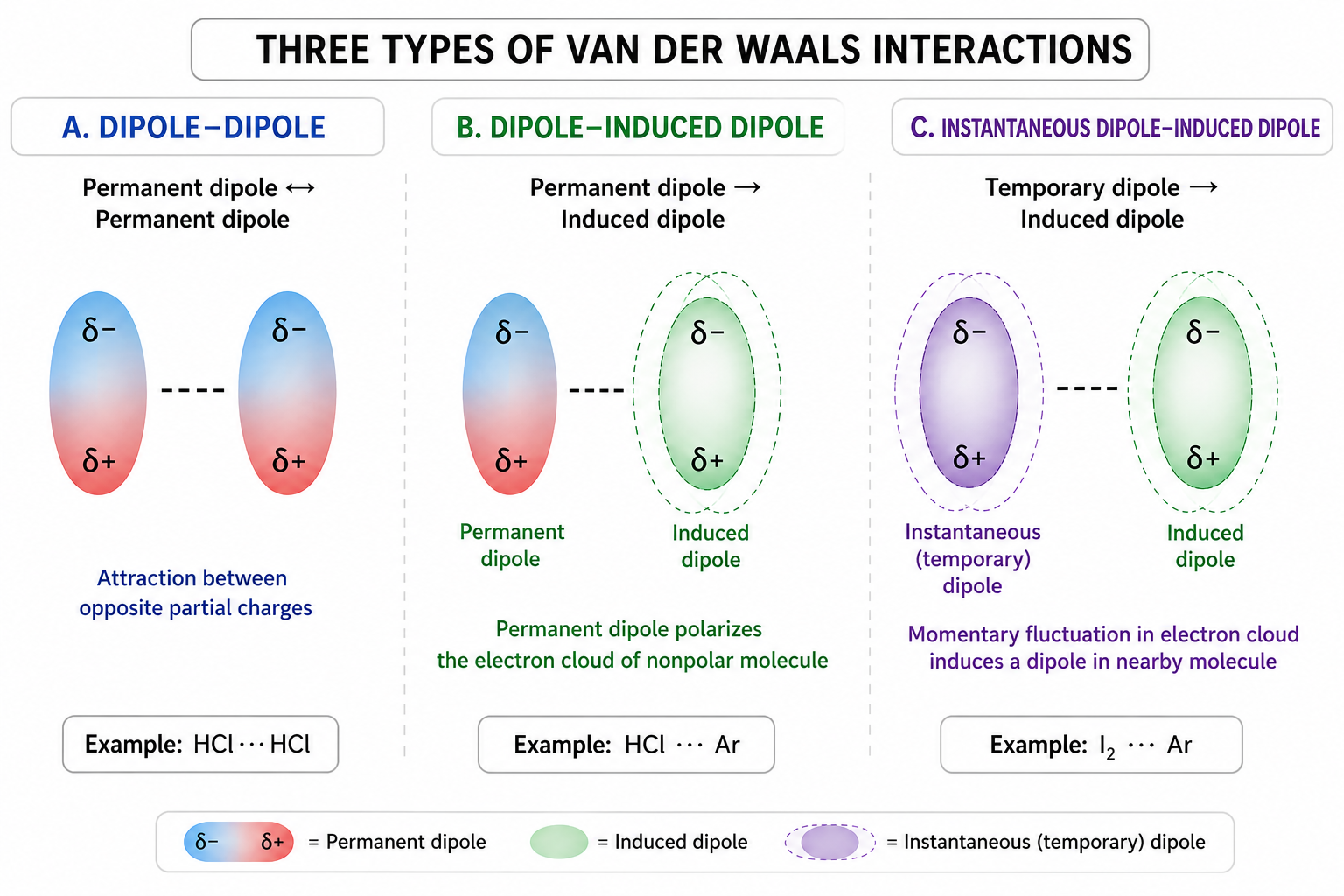
Van der Waals interactions are commonly discussed in terms of three major types of dipole-related interactions:
3.1 Dipole–Dipole Interaction
A molecule possessing a permanent dipole has a partial positive end and a partial negative end.
When two such molecules approach each other, the opposite partial charges can attract one another.
For example:
δ+ — A — δ−
may interact with
δ+ — B — δ−
in an orientation that places opposite partial charges close together.
Dipole–dipole interactions are therefore associated with permanent dipoles.
3.2 Dipole–Induced Dipole Interaction
A permanent dipole in one molecule can influence the electron distribution of a neighboring nonpolar molecule.
The permanent dipole causes polarization of the neighboring molecule and induces a dipole in it.
Therefore:
Permanent dipole
↓
Polarization of neighboring molecule
↓
Induced dipole
↓
Attractive interaction
This interaction is particularly relevant when polar molecules come into contact with otherwise nonpolar atoms or molecules.
3.3 Instantaneous Dipole–Induced Dipole Interaction
This interaction is also known as a London dispersion interaction.
It results from temporary fluctuations in electron distribution.
Even a nonpolar atom can momentarily develop an uneven electron distribution.
The temporary dipole then induces a dipole in a neighboring atom.
This produces attraction between the atoms.
London dispersion forces are particularly important in biological systems because essentially all atoms can participate in these interactions.
4. London Dispersion Forces
Among van der Waals interactions, London dispersion forces are particularly important for biomolecular systems.
They arise from temporary fluctuations in electron density.
Even atoms without permanent dipoles can therefore participate in van der Waals interactions.
The basic sequence is:
Electron fluctuation
↓
Instantaneous dipole
↓
Induced dipole in neighboring atom
↓
Attraction
The magnitude of dispersion interactions depends on factors such as the polarizability of the interacting atoms and the distance between them.
In biological macromolecules, a very large number of such interactions can occur simultaneously. Consequently, although an individual interaction is weak, the cumulative contribution can be substantial.
5. Attractive and Repulsive Components
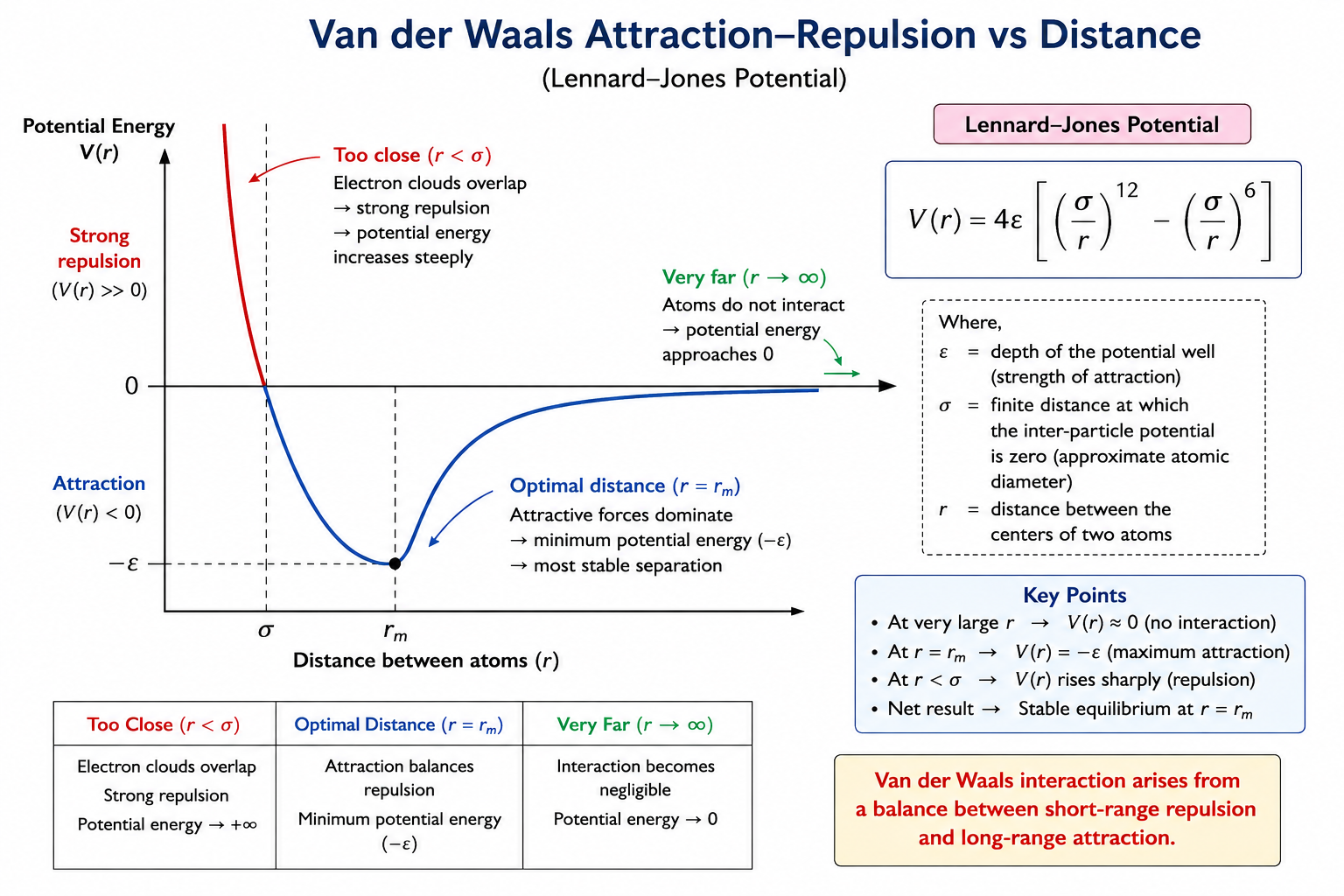
At relatively appropriate distances, atoms experience an attractive interaction.
However, when two atoms are pushed extremely close together, a strong repulsive interaction develops.
This happens because the electron clouds begin to overlap excessively. The resulting repulsion is associated with the quantum-mechanical restrictions described by the Pauli exclusion principle.
Therefore, the van der Waals potential contains two competing components:
Attractive component
and
Repulsive component
The balance between these components determines the preferred distance between atoms.
6. Distance Dependence of Van der Waals Interactions
Van der Waals interactions are highly dependent on the distance between two atoms.
When atoms are relatively far apart, the interaction becomes very weak.
As the atoms approach one another, the attractive interaction increases.
However, if they become too close, repulsion rises extremely rapidly.
Thus, there is an optimal distance at which the attractive contribution is favorable without excessive repulsion.
This distance is commonly associated with the van der Waals contact distance.
A simplified representation is:
Too far apart
→ Very weak interaction
Appropriate distance
→ Favorable attraction
Too close
→ Strong electron-cloud repulsion
This distance dependence is extremely important for understanding protein packing.
7. Lennard-Jones Potential
The attractive and repulsive components of van der Waals interactions are often represented using the Lennard-Jones potential.
A commonly used form is:
V(r) = 4ε [(σ/r)¹² − (σ/r)⁶]
where:
- V(r) = potential energy
- r = distance between the interacting atoms
- ε = depth of the potential well
- σ = characteristic distance related to the atomic size
The two terms have different physical origins.
Repulsive Term
(σ/r)¹²
This term becomes extremely large when atoms are brought very close together.
It represents the strong short-range repulsion associated with electron-cloud overlap.
Attractive Term
−(σ/r)⁶
This term represents the attractive dispersion component.
Because the attractive term decreases approximately as 1/r⁶, the interaction becomes rapidly weaker as the distance increases.
8. Why Does the Repulsive Term Increase So Rapidly?
The repulsive component is commonly represented by an r⁻¹² dependence in the Lennard-Jones potential.
This does not mean that the actual quantum-mechanical repulsion is fundamentally an exact r⁻¹² law.
Rather, the r⁻¹² term is a convenient mathematical approximation used to model the very steep repulsive potential at short distances.
r⁻⁶ → attractive dispersion component
r⁻¹² → repulsive component in the Lennard-Jones model
Therefore, if a question asks which term represents electron-shell repulsion in the standard Lennard-Jones equation, the answer is the r⁻¹² term.
9. Van der Waals Radius
The van der Waals radius is a measure of the effective size of an atom when it is not covalently bonded to another atom.
It represents the approximate distance from the nucleus at which the electron cloud effectively prevents another atom from approaching further without strong repulsion.
When two non-bonded atoms are in favorable contact, their van der Waals radii provide an approximate description of the preferred separation.
Thus:
van der Waals contact distance ≈ sum of appropriate van der Waals radii
This concept is particularly important in structural biology because molecular structures depend on the spatial packing of atoms.
10. Role of Van der Waals Interactions in Protein Structure
Van der Waals interactions are important contributors to protein structure and stability.
When a polypeptide folds, atoms that may have been far apart in the primary sequence can become spatially close.
The folded protein therefore contains a large number of atomic contacts.
If the atoms are positioned at favorable distances, many van der Waals interactions can develop.
The cumulative effect contributes to the stabilization of the folded structure.
Protein Folding Sequence
Unfolded polypeptide
↓
Folding and collapse
↓
Atoms approach one another
↓
Proper packing of side chains
↓
Formation of numerous favorable non-covalent interactions
↓
Stable three-dimensional structure
Van der Waals interactions therefore help the protein achieve an energetically favorable packing arrangement.
11. Van der Waals Interactions in the Hydrophobic Core of Proteins
The interior of many globular proteins contains numerous nonpolar amino acid side chains.
Examples include residues containing:
- Valine
- Leucine
- Isoleucine
- Phenylalanine
- Methionine
- Tryptophan
These side chains can pack closely together.
Close packing allows many van der Waals contacts to form.
However, an important conceptual distinction must be made:
Hydrophobic effect ≠ van der Waals interaction
The hydrophobic effect is largely related to the behavior of water and the thermodynamics of burying nonpolar surfaces, whereas van der Waals interactions arise from interactions between electron distributions.
Both can contribute to protein stability, but they should not be treated as identical forces.
12. Van der Waals Interactions and Protein Packing
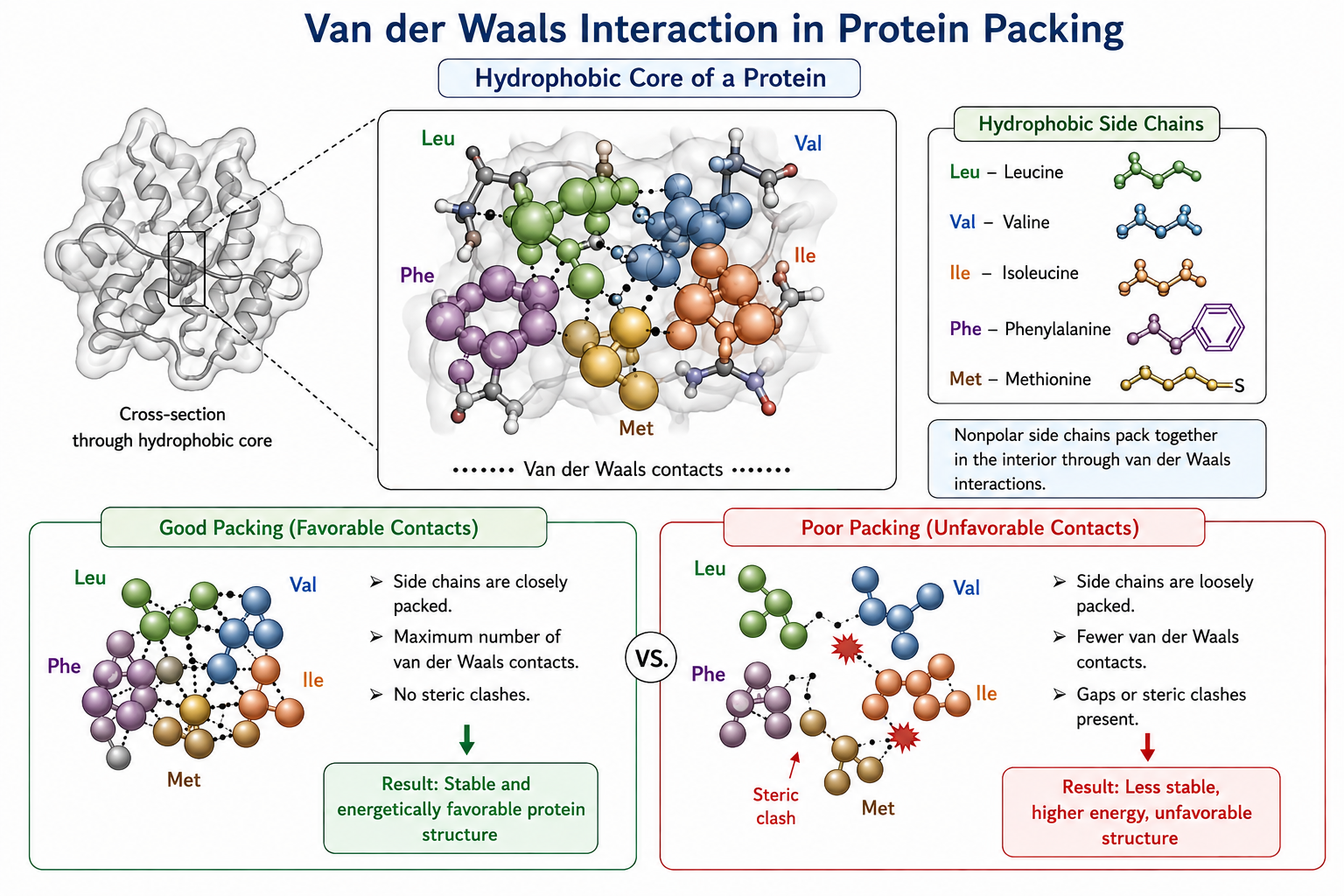
Protein stability depends strongly on how efficiently atoms are packed within the folded structure.
If atoms are too far apart, favorable van der Waals contacts may be lost.
If atoms are excessively close, steric repulsion becomes unfavorable.
Therefore, a properly folded protein maintains an appropriate balance between attraction and repulsion.
This produces a highly organized molecular structure.
Important Concept
Good packing
→ More favorable contacts
→ Reduced empty space
→ Favorable van der Waals interactions
→ Greater structural stability
Poor packing can produce unfavorable interactions and destabilize the structure.
13. Role in Molecular Recognition
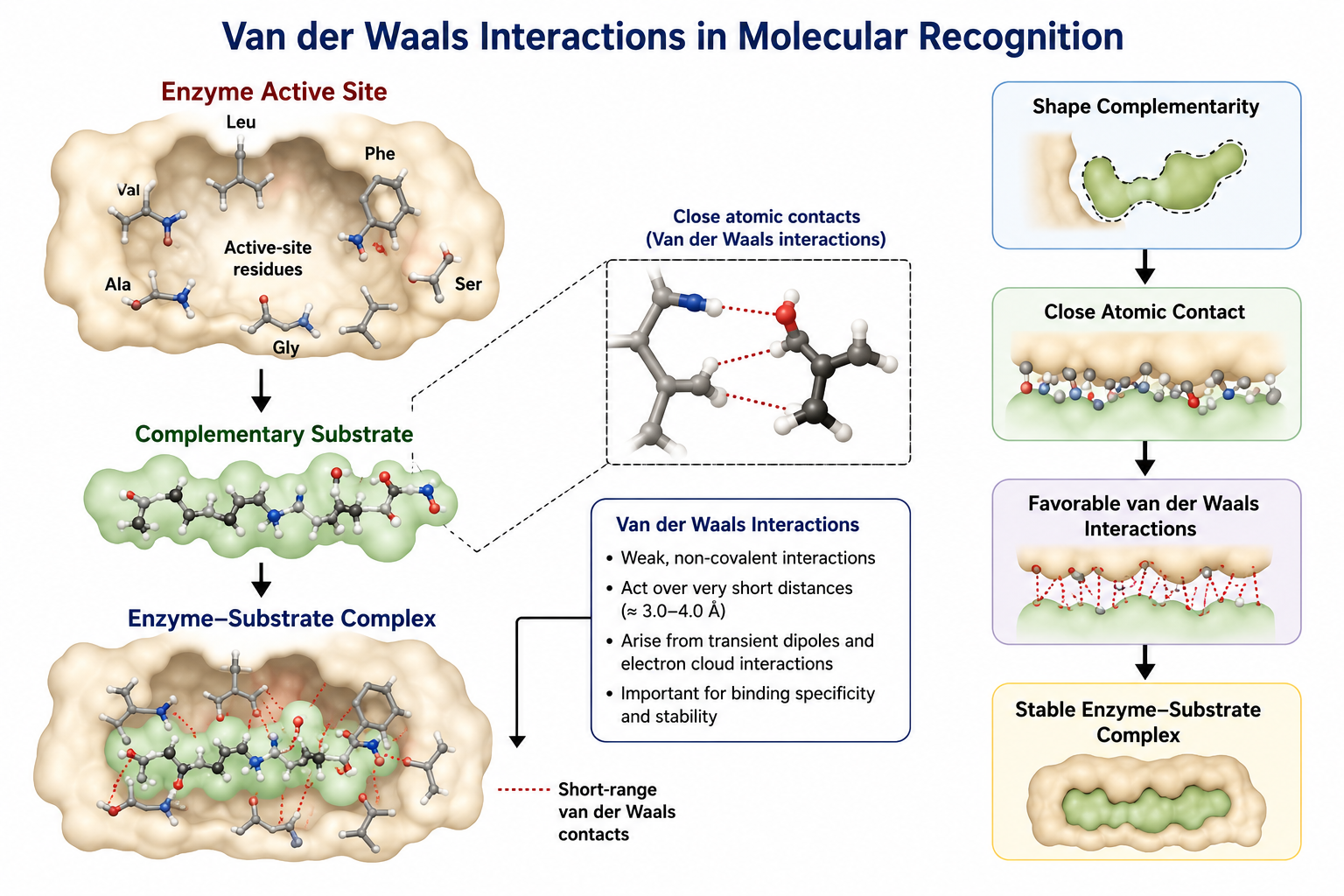
Van der Waals interactions are also important in molecular recognition.
Biological molecules often recognize one another through complementary shape and chemical properties.
For example, an enzyme and its substrate must approach each other in a manner that allows favorable interactions to form.
Similarly, receptors recognize ligands through a combination of:
- Hydrogen bonds
- Electrostatic interactions
- Hydrophobic interactions
- Van der Waals interactions
- Other non-covalent interactions
Van der Waals contacts are particularly important when the surfaces of interacting molecules fit closely together.
Thus, molecular recognition depends not simply on chemical groups but also on three-dimensional complementarity.
14. Van der Waals Interactions in Enzyme–Substrate Binding
An enzyme active site contains amino acid residues arranged in a specific three-dimensional environment.
When a substrate enters the active site, atoms of the substrate come into close proximity with atoms of the enzyme.
If the substrate has a complementary shape, numerous favorable contacts can form.
Van der Waals interactions can therefore contribute to:
Enzyme–substrate recognition
Binding affinity
Correct orientation of the substrate
Stabilization of the enzyme–substrate complex
However, van der Waals interactions generally act together with other forces rather than functioning independently.
15. Van der Waals Interactions in Protein–Protein Interactions
Protein–protein interactions also depend on complementary surfaces.
When two proteins interact, the contact surfaces can contain many atoms positioned close to one another.
The cumulative effect of these interactions can contribute to binding.
A complementary interface generally permits more favorable atomic contacts than an incompatible interface.
Therefore:
Shape complementarity
↓
Close atomic contact
↓
Favorable van der Waals interactions
↓
Contribution to protein–protein association
The overall binding process also depends on electrostatic interactions, hydrogen bonds, hydrophobic effects, solvent effects, and conformational changes.
16. Van der Waals Interactions in Nucleic Acids
Van der Waals interactions are also present in nucleic acids.
They can contribute to the stability and packing of DNA and RNA structures.
In nucleic acids, atoms within the sugar-phosphate backbone and nitrogenous bases can form numerous close contacts.
In addition, interactions involving aromatic bases can contribute to the organization of nucleic acid structures.
Therefore, nucleic acid stability is determined by a combination of:
- Hydrogen bonding
- Base stacking
- Electrostatic interactions
- Hydration
- Van der Waals interactions
- Ionic interactions
The exact contribution of each interaction depends on the structural context.
17. Van der Waals Interactions and Base Stacking
DNA and RNA bases contain aromatic ring systems.
Adjacent bases can stack on one another, producing favorable interactions that contribute to nucleic acid structure.
Although base stacking should not be described simply as a single type of force, van der Waals dispersion interactions contribute to the stabilization of closely packed bases.
Therefore, in nucleic acids, base stacking involves a combination of:
Dispersion interactions
Electrostatic contributions
Hydrophobic effects
and
π-related interactions
This is particularly relevant when analyzing the stability of DNA and RNA structures.
18. Van der Waals Interactions in Lipid Membranes
Van der Waals interactions also contribute to the organization of lipid molecules.
The hydrocarbon chains of membrane lipids can come into close contact.
Close packing of these chains allows weak attractive interactions between neighboring atoms.
However, membrane organization is not controlled by van der Waals interactions alone.
Other major factors include:
- Hydrophobic effect
- Electrostatic interactions
- Hydrogen bonding
- Lipid composition
- Temperature
- Degree of fatty acid unsaturation
The combined balance of these factors influences membrane structure and fluidity.
19. Van der Waals Interactions and Drug–Receptor Binding
Drug molecules interact with receptor or enzyme binding sites through multiple non-covalent forces.
Van der Waals interactions can contribute significantly when the drug fits closely into a binding pocket.
A drug molecule with a complementary shape can establish numerous close contacts with amino acid residues.
Therefore, even though each individual van der Waals interaction is weak, their cumulative contribution may influence binding affinity.
This principle is important in:
Drug discovery
Structure-based drug design
Molecular docking
Protein–ligand interaction analysis
Pharmacology
20. Strength of Van der Waals Interactions
An individual van der Waals interaction is relatively weak compared with a covalent bond.
However, strength should not be considered only on a single-interaction basis.
A protein can contain a very large number of van der Waals contacts.
Therefore:
Weak interaction × many contacts = significant cumulative stabilization
This is one of the most important ideas in biomolecular chemistry.
The combined network of weak interactions can determine the stability and specificity of large biological structures. NCBI’s summary of protein tertiary structure similarly identifies van der Waals forces as individually weak but collectively important, especially for packing within the protein interior.
21. Comparison with Other Stabilizing Interactions
Biomolecules are stabilized by several types of interactions.
Interaction |
Basic Origin |
Relative Character |
Important Biological Role |
|---|---|---|---|
| Covalent bond | Electron sharing | Very strong | Primary molecular framework |
| Hydrogen bond | Electrostatic interaction involving donor and acceptor | Moderate individually | Protein secondary structure, nucleic acids |
| Ionic interaction | Attraction between opposite charges | Strongly environment-dependent | Protein structure and molecular recognition |
| Van der Waals interaction | Electron fluctuations and induced dipoles | Weak individually | Molecular packing and recognition |
| Hydrophobic effect | Solvent-driven organization of nonpolar groups | Collective thermodynamic effect | Protein folding and membrane formation |
It is important to remember that these interactions do not operate independently in biological systems. Protein stability, for example, results from the combined contribution of many interactions and solvent effects.
22. Van der Waals Interaction Versus Hydrogen Bond
They are not.
Van der Waals Interaction
- Arises from dipole-related effects and electron fluctuations.
- Can occur between essentially any atoms in close proximity.
- Strongly dependent on distance.
- Particularly important in molecular packing.
Hydrogen Bond
- Requires an appropriate hydrogen-bond donor and acceptor.
- Has directional character.
- Plays a major role in α-helices, β-sheets, DNA base pairing, and molecular recognition.
Thus, hydrogen bonds and van der Waals interactions are both non-covalent, but their physical origins and structural characteristics are different.
23. Van der Waals Interaction Versus Ionic Interaction
An ionic interaction involves electrostatic attraction between oppositely charged groups.
For example:
Lysine/Arginine side chain (+)
can interact with
Aspartate/Glutamate side chain (−).
Van der Waals interactions, in contrast, do not require fully charged groups.
They can occur between neutral atoms because of fluctuations and induced polarization of electron distributions.
Therefore:
Ionic interaction → charge–charge attraction
Van der Waals interaction → electron distribution/dipole-related interaction
24. Van der Waals Interaction Versus Hydrophobic Effect
The hydrophobic effect is largely a solvent-mediated thermodynamic phenomenon.
Nonpolar groups tend to cluster in aqueous environments because this can reduce the unfavorable organization of water around exposed nonpolar surfaces.
Van der Waals interactions, on the other hand, are direct interactions associated with electron distributions between atoms.
Therefore:
Hydrophobic effect → strongly related to solvent and water organization
Van der Waals interaction → direct short-range interaction between atoms
Both can contribute to protein folding and stabilization.
25. Importance of Distance
Distance is one of the most important determinants of van der Waals interactions.
At very large distances:
Interaction ≈ negligible
As atoms approach:
Attraction increases
At the optimal distance:
Favorable interaction is obtained
At extremely short distances:
Repulsion increases sharply
Therefore, molecular structures must maintain appropriate interatomic distances.
This is why protein structures are highly sensitive to steric clashes.
26. Steric Clashes and Van der Waals Repulsion
A steric clash occurs when atoms are positioned too close to one another.
When two electron clouds overlap excessively, strong repulsion develops.
This can make a molecular conformation energetically unfavorable.
Protein structure prediction and molecular modeling therefore use van der Waals potentials to identify unfavorable atomic contacts.
A properly folded protein generally avoids severe steric clashes.
Thus, van der Waals interactions are important not only for stabilization but also for determining whether a molecular conformation is physically reasonable.
27. Cumulative Nature of Van der Waals Interactions
A single van der Waals contact may contribute only a small amount of stabilization.
However, a protein contains thousands of atoms.
If many atoms are packed correctly, a large number of favorable contacts can form.
This produces a cumulative stabilizing effect.
For this reason, the overall contribution of van der Waals interactions cannot be judged simply by considering one pair of atoms.
This principle is especially important when comparing:
Small molecule interaction
with
Large biomolecular interface
A large complementary interface may contain many simultaneous van der Waals contacts.
28. Role in Structural Complementarity
Van der Waals interactions contribute to the principle of molecular complementarity.
Two molecules that have complementary surfaces can approach closely and establish many favorable contacts.
If the surfaces do not match, atoms may remain too far apart or may produce steric clashes.
Therefore:
Complementary shape
→ Close contact
→ Favorable van der Waals interactions
→ Increased molecular association
This concept is important in enzyme–substrate recognition, receptor–ligand interactions, antibody–antigen recognition, and protein–protein interactions.
29. Van der Waals Interactions and Protein Misfolding
Protein folding depends on achieving a favorable balance of interactions.
If a protein adopts an incorrect conformation, some favorable interactions may be lost while unfavorable contacts may be introduced.
Incorrect packing can therefore destabilize a protein.
Protein misfolding and aggregation are associated with changes in biomolecular structure and interactions. The importance of weak non-covalent interactions in maintaining protein structure also explains why environmental changes can alter protein conformation.
30. Importance in Molecular Modeling
Van der Waals interactions are incorporated into computational models of biomolecules.
Molecular mechanics force fields commonly include terms representing:
- Bond stretching
- Bond angle bending
- Dihedral rotation
- Electrostatic interactions
- van der Waals interactions
The van der Waals term helps determine whether atoms are positioned at favorable distances.
Therefore, van der Waals interactions are important in:
Molecular dynamics
Protein structure prediction
Molecular docking
Drug design
Computational biophysics
31. Integrated View of Stabilizing Interactions
A biomolecule is not stabilized by one interaction alone.
For example, a folded protein may simultaneously involve:
Hydrophobic effect
↓
Hydrogen bonding
↓
Ionic interactions
↓
Van der Waals interactions
↓
Disulfide bonds where present
↓
Stable three-dimensional structure
The final structure represents the balance of many energetic and entropic factors.


