
STABILIZING INTERACTIONS : ELECTROSTATIC
1. Introduction to Stabilizing Interactions
Biological molecules do not function as isolated chemical entities. Their structure, folding, recognition, assembly, and biological activity depend on several types of interactions that occur within and between molecules. These interactions are collectively called stabilizing interactions or non-covalent interactions, although some stabilizing forces can also involve covalent bonds depending on the biological system.
Important stabilizing interactions relevant to biomolecules include:
- Electrostatic interactions
- Hydrogen bonding
- Van der Waals interactions
- Hydrophobic interactions
- Dipole–dipole interactions
- Ion–dipole interactions
Among these, electrostatic interactions are particularly important because charged groups can interact over relatively long distances and strongly influence the structure and function of proteins, nucleic acids, membranes, and biomolecular complexes.
Electrostatic interactions should not be studied only as a definition. Questions can involve charge, distance, pH, pKa, ionic strength, dielectric constant, salt bridges, protein stability, molecular recognition, and the effect of solvent.
2. What Are Electrostatic Interactions?
Electrostatic interactions are attractive or repulsive forces between electrically charged groups or molecules.
They arise because opposite charges attract each other, whereas similar charges repel each other.
The basic principle can be summarized as:
Opposite charges → attraction
Like charges → repulsion
For example:
Lysine (+) ← attraction → Aspartate (−)
where the positively charged amino group of lysine can interact with the negatively charged carboxylate group of aspartate.
Electrostatic interactions are important in maintaining the three-dimensional organization of proteins and nucleic acids and in facilitating interactions between proteins, ligands, substrates, and other biomolecules.
3. Origin of Electrostatic Interactions
Electrostatic interactions originate from the presence of electric charges or partial charges.
Atoms and functional groups can possess:
- Full positive charge
- Full negative charge
- Partial positive charge
- Partial negative charge
A fully charged group may arise through ionization.
For example:
–COOH ⇌ –COO− + H+
The deprotonated carboxyl group carries a negative charge.
Similarly:
–NH2 + H+ ⇌ –NH3+
The protonated amino group carries a positive charge.
Therefore, the charge state of a biomolecule depends strongly on the chemical environment and pH.
This is one of the most important connections between electrostatic interactions and biophysical chemistry.
4. Coulomb’s Law
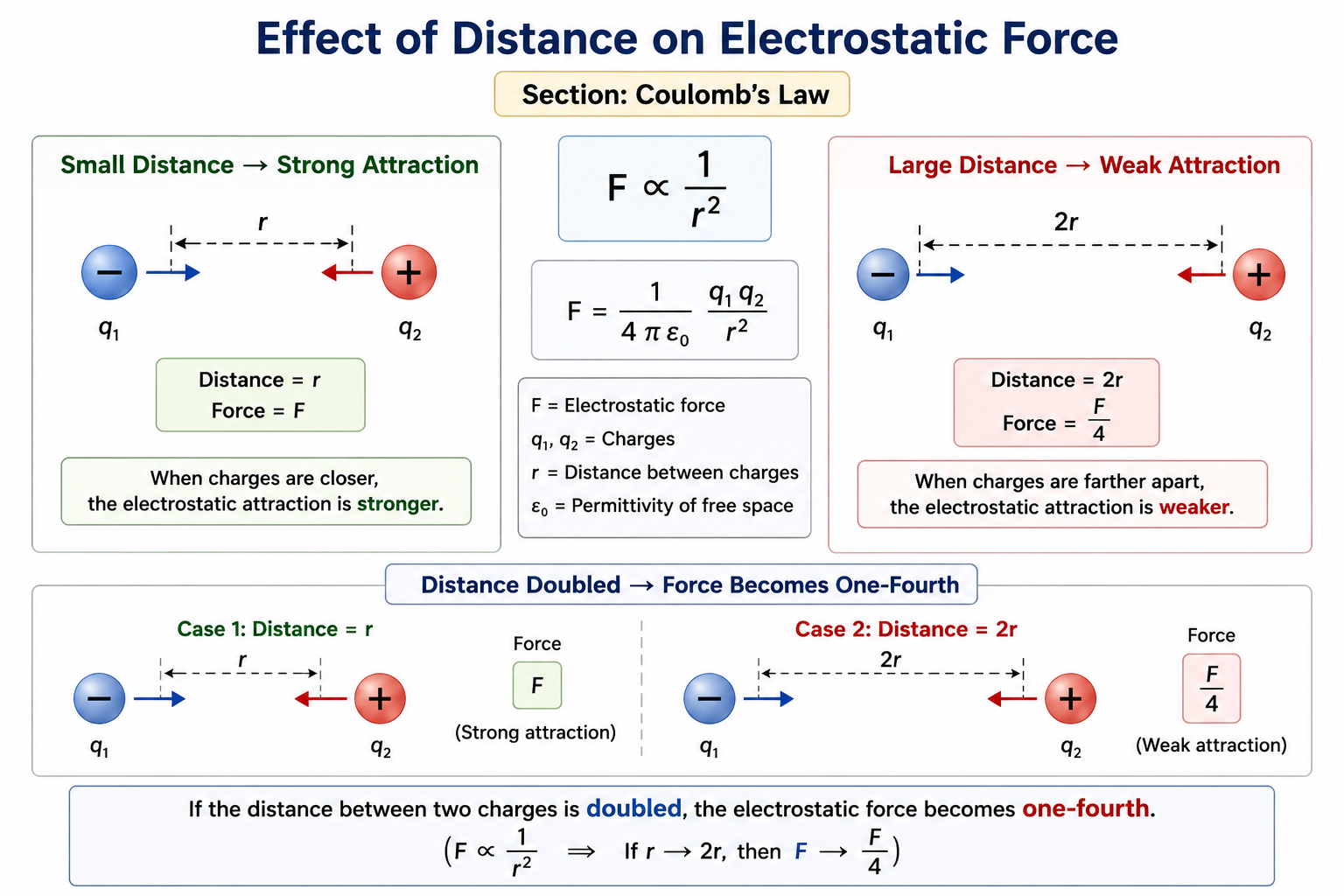
The strength of electrostatic interaction between two point charges is described by Coulomb’s law.
F = (1 / 4πε) × (q1q2 / r2)
where:
- F = electrostatic force
- q1 and q2 = charges
- r = distance between the charges
- ε = dielectric permittivity of the surrounding medium
In a simplified form:
F ∝ q1q2 / r2
This equation gives several important conclusions.
4.1 Effect of Charge
Greater charge generally produces a stronger electrostatic interaction. Thus, interactions involving highly charged groups can be stronger than interactions involving smaller partial charges.
4.2 Effect of Distance
Electrostatic force decreases with the square of distance.
F ∝ 1 / r2
Therefore, bringing two opposite charges closer together increases their electrostatic attraction.
4.3 Effect of the Medium
The surrounding medium strongly influences electrostatic interactions because of its dielectric properties.
Water has a high dielectric constant and therefore substantially reduces the effective electrostatic interaction between charges compared with a low-dielectric environment.
This becomes particularly important when considering charged residues inside a protein.
5. Electrostatic Attraction and Repulsion
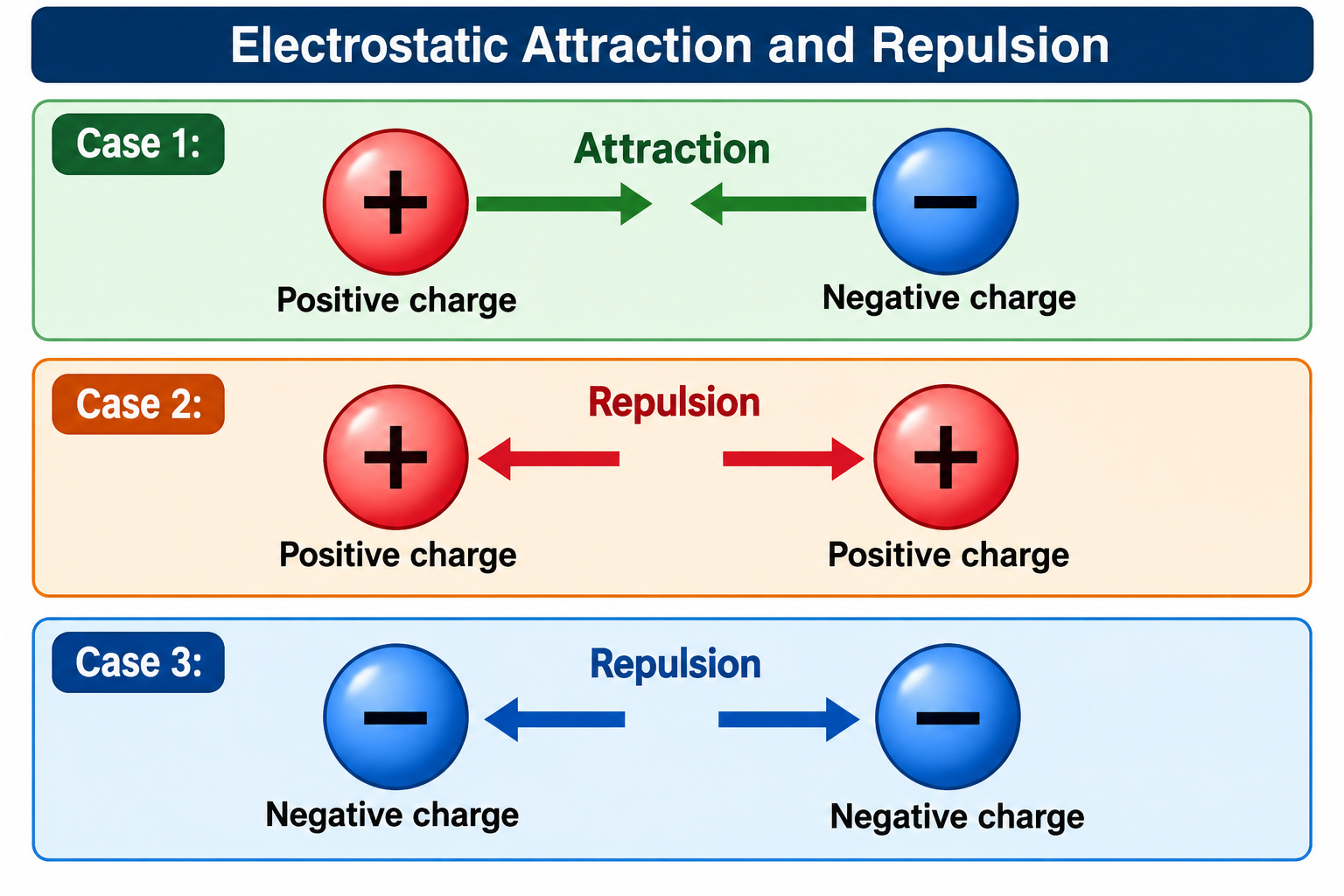
Electrostatic interactions can be either attractive or repulsive.
5.1 Attractive Electrostatic Interaction
When two groups have opposite charges:
(+) ← attraction → (−)
For example:
Lys–NH3+ ⋯ ⁻OOC–Asp
This interaction is favorable from the perspective of direct charge–charge attraction.
5.2 Repulsive Electrostatic Interaction
When two groups have the same charge:
(+) → repulsion ← (+)
or
(−) → repulsion ← (−)
For example:
Lys–NH3+ ⋯ ⁺H3N–Lys
may experience electrostatic repulsion if the two positively charged groups approach each other without compensating interactions.
Similarly:
Asp–COO− ⋯ ⁻OOC–Glu
can experience repulsion between two negatively charged groups.
These attractive and repulsive interactions help determine the final three-dimensional arrangement of biomolecules.
6. Electrostatic Interactions in Amino Acids
Proteins contain several amino acids with ionizable side chains.
Important charged amino acids include:
Positively Charged Amino Acids
- Lysine (Lys, K)
- Arginine (Arg, R)
- Histidine (His, H)
Negatively Charged Amino Acids
- Aspartate (Asp, D)
- Glutamate (Glu, E)
The charge of histidine is especially sensitive to pH because its side-chain pKa is close to the physiological pH range.
Other amino acids can also contribute to electrostatic properties depending on their terminal groups and environmental conditions.
7. Electrostatic Interactions and Salt Bridges
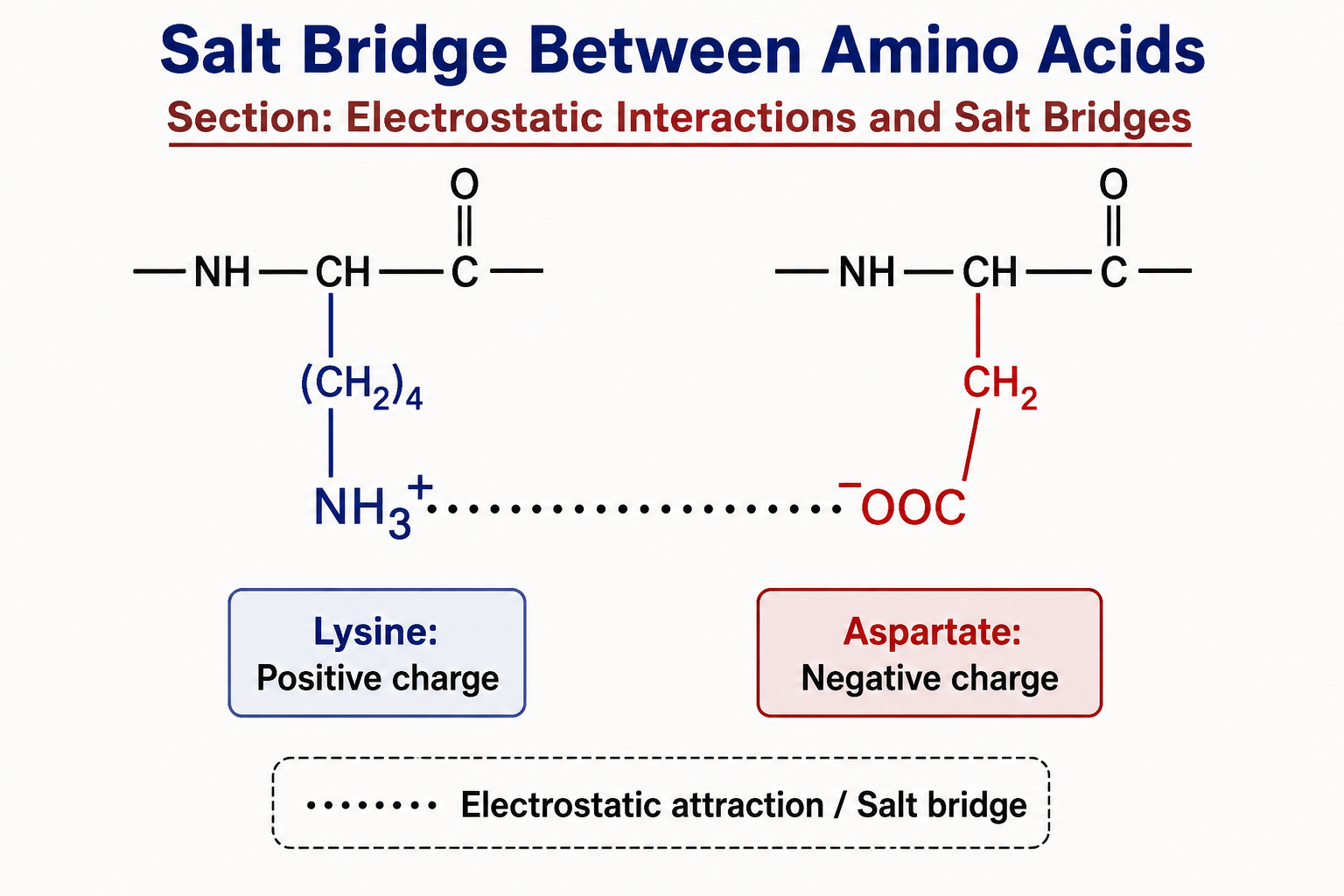
One of the most important examples of electrostatic interaction in proteins is the salt bridge.
A salt bridge is an electrostatic interaction between oppositely charged groups that are sufficiently close to interact.
A common example is:
Lysine–NH3+ ⋯ ⁻OOC–Glutamate
or
Arginine–NH2+ ⋯ ⁻OOC–Aspartate
Salt bridges can occur within a single protein molecule or between different molecules.
They may contribute to:
- Protein folding
- Protein stability
- Protein–protein recognition
- Protein–ligand binding
- Enzyme–substrate interactions
- Specificity of molecular recognition
The presence of a salt bridge does not automatically mean that the protein is more stable.
The net energetic contribution depends on several factors, including solvation, desolvation, geometry, dielectric environment, and interactions with surrounding residues.
8. Salt Bridges and Protein Stability
It is tempting to assume:
Opposite charges attract → salt bridge forms → protein becomes more stable
However, this is an oversimplification.
When a charged residue is exposed to water, it can interact favorably with water molecules. If the same residue becomes buried inside a protein, it may lose these favorable interactions.
This creates a desolvation penalty.
Therefore:
Charge–charge attraction must be considered together with:
Desolvation cost + interactions with surrounding groups + solvent effects
The overall contribution of a salt bridge to protein stability is therefore context-dependent.
9. Electrostatic Interactions and the Dielectric Constant
The dielectric constant of the surrounding environment has a major effect on electrostatic interactions.
Water has a relatively high dielectric constant.
Therefore, charged groups in water experience strong electrostatic screening.
In contrast, the interior of a protein generally has a lower effective dielectric environment than bulk water.
As a result, charge–charge interactions inside a protein can behave differently from those on the protein surface.
This creates an important balance:
Buried opposite charges
↓
Strong direct electrostatic attraction
but
↓
Loss of favorable interactions with water
Therefore:
Net effect = favorable electrostatic interaction − unfavorable desolvation effects
10. Electrostatic Interactions and Water
Water is a polar molecule.
The oxygen atom carries a partial negative charge, while the hydrogen atoms carry partial positive charges.
Therefore, water molecules can interact strongly with charged groups.
For example:
Na+ ← Oδ− of water
and
Cl− ← Hδ+ of water
These are examples of ion–dipole interactions.
Water therefore stabilizes ions in solution through hydration.
For biomolecules, this means that electrostatic interactions cannot be considered independently of solvent.
A charged group inside water is surrounded by water molecules, which can reduce the direct interaction between two charges.
11. Electrostatic Screening
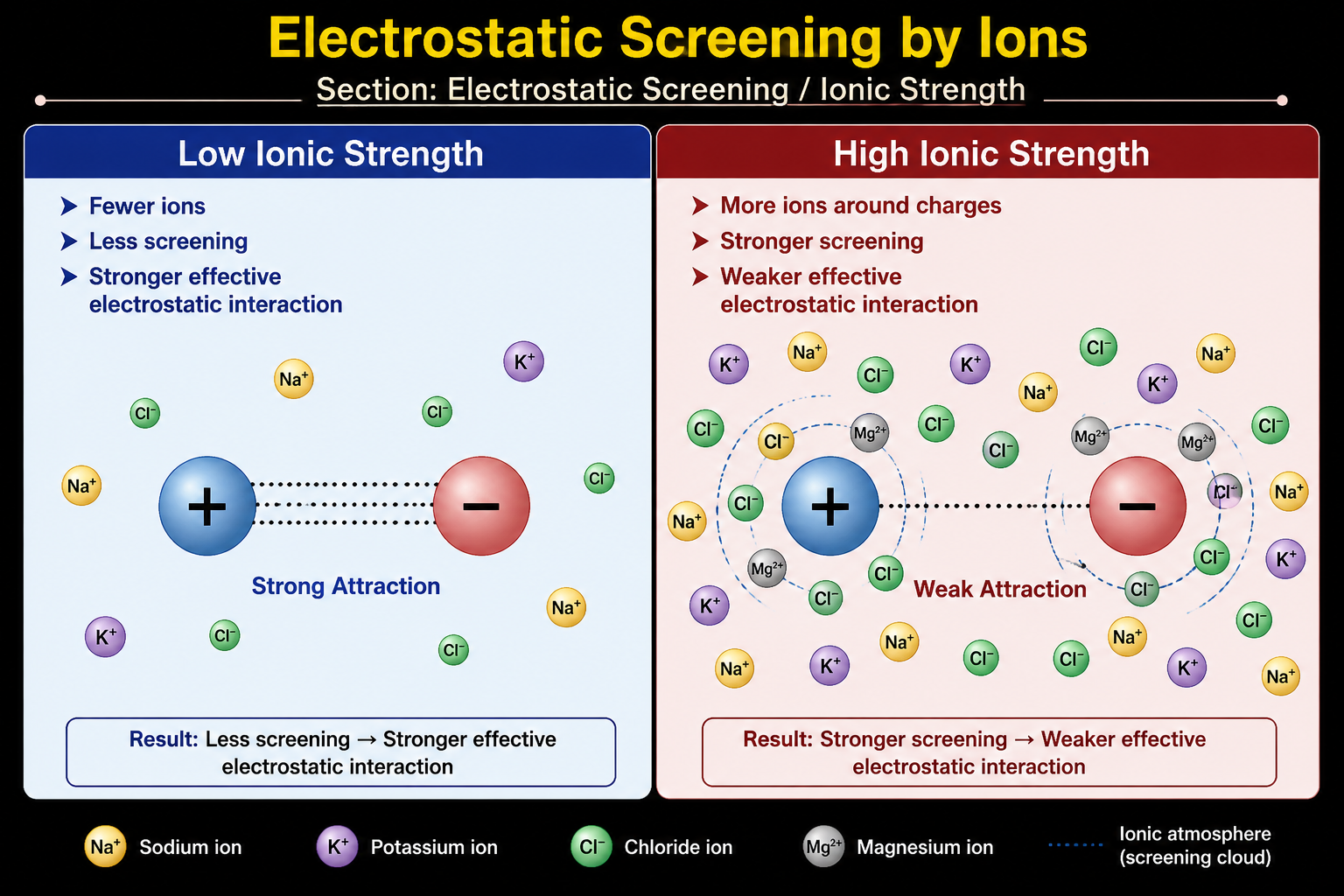
Electrostatic screening refers to the reduction in the effective electrostatic interaction between charges due to the surrounding medium and dissolved ions.
Biological solutions usually contain ions such as:
- Na+
- K+
- Cl−
- Mg2+
- Ca2+
These ions influence the electrostatic environment around biomolecules.
A high concentration of ions generally increases screening of electrostatic interactions.
Therefore:
Increasing ionic strength → increased electrostatic screening → reduced effective long-range electrostatic interactions
This principle is particularly important for charged proteins and nucleic acids.
12. Ionic Strength and Electrostatic Interactions
The ionic strength of a solution is given by:
I = ½ Σ cizi2
where:
- I = ionic strength
- ci = concentration of ion i
- zi = charge of ion i
The square of the charge is important.
For example, a divalent ion such as Mg2+ contributes much more strongly to ionic strength than a monovalent ion at the same concentration because:
z2 = 22 = 4
whereas for Na+:
z2 = 12 = 1
Thus, divalent ions can have a particularly strong effect on electrostatic screening.
13. Electrostatic Interactions and pH
The charge of many biological molecules changes with pH.
This is because many functional groups can gain or lose protons.
For example:
–COOH ⇌ –COO− + H+
At lower pH, the carboxyl group tends to remain protonated.
At higher pH, it tends to become deprotonated.
Similarly:
–NH3+ ⇌ –NH2 + H+
At lower pH, amino groups are more likely to be protonated and positively charged.
Therefore:
pH → protonation state → molecular charge → electrostatic interactions
This relationship is extremely important in protein structure and enzyme function.
14. Electrostatic Interactions and pKa
The pKa of an ionizable group describes its tendency to lose a proton.
The Henderson–Hasselbalch relationship is:
pH = pKa + log([A−] / [HA])
For an acidic group:
- At pH < pKa, the protonated form predominates.
- At pH > pKa, the deprotonated form predominates.
For a basic group, the corresponding protonation behavior must be interpreted according to its conjugate acid/base pair.
The local environment of a protein can shift the pKa of an ionizable residue.
This means that a residue may have a different effective protonation behavior inside a protein than it would in a simple aqueous solution.
15. Electrostatic Interactions in Protein Folding
Protein folding is driven by a combination of forces rather than a single interaction.
These include:
- Hydrophobic interactions
- Hydrogen bonds
- Electrostatic interactions
- Van der Waals interactions
- Disulfide bonds in appropriate proteins
Electrostatic interactions can help stabilize particular conformations by favoring favorable arrangements of charged residues.
For example:
Unfolded protein
→ many possible charge arrangements
Folding
→ specific residues approach each other
Favorable charge interactions
→ contribute to the preferred folded structure
However, electrostatic repulsion can also prevent certain conformations.
Therefore, protein folding depends on the overall energetic balance of many interactions.
16. Electrostatic Interactions in Protein–Protein Interactions
Many proteins recognize and bind to other proteins through complementary surface properties.
A protein surface may contain:
- Positively charged regions
- Negatively charged regions
- Polar regions
- Hydrophobic regions
A complementary interface can promote association.
For example:
Protein A: positive surface
↓
Protein B: negative surface
↓
Electrostatic attraction
↓
Protein–protein complex
Electrostatic interactions can therefore contribute to both the affinity and specificity of biomolecular recognition.
17. Electrostatic Interactions in Protein–Ligand Binding
Electrostatic complementarity is also important in protein–ligand interactions.
Consider an enzyme active site containing a positively charged residue.
A negatively charged substrate group may be attracted toward that region.
The sequence can be represented as:
Charged active-site residue
↓
Electrostatic attraction
↓
Substrate positioning
↓
Formation of enzyme–substrate complex
↓
Catalytic reaction
Electrostatic interactions can therefore assist not only binding but also correct positioning of a substrate within an active site.
18. Electrostatic Interactions in Nucleic Acids
Nucleic acids contain a negatively charged phosphate backbone.
Therefore, DNA and RNA are highly charged polymers under many physiological conditions.
The phosphate groups repel one another because they carry negative charges.
This repulsion is reduced by positively charged ions.
For example:
DNA− + Na+
or
DNA− + Mg2+
Cations can therefore help neutralize the negative charge of nucleic acids.
This is particularly important for DNA compaction and nucleic-acid–protein interactions.
19. Electrostatic Interactions Between DNA and Proteins
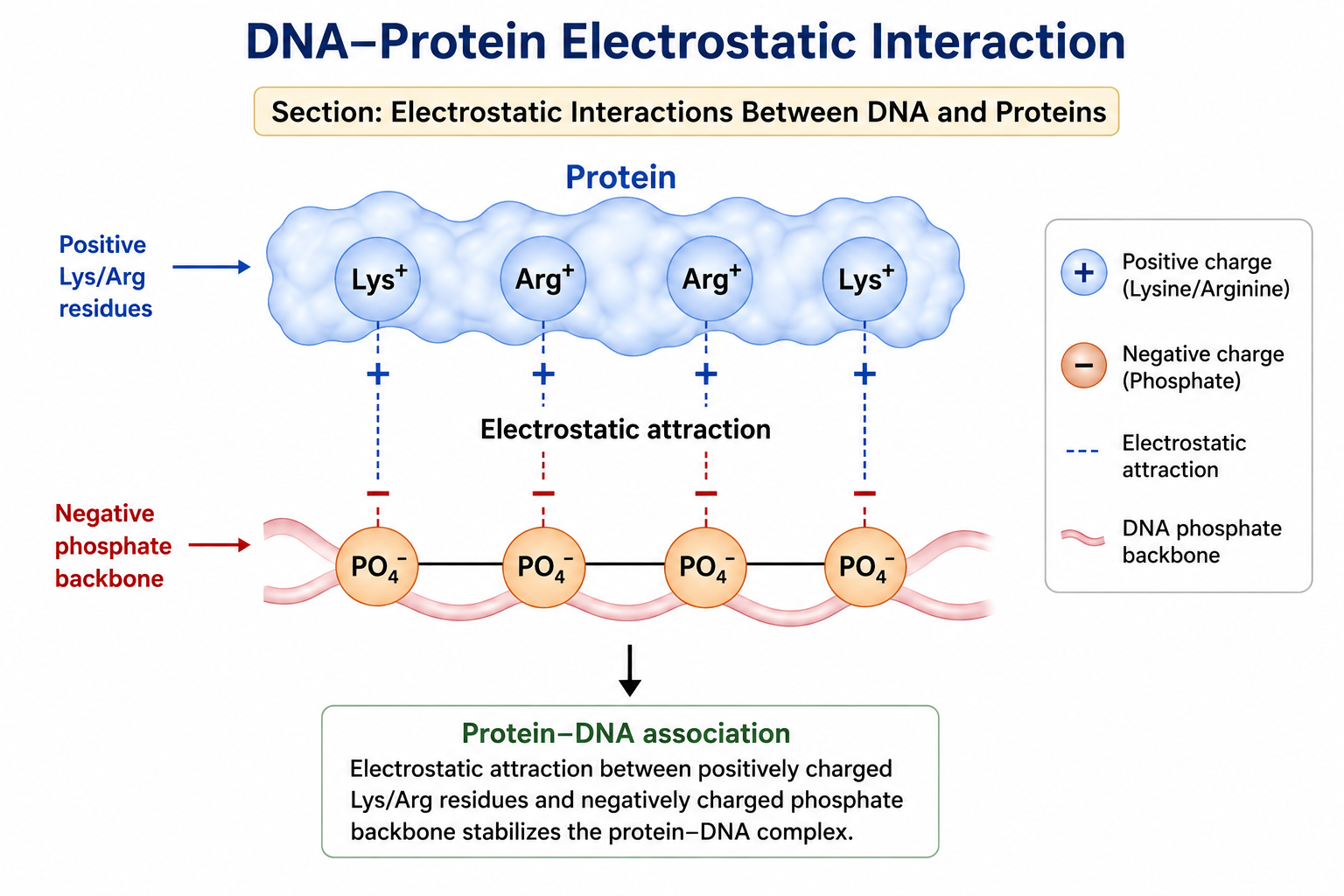
Many DNA-binding proteins contain positively charged amino acid residues, particularly:
- Lysine
- Arginine
These residues can interact electrostatically with the negatively charged phosphate backbone of DNA.
A simplified representation is:
Protein Lys/Arg residues (+)
↓
Electrostatic attraction
↓
DNA phosphate groups (−)
↓
Protein–DNA association
Histones are a classic biological example because their positively charged residues help them interact with negatively charged DNA.
20. Electrostatic Interactions in Enzyme Catalysis
Electrostatic effects are important in enzyme active sites.
Charged amino acid residues can:
- Bind substrates
- Orient substrates
- Stabilize charged intermediates
- Stabilize transition states
- Participate in acid–base catalysis
- Control the protonation state of catalytic residues
For example, an enzyme may contain acidic and basic residues positioned precisely within its active site.
Their spatial arrangement can create a favorable electrostatic environment for catalysis.
Thus:
Active-site architecture
↓
Electrostatic complementarity
↓
Substrate binding and transition-state stabilization
↓
Enhanced catalytic efficiency
21. Electrostatic Complementarity
Electrostatic complementarity refers to the matching of positive and negative charge distributions between interacting biomolecules.
For example:
Positive region ↔ Negative region
This complementarity can occur between:
- Protein and protein
- Protein and DNA
- Protein and RNA
- Protein and ligand
- Enzyme and substrate
Electrostatic complementarity is therefore an important component of molecular recognition.
22. Long-Range Nature of Electrostatic Interactions
Compared with many short-range interactions, electrostatic effects can influence molecular interactions over relatively larger distances.
However, in biological systems, the effective range is strongly influenced by:
- Solvent
- Ionic strength
- Dielectric properties
- Charge distribution
- Molecular geometry
Therefore, the statement:
“Electrostatic interactions are always long-range and unscreened in cells” is incorrect.
Biological solutions contain ions and water, both of which modify electrostatic interactions.
23. Electrostatic Interactions and Molecular Recognition
Biological recognition requires molecules to distinguish specific partners from many other molecules.
Electrostatic interactions contribute to this specificity by providing complementary charge patterns.
For example:
Receptor surface
Positive + Negative + Polar regions
↓
Ligand surface
Complementary Negative + Positive + Polar regions
↓
Molecular recognition
↓
Stable receptor–ligand complex
Electrostatic interactions often work together with hydrogen bonds, hydrophobic interactions, and van der Waals contacts rather than acting independently.
24. Electrostatic Interactions and Membrane Biology
Electrostatic interactions are also important in biological membranes.
Membrane surfaces can contain charged lipids and proteins.
Charged molecules can interact with membrane surfaces through electrostatic attraction.
For example, positively charged regions of proteins can associate with negatively charged phospholipids.
Electrostatic interactions therefore contribute to:
- Membrane–protein association
- Peripheral membrane protein binding
- Signal transduction
- Molecular recruitment to membranes
Changes in membrane composition can consequently influence protein localization and cellular signaling.
25. Electrostatic Interactions and Protein Aggregation
Electrostatic interactions can influence whether proteins remain dispersed or associate with one another.
If protein molecules have similar net charges, electrostatic repulsion can reduce aggregation.
For example:
Protein (−) ← repulsion → Protein (−)
However, under conditions where the net charge decreases or charge complementarity becomes favorable, protein–protein association may increase.
This is one reason why pH and ionic strength can influence protein solubility and aggregation.
26. Effect of pH on Protein Charge
The net charge of a protein depends on the protonation state of its ionizable groups.
At different pH values, the same protein may carry:
- Positive net charge
- Approximately zero net charge
- Negative net charge
The pH at which the protein has no net electrical charge is called the:
Isoelectric point (pI)
At or near the pI, electrostatic repulsion between protein molecules may be reduced.
This can favor aggregation or precipitation under appropriate conditions.
Therefore:
pH → protein charge → electrostatic repulsion/attraction → solubility
This is an important connection between electrostatics and protein chemistry.
27. Electrostatic Interactions Near the Isoelectric Point
At the isoelectric point: pH = pI the net charge of the protein is approximately zero.
This does not mean that every charged group has disappeared.
Instead, positive and negative charges can coexist within the protein while the overall net charge approaches zero.
Therefore:
Net charge ≈ 0
does not mean:
No charged residues are present.
This distinction is frequently useful in conceptual examination questions.
28. Electrostatic Interactions Are Context-Dependent
One of the most important advanced concepts is that an electrostatic interaction cannot be judged solely from the presence of opposite charges.
Its energetic contribution depends on:
- Charge magnitude
- Distance
- Geometry
- Dielectric environment
- Solvent accessibility
- Ionic strength
- pH
- Protonation state
- Neighboring residues
- Desolvation effects
Thus, two opposite charges may have a strong direct attraction but still make a limited or even unfavorable contribution to overall protein stability under certain conditions.
This is particularly important when analyzing buried salt bridges.
29. Electrostatic Interaction vs Hydrogen Bond
Electrostatic interactions and hydrogen bonds are related but should not be treated as identical.
Electrostatic Interaction
It involves attraction or repulsion between charges or charge distributions.
Hydrogen Bond
It involves a hydrogen atom covalently attached to an electronegative atom interacting with another electronegative atom or electron-rich site.
Hydrogen bonds can contain an important electrostatic component, but they have additional directional and geometric requirements.
Electrostatic interaction ≠ hydrogen bond although electrostatic forces contribute to hydrogen-bonding interactions.
30. Electrostatic Interaction vs Van der Waals Interaction
These interactions differ in their origin and behavior.
Feature |
Electrostatic Interaction |
Van der Waals Interaction |
|---|---|---|
| Main basis | Charges/charge distributions | Fluctuating or induced dipoles |
| Can be attractive? | Yes | Yes |
| Can be repulsive? | Yes | Yes |
| Distance dependence | Strongly distance-dependent | Very short-range |
| Important in biomolecules? | Yes | Yes |
| Affected by ionic strength | Strongly | Generally much less directly |
| Example | Salt bridge | Close atomic contact |
In biological systems, several interactions usually operate simultaneously.
31. Important Factors Affecting Electrostatic Interactions
31.1 Charge
Greater charge can increase electrostatic interaction.
31.2 Distance
Increasing distance decreases the direct Coulombic interaction.
31.3 Dielectric Constant
A higher dielectric environment generally reduces the effective interaction between charges.
31.4 Ionic Strength
Increasing ionic strength generally increases screening.
31.5 pH
pH changes protonation states and therefore molecular charge.
31.6 Molecular Geometry
Correct spatial orientation can determine whether two charged groups can interact effectively.
31.7 Solvation
Water can stabilize charged groups and modify the energetic benefit of bringing charges together.
32. A Simple Conceptual Flow
The relationship can be remembered as:
pH
↓
Protonation/deprotonation
↓
Charge distribution
↓
Electrostatic attraction or repulsion
↓
Molecular conformation and interactions
↓
Biological function
This concept connects electrostatics with protein folding, enzyme activity, molecular recognition, and biomolecular assembly.
33. Electrostatic Interactions in Biological Systems
Electrostatic interactions participate in numerous biological processes.
Proteins
They influence:
- Folding
- Stability
- Binding
- Protein–protein interactions
- Protein–ligand interactions
DNA and RNA
They influence:
- Nucleic acid compaction
- Cation binding
- Protein–nucleic acid interactions
Enzymes
They influence:
- Substrate binding
- Transition-state stabilization
- Catalysis
Membranes
They influence:
- Protein recruitment
- Membrane association
- Signaling
Molecular Recognition
They contribute to:
- Specificity
- Orientation
- Binding affinity
36. High-Yield Comparison
Interaction |
Main Participants |
Typical Example |
Major Biological Role |
|---|---|---|---|
| Electrostatic | Charged groups | Lys+–Asp− | Protein stability and recognition |
| Hydrogen bond | Donor and acceptor groups | N–H···O | Protein and nucleic-acid structure |
| Van der Waals | Closely packed atoms | Atom–atom contacts | Molecular packing |
| Hydrophobic | Nonpolar groups in water | Nonpolar side chains | Protein folding |
| Disulfide bond | Cysteine residues | Cys–S–S–Cys | Extracellular protein stability |
The most important conceptual statement to remember is:
- Electrostatic attraction between opposite charges may be favorable, but the overall stabilization of a biomolecule depends on the complete energetic environment, including solvation and desolvation effects.


