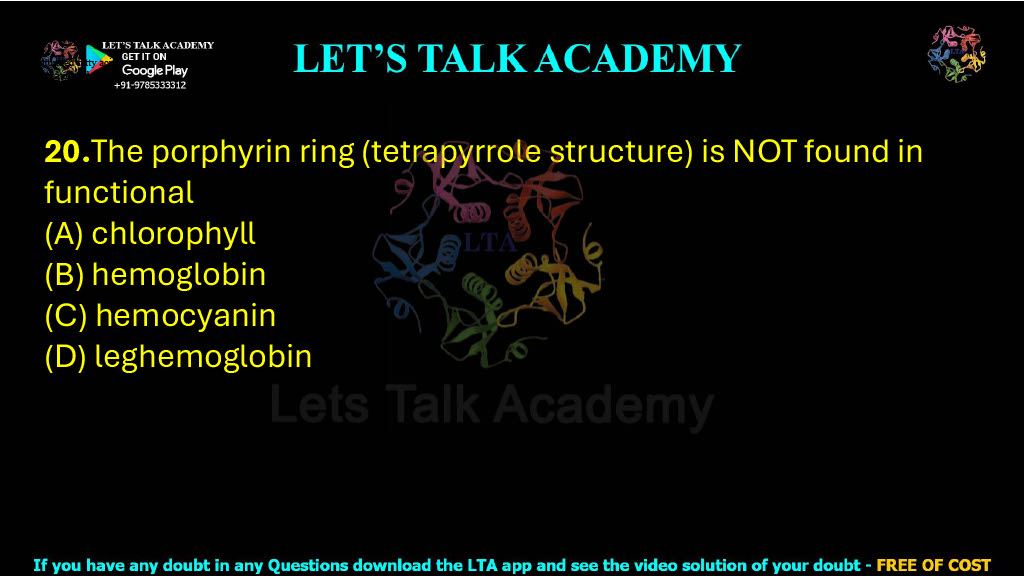
20.The porphyrin ring (tetrapyrrole structure) is NOT found in functional
(A) chlorophyll
(B) hemoglobin
(C) hemocyanin
(D) leghemoglobin
Porphyrin Ring (Tetrapyrrole Structure) Is NOT Found in Which Functional Molecule?
Correct Answer
(C) Hemocyanin
Introduction
The porphyrin ring, also known as the tetrapyrrole ring, is one of the most important molecular structures in biology. It forms the functional core of several biologically essential molecules that participate in oxygen transport, photosynthesis, electron transfer, and cellular respiration. Porphyrins are cyclic compounds composed of four pyrrole rings connected by methine bridges, producing a highly conjugated planar structure capable of binding metal ions at its center.
Many biologically important pigments such as heme and chlorophyll are based on modified porphyrin rings. The central metal ion determines the biological function of the molecule. For example, iron occupies the center of heme, enabling oxygen transport in hemoglobin and leghemoglobin, whereas magnesium occupies the center of chlorophyll, allowing plants to capture light energy during photosynthesis. However, not every oxygen-binding protein contains a porphyrin ring. One notable exception is hemocyanin, which binds oxygen using copper ions rather than a tetrapyrrole structure.
Understanding the Porphyrin (Tetrapyrrole) Ring
A porphyrin is a large cyclic organic molecule consisting of four pyrrole rings linked together through methine (=CH−) bridges. The resulting ring possesses a highly conjugated electron system, making it chemically stable and capable of coordinating metal ions. When a metal ion occupies the center of the porphyrin ring, the resulting complex performs specialized biological functions.
Depending on the central metal atom, porphyrins give rise to different biologically important molecules. An iron-containing porphyrin forms heme, whereas a magnesium-containing porphyrin forms chlorophyll. These molecules are indispensable for respiration and photosynthesis, respectively.
Because the tetrapyrrole ring serves as a scaffold for metal binding, it is one of the most conserved and widely distributed molecular structures in nature.
Concept Behind the Question
The question asks which functional molecule does not contain a porphyrin (tetrapyrrole) ring.
Three of the given molecules—chlorophyll, hemoglobin, and leghemoglobin—contain tetrapyrrole rings as part of their functional prosthetic groups. In contrast, hemocyanin does not contain a heme or porphyrin group. Instead, it binds oxygen through two copper (Cu⁺) ions that are directly coordinated by histidine residues within the protein.
Therefore, although hemocyanin performs oxygen transport just like hemoglobin, its oxygen-binding mechanism is completely different.
Hence, the correct answer is Option (C).
Why Option (A) Is Incorrect
Chlorophyll
Chlorophyll is the principal photosynthetic pigment found in plants, algae, and cyanobacteria. Its primary function is to absorb sunlight and convert solar energy into chemical energy during photosynthesis. Structurally, chlorophyll contains a modified porphyrin (tetrapyrrole) ring with a magnesium (Mg²⁺) ion located at its center.
The conjugated tetrapyrrole ring enables chlorophyll to absorb visible light efficiently, particularly in the blue and red regions of the electromagnetic spectrum. The absorbed energy is then transferred to the photosynthetic reaction centers, initiating the process of ATP and NADPH formation.
Since chlorophyll clearly contains a tetrapyrrole ring, it cannot be the correct answer.
Therefore, Option (A) is incorrect.
Why Option (B) Is Incorrect
Hemoglobin
Hemoglobin is the oxygen-transport protein found in vertebrate red blood cells. Each hemoglobin molecule contains four heme groups, and every heme consists of an iron (Fe²⁺) ion coordinated within a protoporphyrin IX ring, which is a classic tetrapyrrole structure.
The porphyrin ring is responsible for securely holding the iron atom while still allowing reversible oxygen binding. Without this tetrapyrrole ring, hemoglobin would be unable to transport oxygen efficiently from the lungs to body tissues.
Because hemoglobin contains four porphyrin rings, it is one of the best-known examples of a porphyrin-containing protein.
Hence, Option (B) is incorrect.
Why Option (C) Is Correct
Hemocyanin
Hemocyanin is the oxygen-transport protein found in many arthropods (such as crabs, lobsters, and spiders) and molluscs (such as octopuses and squids). Unlike hemoglobin, hemocyanin does not contain a heme group or a porphyrin ring.
Instead, oxygen binds directly between two copper (Cu⁺) ions that are coordinated by histidine residues within the protein. When oxygen binds, the copper ions become oxidized, producing the characteristic blue color of oxygenated hemocyanin. This mechanism is fundamentally different from the iron-porphyrin system found in hemoglobin.
Because hemocyanin lacks a tetrapyrrole (porphyrin) ring entirely, it is the only correct answer.
Therefore, Option (C) is correct.
Why Option (D) Is Incorrect
Leghemoglobin
Leghemoglobin is an oxygen-binding protein present in the root nodules of leguminous plants. It plays a crucial role in nitrogen fixation by maintaining a very low free oxygen concentration around nitrogen-fixing bacteria while still supplying sufficient oxygen for bacterial respiration.
Structurally, leghemoglobin closely resembles vertebrate hemoglobin. It contains a heme prosthetic group in which an iron (Fe²⁺) atom is coordinated by a protoporphyrin IX ring. Thus, leghemoglobin also possesses a tetrapyrrole structure.
The presence of the porphyrin ring allows leghemoglobin to bind oxygen reversibly and regulate oxygen availability within root nodules.
Therefore, Option (D) is incorrect.
Comparison of the Given Molecules
| Molecule | Central Metal | Porphyrin Ring Present? | Primary Function |
|---|---|---|---|
| Chlorophyll | Mg²⁺ | Yes | Photosynthesis |
| Hemoglobin | Fe²⁺ | Yes | Oxygen transport |
| Hemocyanin | Cu⁺ | No | Oxygen transport |
| Leghemoglobin | Fe²⁺ | Yes | Oxygen regulation in root nodules |
Biological Importance of Porphyrin Rings
Porphyrin rings are indispensable because they enable proteins to bind metal ions in a stable yet functional manner. In hemoglobin and myoglobin, the iron-containing porphyrin ring allows reversible oxygen binding, making efficient oxygen transport and storage possible. In chlorophyll, replacement of iron with magnesium transforms the molecule into the primary light-harvesting pigment required for photosynthesis.
Porphyrins also occur in several enzymes, including cytochromes, catalase, and peroxidase, where they facilitate electron transfer and oxidation-reduction reactions. Their versatility arises from the ability of the tetrapyrrole ring to stabilize different metal ions while maintaining the chemical properties required for biological catalysis.
Hemoglobin vs Hemocyanin
Although both hemoglobin and hemocyanin transport oxygen, their structures and mechanisms differ considerably. Hemoglobin contains iron bound within a porphyrin ring, giving oxygenated blood its bright red color. Hemocyanin, on the other hand, lacks any porphyrin structure and binds oxygen using two copper ions, resulting in a blue coloration when oxygenated.
Another important difference is their location. Hemoglobin is enclosed within red blood cells in vertebrates, whereas hemocyanin is generally dissolved directly in the hemolymph of arthropods and molluscs. Despite performing similar physiological roles, these proteins evolved independently and represent different evolutionary solutions for oxygen transport.
Common Mistakes in Competitive Examinations
Many students incorrectly choose chlorophyll because they associate porphyrins only with heme proteins. In reality, chlorophyll also contains a modified tetrapyrrole ring, with magnesium replacing iron at the center.
Another common misconception is assuming that every oxygen-binding protein contains heme. Hemocyanin is an important exception because it binds oxygen using copper ions rather than a porphyrin-bound iron atom.
Students also confuse hemocyanin with hemoglobin because both transport oxygen. Remember that similar function does not necessarily imply similar structure.
High-Yield Points
- A porphyrin ring consists of four pyrrole rings joined by methine bridges.
- Heme is an iron-containing porphyrin.
- Chlorophyll contains a magnesium-centered tetrapyrrole ring.
- Hemoglobin contains four heme (porphyrin) groups.
- Leghemoglobin also contains a heme prosthetic group.
- Hemocyanin contains copper ions and does not possess a porphyrin ring.
Frequently Asked Questions
What is a porphyrin ring?
A porphyrin ring is a cyclic tetrapyrrole structure composed of four pyrrole rings connected by methine bridges. It binds metal ions such as iron or magnesium and forms the functional core of molecules like heme and chlorophyll.
Why does hemocyanin not contain a porphyrin ring?
Hemocyanin binds oxygen using two copper ions coordinated directly by histidine residues. Since oxygen binding does not require a heme prosthetic group, no porphyrin ring is present.
Is chlorophyll a porphyrin?
Yes. Chlorophyll contains a modified tetrapyrrole (porphyrin-like) ring with magnesium at its center, making it structurally related to heme.
Key Takeaways
The porphyrin (tetrapyrrole) ring is a highly conserved biological structure that forms the basis of several essential molecules, including chlorophyll, hemoglobin, and leghemoglobin. These molecules utilize magnesium or iron coordinated within a tetrapyrrole ring to perform photosynthesis or oxygen transport. In contrast, hemocyanin employs two copper ions for oxygen binding and completely lacks a porphyrin ring. Understanding this structural distinction is essential for mastering questions on metalloproteins, respiratory pigments, and photosynthetic pigments in competitive examinations.
Final Answer
Correct Option: (C) Hemocyanin
Explanation
Hemocyanin is the only molecule among the given options that does not contain a porphyrin (tetrapyrrole) ring. Unlike hemoglobin and leghemoglobin, which contain an iron-bound heme (protoporphyrin IX) group, and chlorophyll, which contains a magnesium-centered tetrapyrrole ring, hemocyanin binds oxygen using two copper ions coordinated directly by amino acid residues. Because it lacks a heme prosthetic group and therefore lacks a porphyrin ring, hemocyanin is the correct answer.


