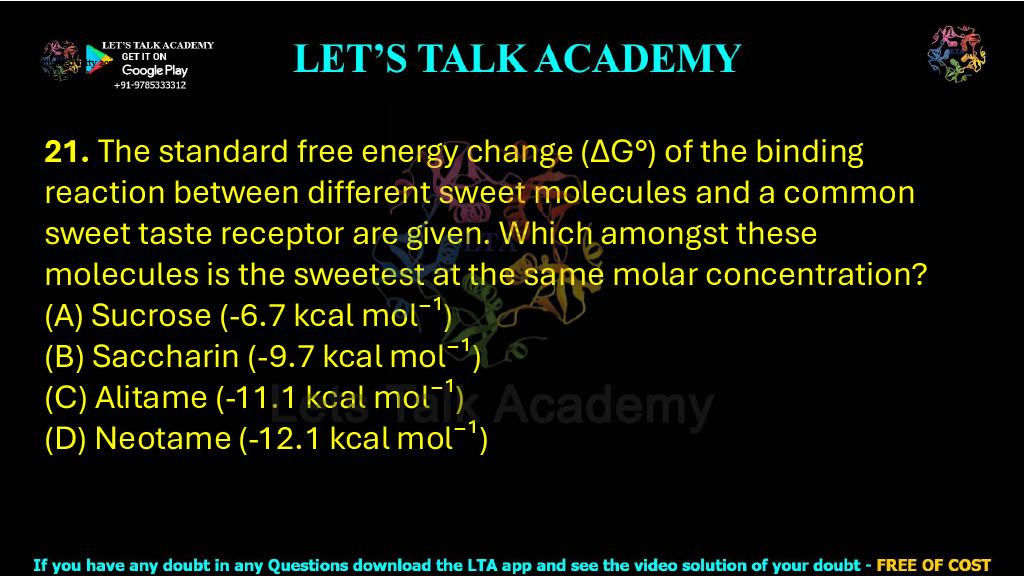
21. The standard free energy change (ΔG°) of the binding reaction between different sweet molecules and a common sweet taste receptor are given. Which amongst these molecules is the sweetest at the same molar concentration?
(A) Sucrose (-6.7 kcal mol⁻¹)
(B) Saccharin (-9.7 kcal mol⁻¹)
(C) Alitame (-11.1 kcal mol⁻¹)
(D) Neotame (-12.1 kcal mol⁻¹)
Which Sweet Molecule Has the Highest Sweetness Based on Standard Free Energy (ΔG°)?
Introduction
The sensation of sweetness begins when a sweet molecule binds to the sweet taste receptor (T1R2/T1R3) located on the taste buds of the tongue. This interaction is an example of a ligand–receptor binding reaction, and like every biochemical interaction, it is governed by the principles of thermodynamics. One of the most important thermodynamic parameters describing this interaction is the standard free energy change (ΔG°).
The value of ΔG° indicates how energetically favorable the binding of a molecule to its receptor is. A more negative ΔG° corresponds to a stronger and more spontaneous interaction between the ligand and the receptor. When different sweet molecules are present at the same molar concentration, the molecule with the strongest receptor binding generally activates more receptors and produces a stronger perception of sweetness.
Understanding the Concept Behind the Question
The standard free energy change is directly related to the equilibrium constant of binding through the Gibbs free energy equation:
ΔG° = −RT ln K
where:
- ΔG° = Standard free energy change
- R = Universal gas constant
- T = Absolute temperature
- K = Equilibrium constant for binding
This equation shows that as ΔG° becomes more negative, the equilibrium constant (K) becomes larger. A larger equilibrium constant indicates stronger receptor binding because more receptor molecules exist in the bound state at equilibrium.
Therefore, when comparing different sweet molecules at the same concentration, the molecule with the most negative ΔG° binds most strongly to the sweet receptor and is perceived as the sweetest.
The given values are:
- Sucrose = −6.7 kcal mol⁻¹
- Saccharin = −9.7 kcal mol⁻¹
- Alitame = −11.1 kcal mol⁻¹
- Neotame = −12.1 kcal mol⁻¹
Among these, −12.1 kcal mol⁻¹ is the most negative value.
Therefore, Neotame binds most strongly to the receptor and is the sweetest molecule.
Why Option (A) Is Incorrect
Sucrose
Sucrose is the natural table sugar obtained from sugarcane and sugar beet. It serves as the standard reference compound for measuring sweetness, with a relative sweetness value of 1. Although sucrose binds efficiently to sweet taste receptors, its binding free energy (−6.7 kcal mol⁻¹) is the least negative among the molecules listed in the question.
A less negative ΔG° indicates weaker receptor binding compared with the artificial sweeteners listed. Consequently, at the same molar concentration, sucrose activates fewer receptors than molecules with more favorable binding energies. This explains why artificial sweeteners can produce a much sweeter taste than ordinary sugar despite being used in much smaller quantities.
Therefore, Option (A) is incorrect.
Why Option (B) Is Incorrect
Saccharin
Saccharin is one of the oldest artificial sweeteners and is considerably sweeter than sucrose. Its binding free energy (−9.7 kcal mol⁻¹) is substantially more negative than that of sucrose, indicating a stronger interaction with the sweet taste receptor.
However, although saccharin binds more strongly than sucrose, its ΔG° is still less negative than those of alitame and neotame. Therefore, saccharin cannot be considered the sweetest molecule among the options provided.
Hence, Option (B) is incorrect.
Why Option (C) Is Incorrect
Alitame
Alitame is a high-intensity artificial sweetener developed from amino acid derivatives. It possesses a very favorable receptor-binding free energy (−11.1 kcal mol⁻¹), allowing it to produce a sweetness intensity hundreds of times greater than that of sucrose.
Although alitame binds more strongly than both sucrose and saccharin, its ΔG° is still slightly less negative than that of neotame (−12.1 kcal mol⁻¹). Since stronger receptor binding corresponds to greater sweetness at equal concentration, alitame is not the sweetest molecule listed.
Therefore, Option (C) is incorrect.
Why Option (D) Is Correct
Neotame
Neotame is an advanced artificial sweetener structurally related to aspartame but possessing an even greater affinity for the sweet taste receptor. Its standard free energy of binding is −12.1 kcal mol⁻¹, which is the most negative value among all the molecules in the question.
A more negative ΔG° indicates that receptor binding is more spontaneous and thermodynamically favorable. Consequently, neotame occupies a larger proportion of sweet taste receptors at the same molar concentration, producing the strongest sweet sensation.
Because receptor activation is directly related to sweetness perception, neotame is considered the sweetest molecule among the given options.
Therefore, Option (D) is the correct answer.
Relationship Between ΔG° and Sweetness
The Gibbs free energy equation explains why receptor affinity determines sweetness intensity.
ΔG° = −RT ln K
From this relationship:
- More negative ΔG° → Larger equilibrium constant (K)
- Larger K → Stronger receptor binding
- Stronger binding → Greater receptor activation
- Greater receptor activation → Stronger perceived sweetness
Thus, sweetness is directly related to receptor-binding affinity rather than simply the chemical identity of the sweet molecule.
Comparison of the Given Sweet Molecules
| Sweet Molecule | ΔG° (kcal mol⁻¹) | Relative Binding Strength | Sweetness at Same Concentration |
|---|---|---|---|
| Sucrose | −6.7 | Lowest | Lowest |
| Saccharin | −9.7 | Higher | Higher |
| Alitame | −11.1 | Very High | Very High |
| Neotame | −12.1 | Highest | Highest |
Biological Significance of Sweet Taste Receptor Binding
Sweet taste perception is initiated when sweet molecules bind to the T1R2/T1R3 G-protein-coupled receptor present on taste receptor cells. Binding activates intracellular signaling pathways that ultimately generate nerve impulses transmitted to the brain, where sweetness is perceived.
Artificial sweeteners exploit this mechanism by binding much more strongly than sucrose. As a result, even minute amounts of compounds such as neotame can stimulate the receptor sufficiently to produce an intense sweet taste while contributing negligible calories. This property has made artificial sweeteners valuable in the management of diabetes, obesity, and calorie-restricted diets.
Common Mistakes in Competitive Examinations
One of the most frequent mistakes is assuming that the molecule with the largest numerical value of ΔG° is the strongest binder. In thermodynamics, the opposite is true. A more negative ΔG° corresponds to a more favorable and stronger binding interaction.
Another common misconception is confusing sweetness with molecular size or molecular weight. Sweetness depends primarily on receptor affinity, not on the molecular mass of the sweetener.
Students also occasionally forget that the question specifies the same molar concentration. At equal concentrations, receptor affinity becomes the deciding factor, making ΔG° the most important parameter.
High-Yield Points
- ΔG° = −RT ln K
- More negative ΔG° → Higher equilibrium constant
- Higher equilibrium constant → Stronger receptor binding
- Stronger receptor binding → Greater sweetness
- Neotame has the most negative ΔG°
- Therefore, neotame is the sweetest molecule at equal molar concentration.
Frequently Asked Questions
Why is neotame sweeter than sucrose?
Neotame binds much more strongly to the sweet taste receptor because its ΔG° is significantly more negative than that of sucrose. Stronger receptor binding leads to greater receptor activation and a sweeter taste.
What does a negative ΔG° indicate?
A negative ΔG° indicates that receptor binding occurs spontaneously and is thermodynamically favorable. The more negative the value, the stronger the interaction.
Does a more negative ΔG° always mean stronger binding?
Yes. According to the Gibbs free energy equation, a more negative ΔG° corresponds to a larger equilibrium constant and therefore stronger ligand–receptor binding.
Key Takeaways
The sweetness of a molecule depends not only on its chemical structure but also on how strongly it binds to the sweet taste receptor. This binding strength is measured by the standard free energy change (ΔG°). According to the Gibbs free energy equation, a more negative ΔG° corresponds to stronger receptor binding and greater sweetness. Among the molecules listed, neotame has the most negative ΔG° (−12.1 kcal mol⁻¹), indicating the strongest receptor affinity and the highest sweetness at the same molar concentration.
Final Answer
Correct Option: (D) Neotame (ΔG° = −12.1 kcal mol⁻¹)
Explanation
The standard free energy change (ΔG°) reflects the strength of binding between a sweet molecule and the sweet taste receptor. According to the equation ΔG° = −RT ln K, a more negative ΔG° corresponds to a larger equilibrium constant (K) and therefore stronger receptor binding. Since neotame has the most negative ΔG° (−12.1 kcal mol⁻¹) among the given molecules, it binds most strongly to the sweet taste receptor and produces the greatest sweetness at the same molar concentration. Therefore, the correct answer is Option (D) – Neotame.


