
Structure of Atomic Structure
The concept of atomic structure forms one of the fundamental foundations of chemistry, biochemistry, molecular biology, and several other areas of life science. Every biological molecule, from a simple water molecule to a highly complex protein or nucleic acid, is ultimately made up of atoms. Therefore, understanding how atoms are constructed and how their constituent particles are arranged is essential for developing a deeper understanding of biological systems.
A strong understanding of atomic structure also makes it easier to understand why different elements behave differently, why some atoms readily form particular types of chemical bonds, why ions are important in cellular physiology, and how the electronic properties of atoms influence the structure and function of biological molecules.
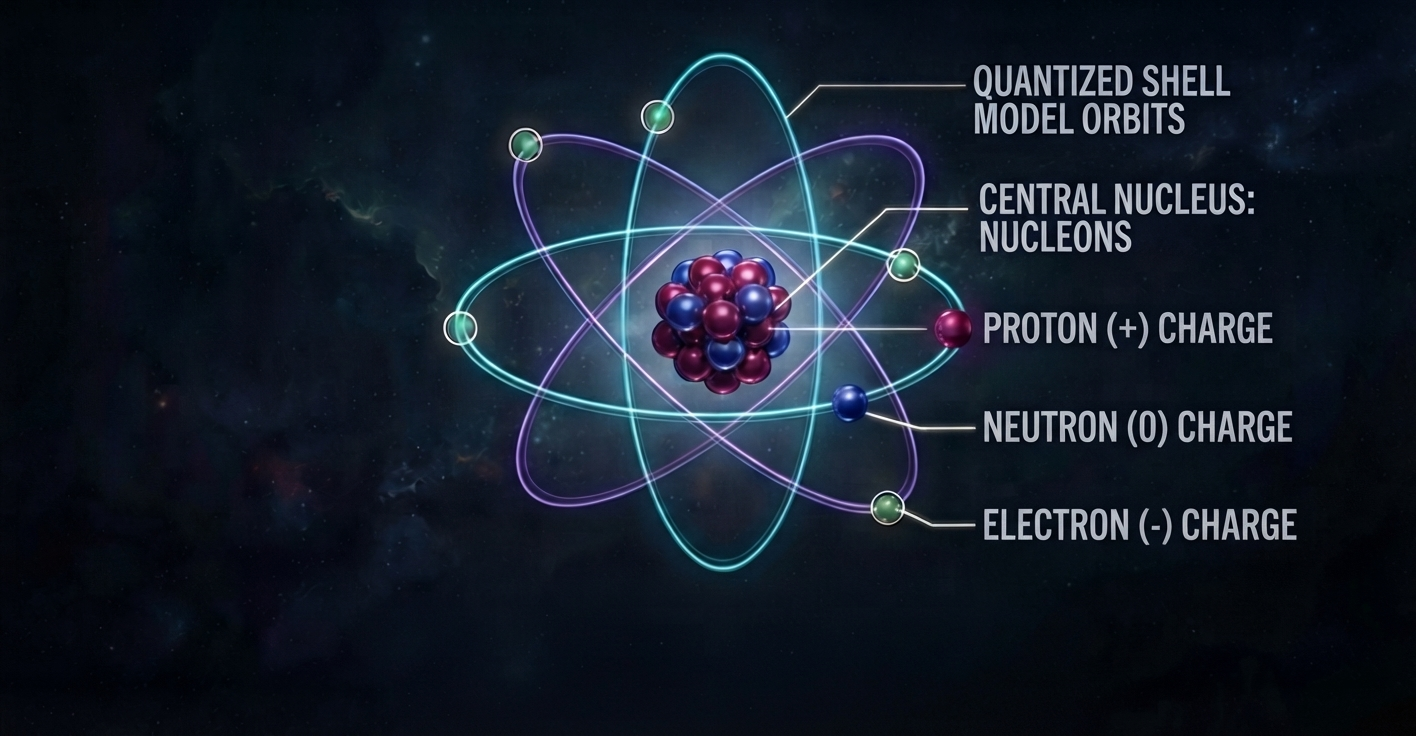
What Is Atomic Structure?
The atomic structure of an element refers to the constitution of its nucleus and the arrangement of the electrons around it. Primarily, the atomic structure of matter is made up of protons, electrons, and neutrons.
The protons and neutrons make up the nucleus of the atom, which is surrounded by the electrons belonging to the atom. The atomic number of an element describes the total number of protons in its nucleus.
Neutral atoms have equal numbers of protons and electrons. However, atoms may gain or lose electrons in order to increase their stability, and the resulting charged entity is called an ion.
Atoms of different elements have different atomic structures because they contain different numbers of protons and electrons. This is the reason for the unique characteristics of different elements.
At the simplest level, an atom can therefore be considered to have a very small, dense central nucleus containing protons and neutrons, surrounded by electrons distributed in different energy levels and orbitals. However, modern atomic theory is considerably more sophisticated than the simple picture of electrons moving around a nucleus like planets around the Sun.
According to modern quantum mechanics, electrons are described in terms of probability distributions rather than fixed circular paths. This quantum mechanical description of electrons is particularly important for understanding chemical bonding and molecular structure.
Basic Constituents of an Atom
An atom consists of three major subatomic particles: protons, neutrons, and electrons. These particles differ in their electrical charge, relative mass, and location within the atom.
| Subatomic Particle | Electrical Charge | Approximate Relative Mass | Location |
|---|---|---|---|
| Proton | +1 | 1 atomic mass unit | Nucleus |
| Neutron | 0 | 1 atomic mass unit | Nucleus |
| Electron | -1 | Approximately 1/1836 of a proton | Electron cloud surrounding the nucleus |
Protons and neutrons together constitute almost the entire mass of an atom. Electrons contribute very little to the total mass but are extremely important in determining the chemical properties and reactivity of the atom.
Protons
A proton is a positively charged subatomic particle located inside the nucleus of an atom. The number of protons present in the nucleus determines the identity of an element.
The number of protons is known as the atomic number and is represented by the symbol Z.
For example, hydrogen contains one proton, carbon contains six protons, nitrogen contains seven protons, oxygen contains eight protons, phosphorus contains fifteen protons, and sulfur contains sixteen protons.
Therefore, if an atom contains six protons, it is carbon. Changing the number of protons changes the identity of the element itself.
Atomic Number
The atomic number is defined as the total number of protons present in the nucleus of an atom.
Atomic number (Z) = Number of protons
In a neutral atom, the number of protons is equal to the number of electrons. Therefore:
Number of protons = Number of electrons = Atomic number
Neutrons
A neutron is a subatomic particle located within the nucleus of an atom. It has no net electrical charge and is therefore electrically neutral.
Neutrons have a mass approximately equal to that of protons. They contribute significantly to the total mass of an atom and also influence the stability of the nucleus.
Importantly, atoms of the same element may contain different numbers of neutrons. Such atoms are called isotopes.
The number of neutrons can be calculated using the relationship:
Number of neutrons = Mass number − Atomic number
Therefore:
N = A − Z
where N represents the number of neutrons, A represents the mass number, and Z represents the atomic number.
Electrons
An electron is a negatively charged subatomic particle associated with an atom. Electrons are located outside the nucleus in regions described by quantum mechanics as orbitals.
Although electrons contribute very little to the total mass of an atom, they play a major role in determining its chemical properties. In particular, the electrons present in the outermost occupied energy level, known as valence electrons, strongly influence chemical bonding and reactivity.
Electrons participate in the formation of covalent bonds, ionic interactions, coordinate bonds, and other molecular interactions. Since biological molecules depend extensively on these interactions, electron behavior is central to biochemistry and molecular biology.
Atomic Number and Mass Number
Two fundamental quantities used to describe an atom are the atomic number and the mass number.
Atomic Number (Z)
The atomic number is the total number of protons present in the nucleus.
Z = Number of protons
For a neutral atom:
Z = Number of protons = Number of electrons
The atomic number uniquely identifies an element. For example, every carbon atom has six protons, while every oxygen atom has eight protons.
Mass Number (A)
The mass number represents the total number of protons and neutrons present in the nucleus.
A = Number of protons + Number of neutrons
Therefore:
A = Z + N
Rearranging this equation:
N = A − Z
For example, carbon-12 has an atomic number of 6 and a mass number of 12. Therefore, it contains six protons and six neutrons. A neutral carbon-12 atom also contains six electrons.
Atomic Mass
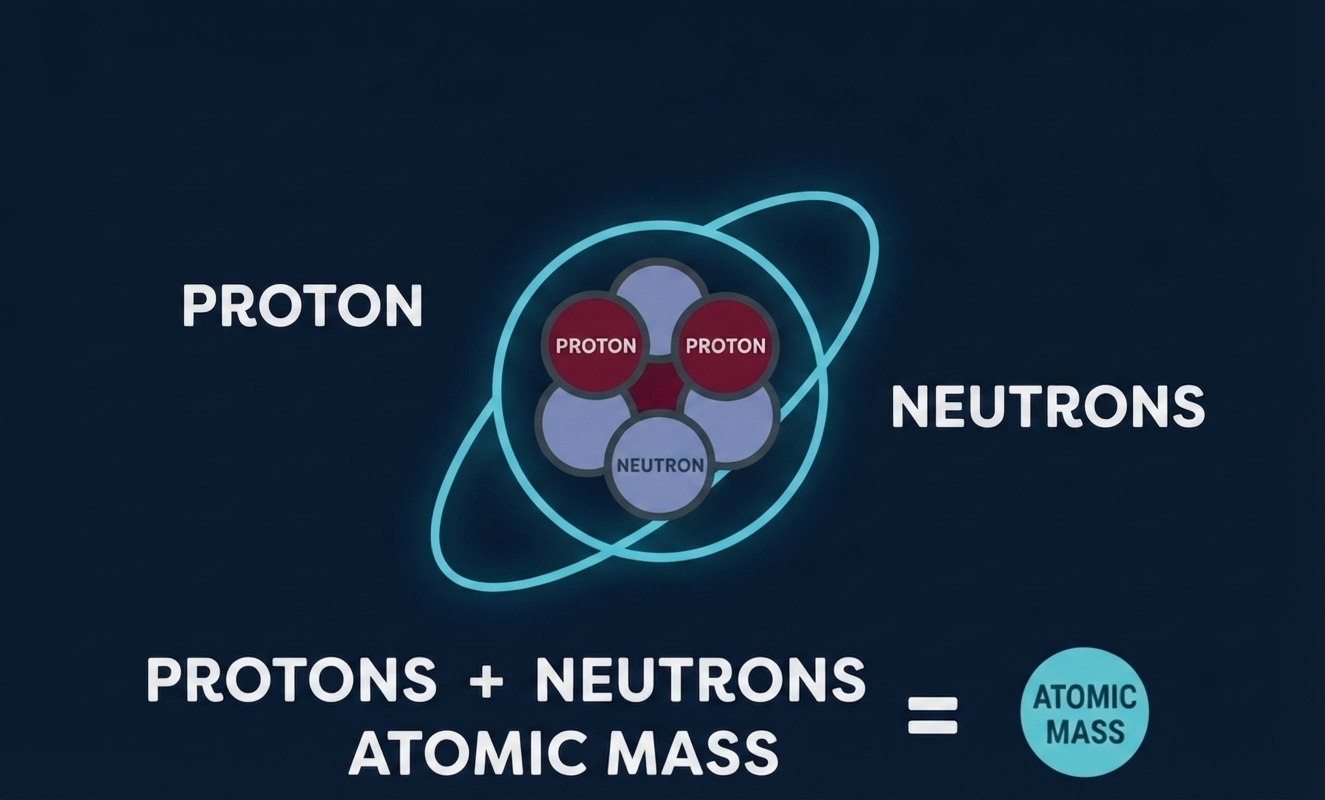
Atomic mass refers to the mass of an atom and is generally expressed in atomic mass units (u) or daltons (Da).
It is important to distinguish between mass number and atomic mass. The mass number refers to a particular isotope and is always a whole number because it represents the total number of protons and neutrons.
In contrast, the atomic mass listed for an element in the periodic table is generally a weighted average of the masses of its naturally occurring isotopes. Consequently, atomic masses shown on the periodic table are often decimal values.
Isotopes
Isotopes are atoms of the same element that contain the same number of protons but different numbers of neutrons.
Since isotopes have the same number of protons, they have the same atomic number. However, because they contain different numbers of neutrons, they have different mass numbers.
Carbon provides a classic example. Important isotopes of carbon include carbon-12, carbon-13, and carbon-14.
All of these isotopes contain six protons, but their neutron numbers differ.
Biological Importance of Isotopes
Isotopes have enormous importance in biological research, medicine, biochemistry, ecology, and molecular biology.
Radioactive isotopes can be used as tracers to follow the movement or transformation of molecules within biological systems. For example, carbon-14 has historically been used to study metabolic pathways and the incorporation of carbon into biological molecules.
Radioactive phosphorus-32 is widely used in molecular biology for labeling nucleic acids and studying DNA and RNA-related processes. Tritium, represented as hydrogen-3, has also been used in biochemical research as a radioactive tracer.
Stable isotopes such as carbon-13 and nitrogen-15 are valuable in metabolic tracing, isotope-labeling experiments, structural biology, and nuclear magnetic resonance studies.
Ions and Ion Formation
An ion is an electrically charged atom or molecule formed when electrons are gained or lost.
When an atom loses one or more electrons, it becomes positively charged and is called a cation. When an atom gains one or more electrons, it becomes negatively charged and is called an anion.
Cations
A cation is formed when an atom loses electrons.
For example:
Na → Na+ + e−
Sodium loses one electron and forms a positively charged sodium ion.
Anions
An anion is formed when an atom gains electrons.
For example:
Cl + e− → Cl−
Chlorine gains one electron and forms a negatively charged chloride ion.
Biological Importance of Ions
Ions are essential components of living systems. Sodium, potassium, calcium, magnesium, chloride, phosphate, and several other ions participate in numerous cellular processes.
Na+ and K+ are essential for establishing and maintaining membrane potential. Their concentration gradients across cell membranes are fundamental to nerve impulse transmission and many transport processes.
Ca2+ functions as an important intracellular signaling molecule and participates in processes such as muscle contraction, neurotransmitter release, fertilization, and enzyme regulation.
Mg2+ is important for enzyme activity and interacts with ATP and nucleic acids. Chloride contributes to osmotic balance and electrical neutrality in biological fluids.
Development of Atomic Models
Our modern understanding of atomic structure developed gradually through a series of scientific experiments and theoretical models. Each atomic model attempted to explain the observations available at that time. When new experimental evidence revealed limitations in an existing model, scientists proposed a more advanced model.
The major stages in the development of atomic structure are:
- Dalton’s Atomic Theory
- Thomson’s Atomic Model
- Rutherford’s Nuclear Model
- Bohr’s Atomic Model
- Quantum Mechanical Model
1. Dalton’s Atomic Theory
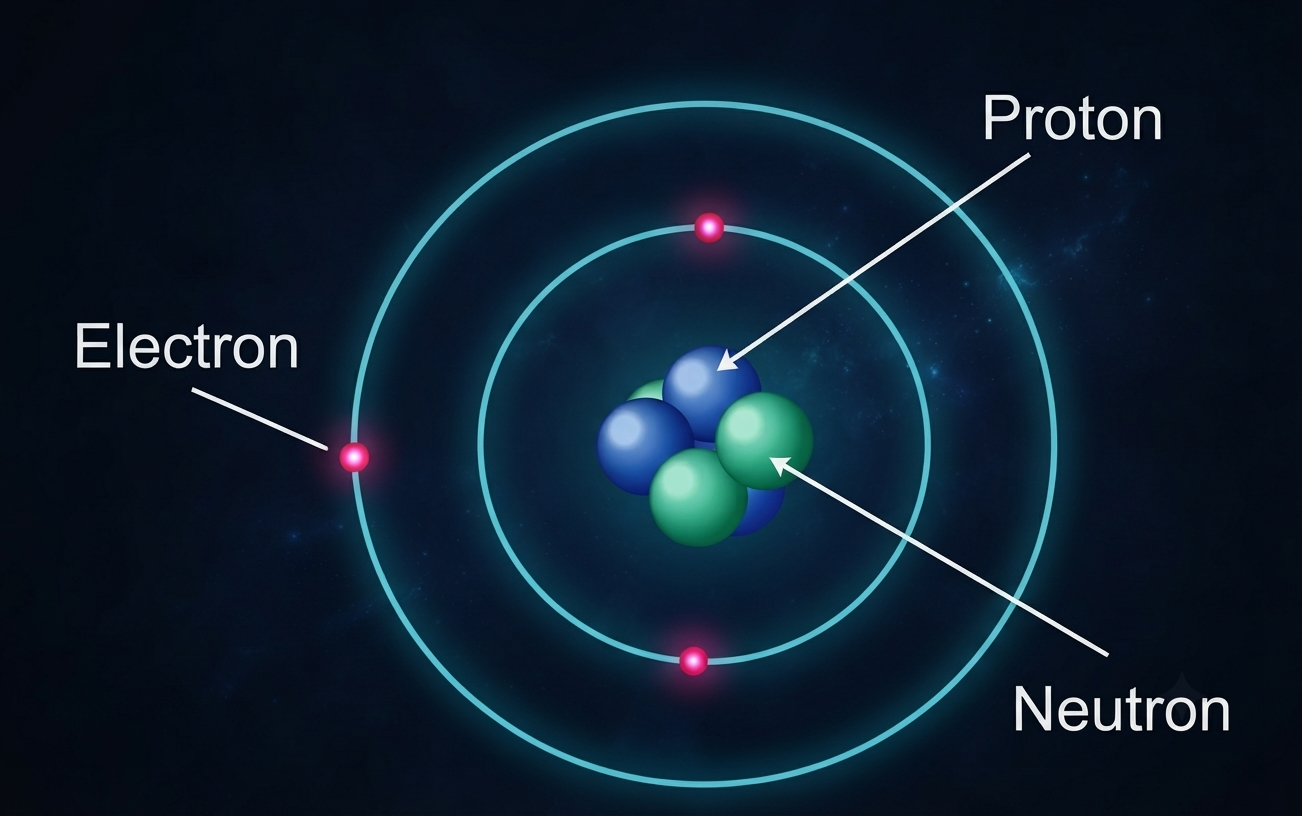
John Dalton proposed his atomic theory in the early nineteenth century to explain the laws of chemical combination. Dalton’s theory provided the first systematic scientific explanation of matter in terms of atoms.
Major Postulates of Dalton’s Atomic Theory
- All matter is composed of extremely small particles called atoms. According to Dalton, atoms were the fundamental units of matter.
- Atoms cannot be created, destroyed, or subdivided during ordinary chemical reactions. In a chemical reaction, atoms are rearranged to form new substances.
- Atoms of the same element are identical in mass and chemical properties.
- Atoms of different elements have different masses and chemical properties.
- Atoms combine in simple whole-number ratios to form compounds.
- In a particular compound, the relative number and types of atoms remain fixed.
Laws Explained by Dalton’s Atomic Theory
1. Law of Conservation of Mass
The law of conservation of mass states that mass can neither be created nor destroyed during an ordinary chemical reaction. The total mass of the reactants is equal to the total mass of the products.
At the atomic level, this can be understood because chemical reactions involve the rearrangement of atoms rather than the creation or destruction of atoms.
Example:
In the reaction:
2H2 + O2 → 2H2O
The number of hydrogen and oxygen atoms remains the same before and after the reaction. Therefore, the total mass is conserved.
2. Law of Definite Proportions
The law of definite proportions, also called the law of constant composition, states that a pure chemical compound always contains the same elements in the same fixed proportion by mass, regardless of its source or method of preparation.
For example, pure water always contains hydrogen and oxygen in a definite mass ratio.
The law can be understood using Dalton’s idea that atoms combine in fixed numerical ratios. Water always has the molecular composition H2O.
3. Law of Multiple Proportions
The law of multiple proportions states that when two elements combine to form more than one compound, the masses of one element that combine with a fixed mass of the other element are in simple whole-number ratios.
A classic example is provided by carbon and oxygen, which form carbon monoxide and carbon dioxide.
CO: one carbon atom combines with one oxygen atom.
CO2: one carbon atom combines with two oxygen atoms.
Thus, the relative amount of oxygen combining with the same amount of carbon occurs in a simple whole-number ratio.
4. Law of Reciprocal Proportions
The law of reciprocal proportions states that when two elements separately combine with a fixed mass of a third element, the ratio in which they combine with each other is either the same or a simple multiple of the ratio of their separate combining masses with the third element.
This law is another important relationship associated with the quantitative study of chemical combination and supports the concept that elements combine according to definite quantitative relationships.
Limitations of Dalton’s Atomic Theory
- Atoms are not indivisible. Dalton considered atoms indivisible, but the discovery of electrons, protons, and neutrons demonstrated that atoms contain smaller subatomic particles.
- Atoms of the same element are not always identical in mass. The discovery of isotopes showed that atoms of the same element can contain different numbers of neutrons and therefore have different masses. For example, 12C, 13C, and 14C are isotopes of carbon.
- It could not explain atomic structure and chemical behavior. Dalton’s theory did not explain electrons, energy levels, chemical bonding, electronic configuration, atomic spectra, or ion formation.
2. Thomson’s Atomic Model

J. J. Thomson discovered the electron through his experiments with cathode rays. This discovery demonstrated that atoms are divisible and contain negatively charged subatomic particles.
Thomson proposed the plum-pudding model of the atom. According to this model, the atom consisted of a diffuse region of positive charge in which negatively charged electrons were embedded.
Main Features of Thomson’s Model
- The atom contains negatively charged electrons.
- A positive charge is distributed throughout the atom.
- Electrons are embedded within the positively charged region.
- The total positive charge balances the total negative charge.
- Therefore, the atom as a whole is electrically neutral.
Importance of Thomson’s Model
Thomson’s model was important because it established that the atom is not indivisible. The discovery of the electron introduced the concept of subatomic particles and represented a major improvement over Dalton’s theory.
Limitations of Thomson’s Atomic Model
- It could not explain the existence of the nucleus. Thomson assumed that positive charge was distributed throughout the atom, whereas Rutherford later demonstrated that positive charge is concentrated in a tiny central nucleus.
- It could not explain alpha-particle scattering. The large-angle deflection of a small fraction of alpha particles observed in Rutherford’s experiment was inconsistent with a uniformly distributed positive charge.
- It could not explain atomic spectra and electron arrangement. The model provided no satisfactory explanation for discrete atomic energy levels, line spectra, or the detailed arrangement of electrons.
3. Rutherford’s Nuclear Model
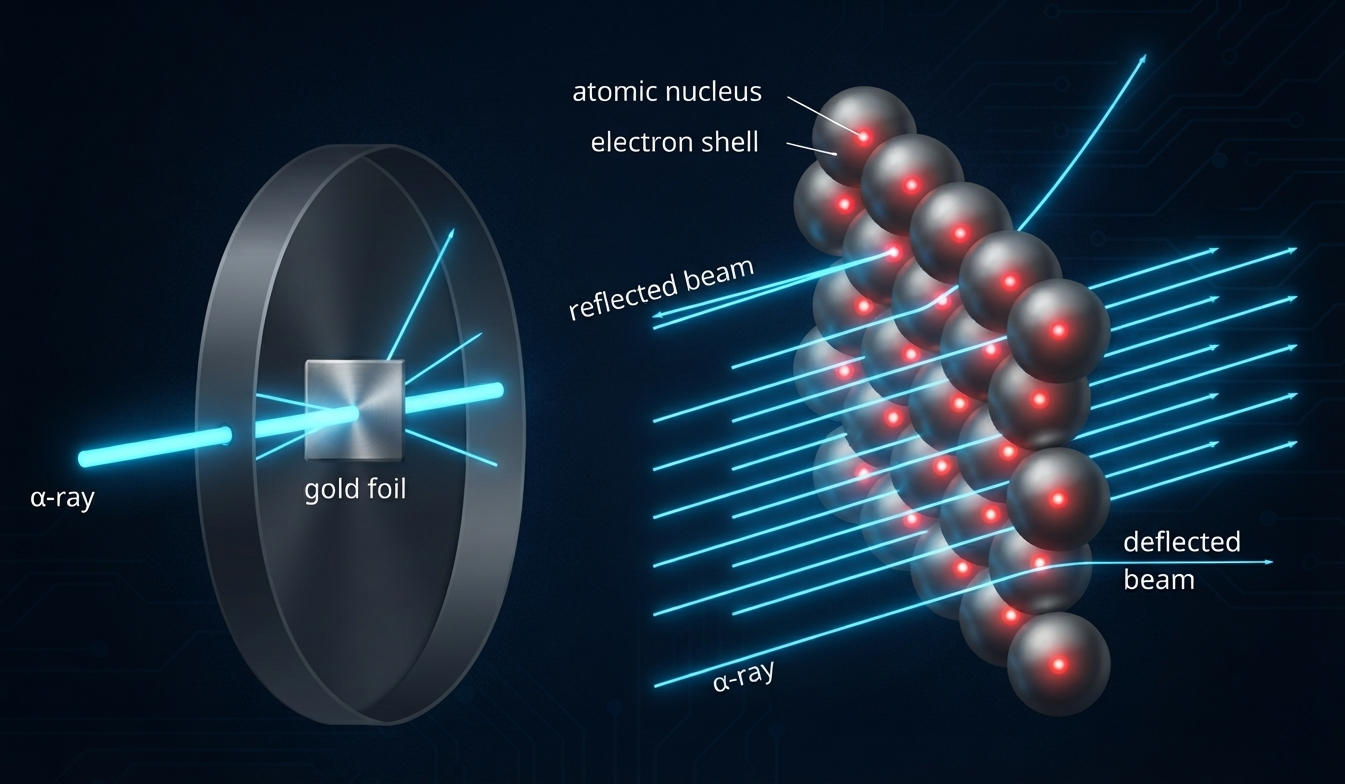
Ernest Rutherford, along with his collaborators, performed the famous alpha-particle scattering experiment using a thin gold foil. This experiment provided strong evidence for the existence of a small, dense atomic nucleus.
Rutherford’s Alpha-Particle Scattering Experiment
In the experiment, positively charged alpha particles were directed toward a very thin sheet of gold foil. A detector was used to observe the directions in which the particles emerged after interacting with the foil.
Major Observations
- Most alpha particles passed through the gold foil without significant deflection.
- Some alpha particles were deflected through small angles.
- A very small number of alpha particles were deflected through very large angles, and a few were scattered backward.
Conclusions of Rutherford’s Experiment
Rutherford concluded that most of the atom is empty space. Almost all of the positive charge and most of the mass are concentrated in a very small, dense central region called the nucleus.
Electrons are present outside the nucleus, occupying the remaining volume of the atom.
Main Features of Rutherford’s Nuclear Model
- The atom contains a tiny central nucleus.
- The nucleus contains positive charge.
- Most of the atomic mass is concentrated in the nucleus.
- Electrons are present outside the nucleus.
- Most of the volume of an atom is empty space.
Limitations of Rutherford’s Nuclear Model
- It could not explain atomic stability. According to classical electromagnetic theory, an accelerating charged electron should continuously lose energy by radiation. The electron would therefore lose energy and spiral into the nucleus. However, atoms are stable.
- It could not explain line spectra. Atoms produce characteristic discrete spectral lines, but Rutherford’s model could not explain why electrons emit or absorb only specific amounts of energy.
- It did not explain the arrangement and energy of electrons. The model established the existence of the nucleus but did not specify how electrons are distributed around it or why electrons should possess particular energies.
4. Bohr’s Atomic Model
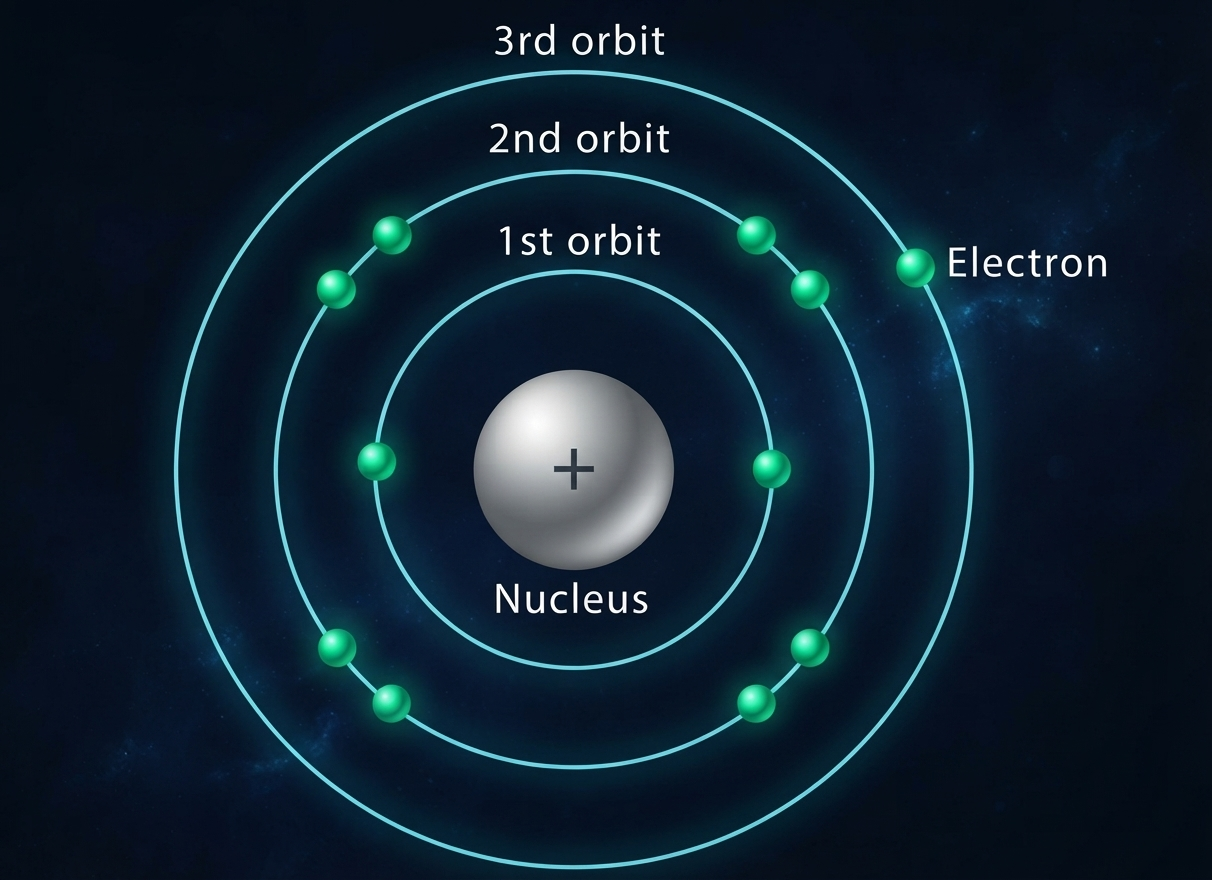
In 1913, Niels Bohr proposed an atomic model that incorporated the idea of quantized energy levels into Rutherford’s nuclear model. Bohr developed his model mainly to explain the stability and line spectrum of the hydrogen atom.
Main Postulates of Bohr’s Model
- Electrons revolve around the nucleus only in certain permitted energy levels or stationary states.
- An electron in an allowed stationary state does not continuously radiate energy.
- Electrons can move from one energy level to another by absorbing or emitting a definite amount of energy.
- The energy absorbed or emitted is equal to the difference between the two energy levels.
The energy associated with electromagnetic radiation is given by:
E = hν
Therefore, during an electronic transition:
ΔE = hν
Bohr also proposed that the angular momentum of an electron is quantized:
mvr = nh/2π
where n = 1, 2, 3, 4, … represents the principal quantum number.
Ground State and Excited State
The lowest energy state of an atom is called the ground state. When an electron absorbs energy and moves to a higher energy level, the atom is said to be in an excited state.
When the electron returns from a higher energy level to a lower energy level, energy is released as electromagnetic radiation.
Successes of Bohr’s Model
- It explained the stability of the hydrogen atom.
- It introduced the concept of quantized energy levels.
- It successfully explained the hydrogen emission spectrum.
- It worked well for hydrogen-like one-electron species such as H, He+, and Li2+.
Limitations of Bohr’s Atomic Model
- It could not satisfactorily explain multi-electron atoms. The model works well for hydrogen and hydrogen-like species but becomes inadequate when electron-electron interactions are present.
- It could not explain several spectral phenomena. The simple Bohr model could not adequately explain the fine structure of spectral lines and phenomena such as the Zeeman effect and Stark effect.
- It is inconsistent with modern quantum mechanics. Bohr’s model assumes electrons move in definite circular orbits, whereas quantum mechanics describes electrons using wave functions and probability distributions.
5. Quantum Mechanical Model of the Atom
The quantum mechanical model is the modern model used to describe atomic structure. It developed from the work of several scientists, including Louis de Broglie, Werner Heisenberg, Erwin Schrödinger, Max Born, Wolfgang Pauli, and others.
Unlike the Bohr model, the quantum mechanical model does not describe electrons as particles moving around the nucleus in fixed circular paths. Instead, electrons are described using mathematical wave functions and probability distributions.
Wave Nature of Electrons
Louis de Broglie proposed that particles such as electrons possess wave-like properties. The wavelength associated with a moving particle is expressed as:
λ = h/p
where λ is the wavelength, h is Planck’s constant, and p is momentum.
Heisenberg’s Uncertainty Principle
Werner Heisenberg proposed the uncertainty principle, which states that the position and momentum of a particle cannot both be known with unlimited precision simultaneously.
The principle is expressed as:
Δx Δp ≥ ℏ/2
This means that an electron cannot be described as moving along a precisely defined classical path around the nucleus.
Schrödinger Wave Equation
Erwin Schrödinger developed a wave equation that provides a mathematical description of the quantum state of an electron.
The solution of the Schrödinger equation gives a wave function represented by ψ. The square of the wave function provides the probability density of finding an electron:
|ψ|2 = probability density
Atomic Orbital
The region of space around the nucleus in which there is a high probability of finding an electron is called an atomic orbital.
The major types of orbitals are:
- s orbital: 1 orbital, maximum 2 electrons
- p subshell: 3 orbitals, maximum 6 electrons
- d subshell: 5 orbitals, maximum 10 electrons
- f subshell: 7 orbitals, maximum 14 electrons
Quantum Numbers
The quantum mechanical model describes electrons using four quantum numbers:
- Principal quantum number (n): Describes the principal energy level.
- Azimuthal quantum number (l): Describes the subshell and orbital shape.
- Magnetic quantum number (ml): Describes the orientation of the orbital.
- Spin quantum number (ms): Describes the spin state of the electron.
Electronic Configuration
The arrangement of electrons in different orbitals is called the electronic configuration. Electron distribution is governed by the Aufbau principle, Pauli exclusion principle, and Hund’s rule.
Limitations and Practical Challenges of the Quantum Mechanical Model
The quantum mechanical model is the most successful modern framework for describing atomic and molecular structure. Therefore, its limitations are mainly related to mathematical complexity and the need for approximations in complex systems rather than fundamental failure.
- Exact solutions are generally not possible for complex multi-electron atoms. Electron-electron interactions make the mathematical equations extremely complicated, so approximate methods are required for many-electron systems.
- It becomes computationally demanding for large biological molecules. Molecules such as proteins and nucleic acids contain very large numbers of atoms and electrons, making a complete exact quantum mechanical treatment impractical.
- More advanced theories are required for certain situations. The basic non-relativistic quantum mechanical model is not sufficient for all relativistic and highly precise phenomena, where approaches such as relativistic quantum mechanics and quantum electrodynamics may be required.
Comparison of Atomic Models
| Atomic Model | Main Concept | Major Contribution | Major Limitation |
|---|---|---|---|
| Dalton | Atom as an indivisible particle | Provided the first scientific atomic theory | Could not explain subatomic particles and isotopes |
| Thomson | Electrons embedded in positive charge | Introduced the electron into atomic structure | Could not explain the nucleus or alpha-particle scattering |
| Rutherford | Small, dense, positive nucleus surrounded by electrons | Established the nuclear structure of the atom | Could not explain atomic stability and line spectra |
| Bohr | Electrons occupy quantized energy levels | Explained hydrogen spectrum and atomic stability | Failed for complex multi-electron atoms and several spectral effects |
| Quantum Mechanical | Electrons described by wave functions and probability distributions | Provides the modern framework for atomic structure | Exact treatment becomes mathematically and computationally difficult for complex systems |
Atomic Orbitals
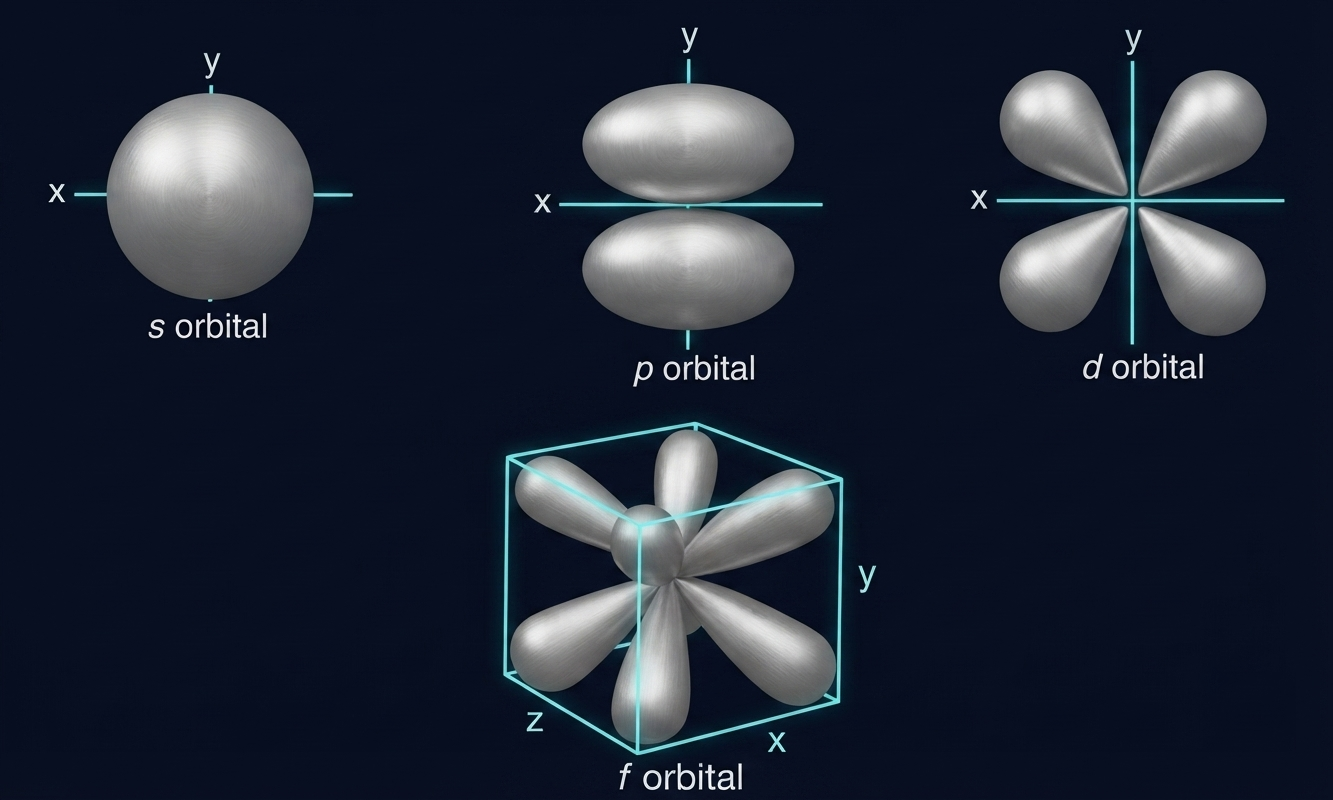
An atomic orbital is a mathematical description of the probability distribution of an electron around the nucleus.
The four major types of atomic orbitals are:
- s orbital
- p orbital
- d orbital
- f orbital
s Orbital
The s orbital is approximately spherical in shape. Each s subshell contains one orbital and can accommodate a maximum of two electrons.
p Orbital
The p subshell contains three orbitals. Since each orbital can accommodate a maximum of two electrons, the p subshell can hold a maximum of six electrons.
The three p orbitals are conventionally designated as px, py, and pz, corresponding to their orientations along different spatial axes.
d Orbital
The d subshell contains five orbitals and can accommodate a maximum of ten electrons.
f Orbital
The f subshell contains seven orbitals and can accommodate a maximum of fourteen electrons.
| Subshell | Number of Orbitals | Maximum Number of Electrons |
|---|---|---|
| s | 1 | 2 |
| p | 3 | 6 |
| d | 5 | 10 |
| f | 7 | 14 |
Principal Energy Levels and Shells
Electrons occupy different principal energy levels, which are represented by the principal quantum number n.
The principal quantum number can have values such as:
n = 1, 2, 3, 4, …
These levels are often described as shells and may also be represented by the letters K, L, M, N, and so on.
As the principal quantum number increases, the average distance of the electron from the nucleus generally increases, and the electron is associated with a higher energy level.
Quantum Numbers
The position and state of an electron in an atom are described using four quantum numbers. These are the principal quantum number, azimuthal quantum number, magnetic quantum number, and spin quantum number.
Principal Quantum Number
The principal quantum number is represented by n. It describes the principal energy level or shell occupied by an electron.
The possible values are positive integers:
n = 1, 2, 3, 4, …
Azimuthal Quantum Number
The azimuthal quantum number is represented by l. It describes the subshell and the shape of the orbital.
For a given value of n, the possible values of l range from:
l = 0 to n − 1
The values correspond to:
- l = 0: s subshell
- l = 1: p subshell
- l = 2: d subshell
- l = 3: f subshell
Magnetic Quantum Number
The magnetic quantum number is represented by ml. It describes the orientation of an orbital in space.
For a given value of l, the possible values of ml range from −l to +l, including zero.
Spin Quantum Number
The spin quantum number is represented by ms. An electron can have one of two possible spin states:
+1/2 or −1/2
The four quantum numbers are important for describing the electronic structure of atoms and form an important conceptual area for CSIR NET questions involving atomic and molecular structure.
Electronic Configuration
The arrangement of electrons in different energy levels, subshells, and orbitals is known as the electronic configuration of an atom.
Electron distribution follows important principles, including the Aufbau principle, Pauli exclusion principle, and Hund’s rule.
Aufbau Principle
The Aufbau principle states that electrons generally occupy available orbitals in order of increasing energy.
In simplified terms, lower-energy orbitals are occupied before higher-energy orbitals.
Pauli Exclusion Principle
The Pauli exclusion principle states that no two electrons in an atom can have an identical set of all four quantum numbers.
Consequently, an individual orbital can contain a maximum of two electrons, and those two electrons must have opposite spins.
Hund’s Rule
Hund’s rule states that when electrons occupy degenerate orbitals, they tend to occupy separate orbitals with parallel spins before pairing occurs.
Example of Electronic Configuration
Carbon has an atomic number of 6 and therefore contains six electrons in its neutral state.
Its electronic configuration can be written as:
1s2 2s2 2p2
The two electrons in the 2p subshell are particularly important in determining the chemical behavior of carbon.
Carbon’s electronic configuration helps explain why carbon can form four covalent bonds and why it is capable of generating a remarkably diverse range of biological molecules.
Valence Electrons
The electrons present in the outermost occupied energy level are commonly referred to as valence electrons.
Valence electrons are particularly important because they participate in chemical bonding and strongly influence the chemical reactivity of an element.
In biological systems, the behavior of valence electrons contributes to the formation and stability of biomolecules.
Carbon, for example, has four valence electrons and can form stable covalent bonds with carbon itself and with elements such as hydrogen, oxygen, nitrogen, sulfur, and phosphorus.
Why Carbon Is Important in Biological Systems
Carbon is the central element of organic chemistry and biochemistry. Its ability to form four stable covalent bonds allows it to generate an enormous variety of molecular structures.
Carbon atoms can form straight chains, branched chains, rings, aromatic systems, and highly complex three-dimensional molecular frameworks.
The major classes of biological molecules, including carbohydrates, lipids, proteins, and nucleic acids, contain carbon as a major structural component.
Therefore, understanding the electronic structure and bonding capacity of carbon is essential for understanding the molecular basis of life.
Atomic Structure and Chemical Bonding
The arrangement of electrons determines how atoms interact with one another. These interactions lead to the formation of chemical bonds and molecular structures.
Covalent Bonds
Covalent bonds involve the sharing of electron pairs between atoms. They are among the most important bonds in biological molecules.
The backbone of proteins, nucleic acids, carbohydrates, and many other biomolecules depends extensively on covalent bonding.
Ionic Interactions
Ionic interactions arise from electrostatic attraction between oppositely charged species. These interactions can contribute significantly to the structure and stability of proteins and other biomolecules.
Hydrogen Bonds
Hydrogen bonds are weaker than covalent bonds individually but are extremely important in biological systems.
Hydrogen bonding contributes to DNA base pairing, protein secondary structure, water properties, molecular recognition, and interactions between biological macromolecules.
Van der Waals Interactions
Van der Waals interactions arise from attractive forces associated with temporary or permanent distributions of electrical charge.
Although individual van der Waals interactions are weak, large numbers of such interactions can contribute significantly to molecular stability.
Atomic Structure and Biological Molecules
Every biological molecule is ultimately composed of atoms. The arrangement of these atoms and the interactions between them determine the physical and chemical properties of the molecule.
In proteins, the properties of carbon, hydrogen, oxygen, nitrogen, sulfur, and other elements contribute to amino acid structure and protein folding.
In nucleic acids, carbon, hydrogen, oxygen, nitrogen, and phosphorus form the structural framework of nucleotides and polynucleotides.
In carbohydrates, carbon, hydrogen, and oxygen form the basic molecular framework, while specific bonding patterns determine the properties of different sugars and polysaccharides.
Lipids contain carbon and hydrogen-rich structures that contribute to their hydrophobic nature, while polar groups containing elements such as oxygen, nitrogen, phosphorus, or sulfur can provide additional chemical properties.
Atomic Structure and Water
Water is one of the most important molecules in biological systems, and its properties are closely related to the atomic structure and electron distribution of hydrogen and oxygen.
Oxygen is more electronegative than hydrogen, resulting in a polar water molecule. This polarity allows water molecules to form hydrogen bonds with one another and with many other biological molecules.
Water’s polarity contributes to its ability to dissolve many ionic and polar substances and plays a major role in maintaining the organization of biological systems.
Atomic Structure and Biological Ions
Several elements are essential for life because their atoms can form ions that participate in physiological and biochemical processes.
Sodium
Sodium commonly exists as Na+ in biological systems. It contributes to membrane potential, osmotic regulation, and several transport processes.
Potassium
Potassium exists primarily as K+ inside cells and is essential for maintaining membrane potential and supporting normal cellular function.
Calcium
Calcium ions, Ca2+, function as important signaling molecules. They participate in muscle contraction, neurotransmitter release, secretion, fertilization, and numerous signaling pathways.
Magnesium
Magnesium ions, Mg2+, are important cofactors for many enzymes and interact with ATP and nucleic acids.
Iron
Iron is essential for oxygen transport in hemoglobin and participates in electron-transfer reactions through proteins such as cytochromes and iron-sulfur proteins.
Atomic Structure and Spectroscopy
The interaction between atoms or molecules and electromagnetic radiation is closely related to their electronic structure.
Electrons can absorb or release specific amounts of energy when they undergo transitions between different energy states. These transitions form the basis of several spectroscopic techniques.
Important analytical methods connected to these principles include UV-visible spectroscopy, fluorescence spectroscopy, atomic absorption spectroscopy, nuclear magnetic resonance spectroscopy, and mass spectrometry.
Understanding atomic and molecular structure therefore helps students understand the theoretical foundation of several techniques used in biological research.
Atomic Structure and Energy Levels
Electrons are associated with specific energy states. The energy of an electron depends on the orbital and the overall electronic environment of the atom.
When an electron absorbs energy, it may move to a higher-energy state. When it returns to a lower-energy state, energy can be released.
The energy associated with electromagnetic radiation is related to its frequency according to:
E = hν
where E is energy, h is Planck’s constant, and ν is frequency.
This relationship becomes particularly important when studying spectroscopy and molecular energy transitions.
Atomic Structure and Electronegativity
Electronegativity refers to the tendency of an atom to attract shared electrons toward itself in a chemical bond.
Differences in electronegativity between atoms influence bond polarity. This is highly relevant to biological chemistry because molecular polarity affects solubility, intermolecular interactions, hydrogen bonding, membrane association, and protein structure.
Oxygen and nitrogen, for example, frequently contribute to polar functional groups in biomolecules. Carbon-hydrogen bonds are generally less polar, contributing to the hydrophobic character of many organic structures.
Atomic Structure and Oxidation-Reduction Reactions
Atomic and electronic structure is also fundamental to oxidation-reduction or redox reactions.
Oxidation can be described as the loss of electrons, while reduction can be described as the gain of electrons.
Redox reactions are extremely important in biological systems. Cellular respiration, photosynthesis, electron transport chains, and many metabolic pathways involve the transfer of electrons between molecules.
Therefore, understanding how electrons are distributed and transferred at the atomic level helps explain the molecular basis of biological energy metabolism.
Atomic Structure and Biological Energy
The organization of electrons and the ability of atoms and molecules to participate in redox reactions are closely related to biological energy transformations.
During cellular respiration, electrons are transferred through a series of electron carriers. The energy released through these reactions contributes to the establishment of a proton gradient that ultimately drives ATP synthesis.
Similarly, photosynthetic organisms use light energy to drive electron-transfer reactions that ultimately support the synthesis of energy-rich molecules.
Thus, even advanced topics such as oxidative phosphorylation and photosynthetic electron transport can ultimately be connected to the behavior of electrons.
Atomic Structure and the Periodic Table
The periodic table organizes elements according to their atomic number and recurring patterns in their electronic structures.
Elements within the same group often show related chemical behavior because they have similar patterns of valence electrons.
Understanding periodic trends such as atomic radius, ionization energy, electron affinity, and electronegativity helps explain why different elements behave differently in biological and chemical systems.
Ionization Energy
Ionization energy is the energy required to remove an electron from an isolated gaseous atom or ion under specified conditions.
Ionization energy provides information about how strongly an electron is held by an atom. It generally increases across a period and decreases down a group, although several exceptions occur because of electron configuration and subshell effects.
This concept becomes useful when understanding why certain elements readily form positive ions while others do not.
Electron Affinity
Electron affinity describes the energy change associated with the addition of an electron to a neutral gaseous atom.
It is related to the tendency of atoms to accept electrons and is therefore relevant to the formation of anions and the chemical reactivity of elements.
Atomic Structure and Molecular Biology
Molecular biology is fundamentally based on interactions between atoms and molecules. DNA replication, transcription, translation, enzyme catalysis, protein folding, and molecular recognition all depend on chemical interactions.
The hydrogen bonds between complementary bases help stabilize DNA structure. Covalent phosphodiester bonds form the backbone of nucleic acids. Peptide bonds connect amino acids in proteins. Disulfide bonds can stabilize certain protein structures through interactions involving sulfur atoms.
These examples demonstrate that atomic structure is not an isolated chemistry concept. It is directly connected to the molecular mechanisms of life.
Atomic Structure in Enzyme Function
Enzyme activity depends on precise interactions between the enzyme and its substrate. These interactions involve atoms and functional groups positioned within the active site.
Hydrogen bonding, ionic interactions, van der Waals forces, hydrophobic interactions, and covalent interactions can all contribute to enzyme-substrate recognition and catalysis.
Metal ions such as Mg2+, Zn2+, Fe2+, Fe3+, and Mn2+ can also function as cofactors in enzymatic reactions.


