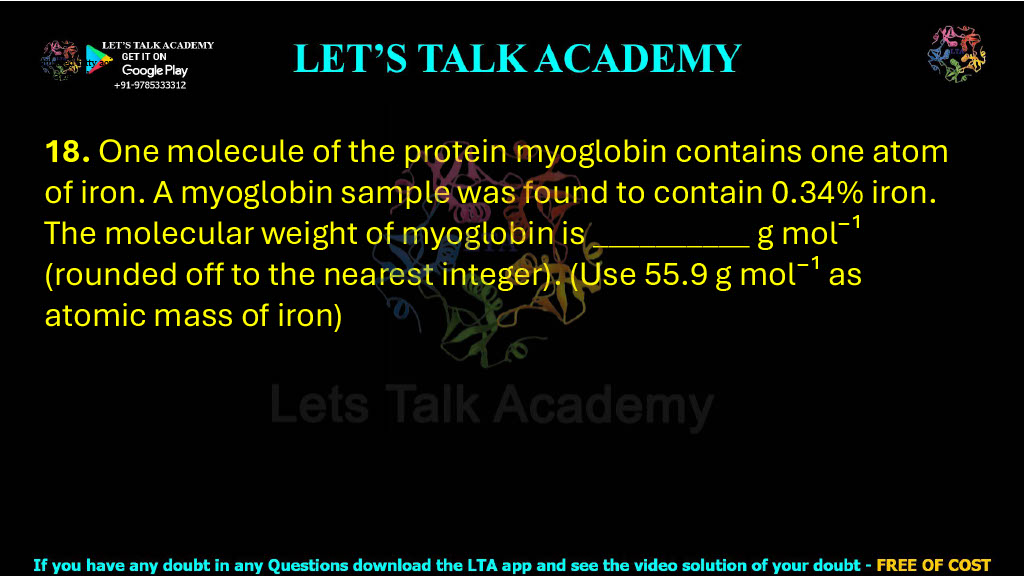
18. One molecule of the protein myoglobin contains one atom of iron. A myoglobin sample was found to contain 0.34% iron. The molecular weight of myoglobin is __________ g mol⁻¹ (rounded off to the nearest integer). (Use 55.9 g mol⁻¹ as atomic mass of iron)
Molecular Weight of Myoglobin from Iron Content
Correct Answer
16,441 g mol⁻¹
Introduction
Myoglobin is a small oxygen-binding globular protein primarily found in the skeletal and cardiac muscles of vertebrates. Its principal function is to store oxygen and facilitate its diffusion within muscle cells, ensuring a continuous supply during periods of high metabolic demand. Structurally, each myoglobin molecule consists of a single polypeptide chain and contains one heme group, which in turn possesses one iron (Fe) atom. Because each myoglobin molecule contains exactly one iron atom, the percentage of iron present in the protein can be used to determine its molecular weight.
Numerical problems based on percentage composition are among the most frequently asked questions in CSIR NET Life Sciences, GATE Biotechnology, IIT JAM, CUET PG, NEET PG, and university entrance examinations. These questions test a student’s understanding of percentage calculations, molecular weight relationships, and protein chemistry rather than memorization. Once the underlying concept is understood, such numericals become straightforward and can be solved within a few seconds during examinations.
Understanding the Concept Behind the Question
The question states that one molecule of myoglobin contains one atom of iron. Therefore, one mole of myoglobin contains exactly one mole of iron atoms.
The atomic mass of one mole of iron is given as:
Atomic mass of Fe = 55.9 g mol⁻¹
The protein contains 0.34% iron by mass, meaning that in every 100 g of pure myoglobin, the amount of iron present is 0.34 g.
Using the definition of percentage composition, the molecular weight of myoglobin can be calculated directly because the mass of one mole of iron corresponds to one mole of myoglobin.
Formula Used
The percentage composition formula is:
Percentage of Iron = (Mass of Iron / Molecular Weight of Myoglobin) × 100
Rearranging the equation to calculate molecular weight:
Molecular Weight of Myoglobin = (Mass of Iron × 100) / Percentage of Iron
Step-by-Step Calculation
Step 1: Write the Given Data
Atomic mass of iron (Fe)
= 55.9 g mol⁻¹
Percentage of iron
= 0.34%
One molecule of myoglobin contains
= One atom of iron
Step 2: Apply the Formula
Molecular Weight = (55.9 × 100) / 0.34
Step 3: Multiply the Numerator
55.9 × 100 = 5590
Therefore,
Molecular Weight = 5590 / 0.34
Step 4: Perform the Division
5590 ÷ 0.34 = 16,441.18
Rounded to the nearest integer,
Molecular Weight = 16,441 g mol⁻¹
Final Answer
Molecular Weight of Myoglobin = 16,441 g mol⁻¹
Why Does This Formula Work?
The formula is based on the definition of percentage composition. Since every myoglobin molecule contains exactly one iron atom, one mole of myoglobin contains one mole of iron, which weighs 55.9 g.
If this amount of iron represents 0.34% of the total mass of the protein, then the total molecular weight must be much larger. Rearranging the percentage formula allows us to determine the molecular weight directly without requiring any additional information.
This approach is commonly used in biochemistry to determine the molecular weights of metalloproteins containing a fixed number of metal atoms.
Biological Importance of Myoglobin
Myoglobin is an oxygen-storage protein found predominantly in muscle tissue. Unlike hemoglobin, which transports oxygen through the bloodstream, myoglobin stores oxygen inside muscle cells and releases it when oxygen levels decrease during vigorous physical activity.
The heme group of myoglobin contains a single ferrous iron (Fe²⁺) atom that binds oxygen reversibly. This enables muscle cells to maintain aerobic metabolism even during periods of intense exercise when oxygen demand exceeds oxygen supply.
Because myoglobin contains only one polypeptide chain and one heme group, it serves as an excellent model protein for studying protein structure, oxygen binding, and metalloprotein chemistry.
Myoglobin vs Hemoglobin
Although myoglobin and hemoglobin both contain heme and bind oxygen, they differ significantly in structure and function.
| Feature | Myoglobin | Hemoglobin |
|---|---|---|
| Number of Polypeptide Chains | 1 | 4 |
| Number of Heme Groups | 1 | 4 |
| Number of Iron Atoms | 1 | 4 |
| Primary Function | Oxygen storage | Oxygen transport |
| Location | Muscle cells | Red blood cells |
Because each myoglobin molecule contains only one iron atom, percentage composition calculations become much simpler than those involving hemoglobin.s incorrectly by using 0.0034 instead of 0.34. Since the formula already includes multiplication by 100, the percentage should be substituted directly as 0.34, not as its decimal equivalent.
High-Yield Exam Points
- Myoglobin contains one heme group.
- Each heme group contains one Fe²⁺ atom.
- Atomic mass of iron = 55.9 g mol⁻¹.
-
Percentage formula:
Percentage = (Part / Whole) × 100
-
Molecular weight formula:
Molecular Weight = (Mass of Iron × 100) / Percentage of Iron
-
Final molecular weight:
16,441 g mol⁻¹
Frequently Asked Questions
Why does one molecule of myoglobin contain only one iron atom?
Each myoglobin molecule contains a single heme prosthetic group, and each heme group contains one ferrous iron (Fe²⁺) atom responsible for oxygen binding.
Why is percentage composition used?
Percentage composition relates the mass of one component (iron) to the total molecular mass of the protein. Since the number of iron atoms per molecule is known, the molecular weight can be calculated directly.
Is the molecular weight of myoglobin approximately 17,000 Da?
Yes. The experimentally determined molecular weight of mammalian myoglobin is approximately 16.7 kDa, which agrees closely with the calculated value obtained from the percentage composition.
Key Takeaways
Myoglobin is a heme-containing oxygen-storage protein that possesses exactly one iron atom per molecule. Because the percentage of iron in the protein is known, the molecular weight can be calculated using the percentage composition formula. Substituting the atomic mass of iron (55.9 g mol⁻¹) and the iron percentage (0.34%) gives a molecular weight of 16,441 g mol⁻¹. This numerical illustrates an important application of percentage composition in protein chemistry and is frequently asked in competitive examinations.
Final Answer
Correct Answer: 16,441 g mol⁻¹
Explanation
Each molecule of myoglobin contains one iron atom, so one mole of myoglobin contains one mole of iron, which has a mass of 55.9 g. Since iron constitutes 0.34% of the total mass of myoglobin, the molecular weight is calculated using the percentage composition formula:
Molecular Weight = (55.9 × 100) ÷ 0.34
= 5590 ÷ 0.34
= 16,441.18 g mol⁻¹
Rounded to the nearest integer, the molecular weight of myoglobin is 16,441 g mol⁻¹.


