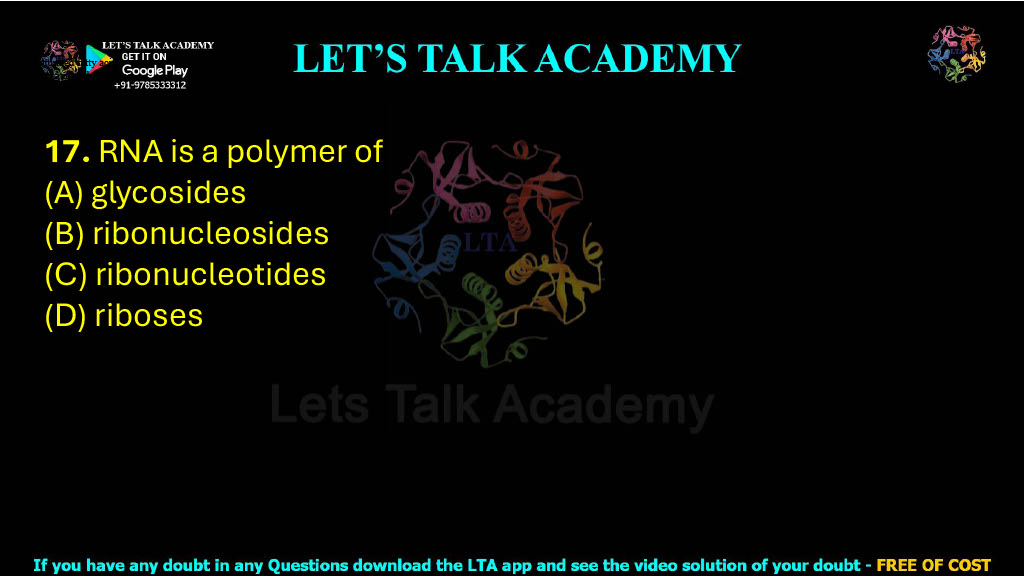
17. RNA is a polymer of
(A) glycosides
(B) ribonucleosides
(C) ribonucleotides
(D) riboses
RNA is a Polymer of Ribonucleotides
Correct Answer
Correct Option: (C) Ribonucleotides
Introduction
Ribonucleic acid (RNA) is one of the most important biological macromolecules present in all living organisms. It plays a central role in gene expression by carrying genetic information from DNA to ribosomes and participating directly in protein synthesis. In addition to messenger RNA (mRNA), transfer RNA (tRNA), and ribosomal RNA (rRNA), several regulatory RNA molecules such as microRNA (miRNA), small interfering RNA (siRNA), and long non-coding RNA (lncRNA) are involved in controlling gene expression and numerous cellular processes.
A fundamental concept in molecular biology is that RNA is a polymer of ribonucleotides. Understanding the difference between ribose, ribonucleosides, and ribonucleotides is extremely important because competitive examinations such as CSIR NET, GATE, IIT JAM, CUET PG, DBT BET, and NEET PG frequently test these closely related terms. Many students confuse nucleosides with nucleotides, making this a high-yield examination topic.
Why Option (C) is the Correct Answer
RNA is composed of repeating units called ribonucleotides, which are linked together by 3′–5′ phosphodiester bonds to form a long polynucleotide chain. Each ribonucleotide consists of three essential components: a ribose sugar, a nitrogenous base, and one phosphate group. The nitrogenous bases found in RNA are adenine (A), guanine (G), cytosine (C), and uracil (U).
During RNA synthesis, RNA polymerase joins ribonucleotides by forming phosphodiester bonds between the phosphate group of one nucleotide and the hydroxyl group of the next ribose sugar. Because these ribonucleotides are the repeating structural units of RNA, RNA is correctly described as a polymer of ribonucleotides.
Therefore, Option (C) is the correct answer.
Structure of a Ribonucleotide
A ribonucleotide contains three components:
- Nitrogenous Base (Adenine, Guanine, Cytosine, or Uracil)
- Ribose Sugar
- Phosphate Group
The phosphate group distinguishes a nucleotide from a nucleoside. During polymerization, these ribonucleotides are connected through phosphodiester linkages, forming the sugar-phosphate backbone of RNA.
Detailed Explanation of Every Option
Option (A): Glycosides
This option is incorrect because glycosides are compounds in which a sugar molecule is chemically linked to another functional group through a glycosidic bond. Although nucleosides contain an N-glycosidic bond between the sugar and the nitrogenous base, RNA itself is not composed of glycosides. RNA is specifically built from ribonucleotides linked together through phosphodiester bonds rather than glycosidic bonds. Therefore, glycosides cannot be considered the repeating units of RNA.
Option (B): Ribonucleosides
This option is incorrect because a ribonucleoside contains only two components: a ribose sugar and a nitrogenous base. It lacks the phosphate group that is essential for forming phosphodiester bonds during RNA synthesis. Since nucleosides cannot polymerize into nucleic acids without phosphate groups, RNA cannot be described as a polymer of ribonucleosides.
Examples of ribonucleosides include:
- Adenosine
- Guanosine
- Cytidine
- Uridine
Although these molecules are closely related to RNA components, they are not the actual building blocks of RNA.
Option (C): Ribonucleotides
This is the correct answer because ribonucleotides are the true monomeric units of RNA. Every ribonucleotide contains a nitrogenous base, ribose sugar, and phosphate group. These molecules are joined by phosphodiester bonds to produce the long RNA polymer. During transcription, RNA polymerase incorporates ribonucleotide triphosphates (ATP, GTP, CTP, and UTP) into the growing RNA strand, releasing pyrophosphate and forming stable phosphodiester linkages.
Because ribonucleotides are the structural and functional monomers of RNA, this option accurately describes the chemical composition of RNA.
Option (D): Riboses
This option is incorrect because ribose is only the sugar component of RNA. Although every ribonucleotide contains one ribose molecule, ribose alone cannot form RNA because it lacks both the nitrogenous base and phosphate group. RNA requires all three components to construct its backbone and encode genetic information. Therefore, ribose is merely one constituent of RNA rather than its repeating monomeric unit.
Difference Between Ribose, Ribonucleoside, and Ribonucleotide
Students often confuse these three terms because they differ by only one chemical component. Ribose is simply a five-carbon sugar. When a nitrogenous base is attached to ribose through an N-glycosidic bond, the molecule becomes a ribonucleoside. When one or more phosphate groups are added to the ribonucleoside, it becomes a ribonucleotide. Since phosphodiester bond formation requires phosphate groups, only ribonucleotides can polymerize to form RNA.
This distinction is one of the most frequently tested concepts in molecular biology and biochemistry.
RNA Polymer Formation
RNA synthesis occurs during the process of transcription. RNA polymerase catalyzes the formation of phosphodiester bonds between successive ribonucleotides, producing a single-stranded RNA molecule. The enzyme uses ribonucleotide triphosphates (ATP, GTP, CTP, and UTP) as substrates. As each nucleotide is added, pyrophosphate is released, making the reaction energetically favorable.
The resulting RNA strand possesses a sugar-phosphate backbone with nitrogenous bases projecting outward, allowing complementary base pairing and secondary structure formation.
Biological Importance of Ribonucleotides
Ribonucleotides serve not only as the building blocks of RNA but also perform numerous essential functions in cellular metabolism. ATP acts as the universal energy currency of the cell, GTP participates in protein synthesis and signal transduction, CTP contributes to phospholipid synthesis, and UTP is involved in carbohydrate metabolism. Thus, ribonucleotides are multifunctional molecules that participate in both genetic information transfer and metabolic reactions.
Final Answer
RNA is a polynucleotide composed of repeating ribonucleotide units. Each ribonucleotide consists of a ribose sugar, a nitrogenous base, and a phosphate group. These ribonucleotides are joined together through 3′–5′ phosphodiester bonds, forming the sugar-phosphate backbone of RNA. Because only ribonucleotides possess the phosphate groups necessary for polymerization, they are the true monomeric units of RNA.
Therefore, the correct answer is: (C) Ribonucleotides


