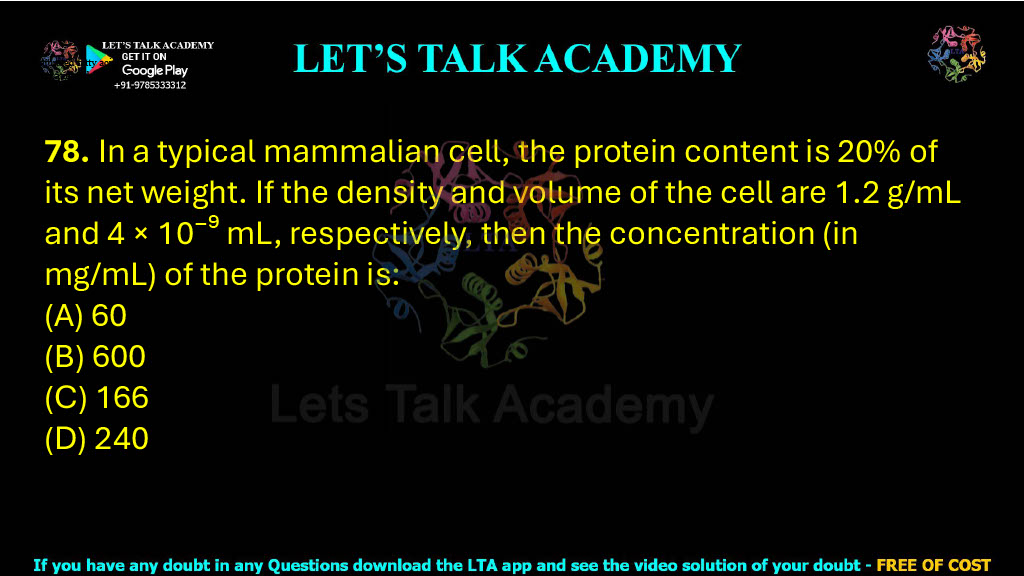
78. In a typical mammalian cell, the protein content is 20% of its net weight. If the density and volume of the cell are 1.2 g/mL and 4 × 10⁻⁹ mL, respectively, then the concentration (in mg/mL) of the protein is:
(A) 60
(B) 600
(C) 166
(D) 240
How to Calculate Protein Concentration in a Mammalian Cell?
Correct Answer
(D) 240 mg/mL
Introduction
The concentration of proteins inside a living cell is one of the most important quantitative parameters in cell biology and biochemistry. Proteins constitute the largest fraction of the cell’s dry mass and are responsible for virtually every biological process, including enzyme catalysis, structural support, intracellular transport, signaling, and regulation of gene expression. Measuring protein concentration provides valuable information about cellular metabolism, growth, and physiological status, making such calculations common in molecular biology, biotechnology, and biochemical research.
In numerical problems, protein concentration is often calculated using the density of the cell, its volume, and the percentage of total cellular mass represented by proteins. Since concentration is defined as the amount of solute per unit volume, the calculation requires determining the total cell mass, estimating the fraction contributed by proteins, and finally expressing the result in mg/mL.
Understanding the Concept Behind the Question
The given data are:
- Protein content = 20% of total cell weight
- Cell density = 1.2 g/mL
- Cell volume = 4 × 10⁻⁹ mL
The objective is to determine the protein concentration inside the cell.
Since concentration is:
Concentration = Protein Mass / Cell Volume
we first calculate the total mass of the cell.
Step 1. Calculate the Total Mass of the Cell
The relationship between density, mass, and volume is:
Mass = Density × Volume
Substituting the given values:
Mass = 1.2 g/mL × 4 × 10⁻⁹ mL
Mass = 4.8 × 10⁻⁹ g
Thus, the total mass of one mammalian cell is:
4.8 × 10⁻⁹ g
Step 2. Calculate the Protein Mass
Proteins constitute 20% of the total cell mass.
Therefore,
Protein Mass = 20% × Total Mass
= 0.20 × 4.8 × 10⁻⁹ g
= 9.6 × 10⁻¹⁰ g
Step 3. Calculate Protein Concentration
Protein concentration is:
Protein Concentration = Protein Mass / Cell Volume
Substituting the calculated values:
= (9.6 × 10⁻¹⁰ g) / (4 × 10⁻⁹ mL)
= 0.24 g/mL
Step 4. Convert g/mL to mg/mL
Since:
1 g = 1000 mg
Therefore,
0.24 g/mL × 1000
= 240 mg/mL
Final Calculation
Protein Concentration = 240 mg/mL
Alternative Short Method
The cell density is:
1.2 g/mL
Protein forms 20% of the total mass.
Therefore,
Protein concentration = 20% × 1.2 g/mL
= 0.24 g/mL
= 240 mg/mL
This direct method produces the same answer without explicitly calculating the mass of an individual cell because the cell volume cancels during the calculation.
Formula Used
Cell Mass
Mass = Density × Volume
Protein Mass
Protein Mass = Percentage × Total Mass
Protein Concentration
Protein Concentration = Protein Mass / Cell Volume
Biological Importance
Proteins represent approximately 15–25% of the total wet weight of most mammalian cells and perform nearly every essential cellular function. High intracellular protein concentrations are necessary to sustain enzyme-catalyzed reactions, maintain cytoskeletal integrity, regulate signaling pathways, and support DNA replication and transcription. Quantifying protein concentration is also crucial in proteomics, recombinant protein production, enzyme purification, pharmaceutical biotechnology, and cell physiology research.
High-Yield Points
- Mass = Density × Volume
- Concentration = Mass / Volume
- Protein concentration depends on protein percentage and cell density.
- Typical mammalian cells contain 15–25% protein by wet weight.
- 1 g = 1000 mg
- Cell volume cancels when concentration is calculated from density and percentage composition.
- Protein concentration is commonly expressed in mg/mL.
Frequently Asked Questions
Why does the cell volume cancel during the calculation?
Because both the total cell mass and protein mass are proportional to cell volume, dividing protein mass by the same volume eliminates the volume term.
Why is protein concentration so high inside cells?
Cells contain thousands of structural proteins, enzymes, ribosomes, cytoskeletal proteins, membrane proteins, and regulatory proteins, resulting in very high intracellular protein concentrations.
Can this method be applied to any cell type?
Yes. As long as the cell density and the percentage composition are known, the concentration of any cellular component can be calculated using the same approach.
Key Takeaways
To calculate intracellular protein concentration, the total cell mass is first determined using density × volume. Since proteins constitute 20% of the total cellular weight, the protein mass equals one-fifth of the total mass. Dividing the protein mass by the cell volume yields a concentration of 0.24 g/mL, which is equivalent to 240 mg/mL. An even simpler approach is to recognize that protein concentration equals 20% of the cell density, giving the same result directly. Therefore, the correct answer is 240 mg/mL, corresponding to Option (D).
Final Answer
Correct Option: (D) 240 mg/mL
Explanation
The total mass of the cell is calculated using:
Mass = Density × Volume
= 1.2 g/mL × 4 × 10⁻⁹ mL
= 4.8 × 10⁻⁹ g
Since proteins constitute 20% of the total cell mass:
Protein Mass = 0.20 × 4.8 × 10⁻⁹ = 9.6 × 10⁻¹⁰ g
The protein concentration is:
Protein Concentration = Protein Mass / Cell Volume
= (9.6 × 10⁻¹⁰ g) / (4 × 10⁻⁹ mL)
= 0.24 g/mL
Converting into milligrams:
0.24 × 1000 = 240 mg/mL
Therefore, the protein concentration inside the mammalian cell is 240 mg/mL, making Option (D) the correct answer.


