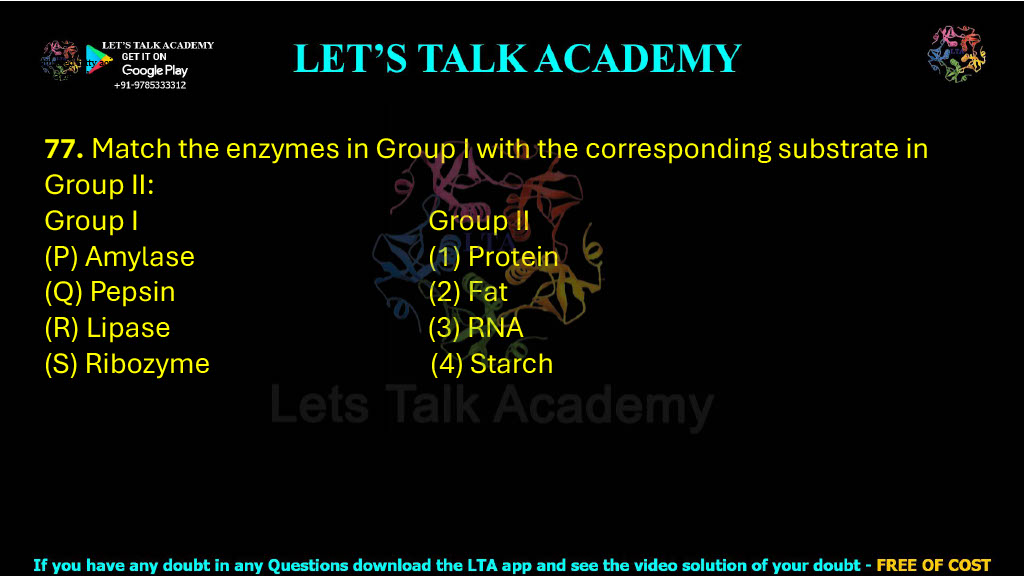
77. Match the enzymes in Group I with the corresponding substrate in Group II:
Group I
(P) Amylase
(Q) Pepsin
(R) Lipase
(S) Ribozyme
Group II
(1) Protein
(2) Fat
(3) RNA
(4) Starch
Match the Enzymes with Their Corresponding Substrates
Correct Answer
P–4, Q–1, R–2, S–3
Introduction
Enzymes are highly specific biological catalysts that accelerate biochemical reactions without being consumed during the process. One of their most remarkable characteristics is substrate specificity, meaning that each enzyme recognizes and acts only on particular molecules. This specificity arises from the precise three-dimensional arrangement of amino acid residues within the enzyme’s active site, allowing only suitable substrates to bind efficiently. Enzyme-substrate recognition is fundamental to digestion, metabolism, DNA replication, RNA processing, signal transduction, and countless other biological processes.
Among the most familiar digestive enzymes are amylase, pepsin, and lipase, each responsible for breaking down a different class of biomolecules. In contrast, ribozymes are unique because they are catalytic RNA molecules rather than proteins. These catalytic RNAs participate in RNA processing and cleavage reactions, demonstrating that biological catalysis is not restricted to proteins alone.
Understanding the Concept Behind the Question
Each enzyme catalyzes the breakdown or modification of a specific substrate.
The correct enzyme-substrate relationships are:
- Amylase → Starch
- Pepsin → Protein
- Lipase → Fat
- Ribozyme → RNA
These associations are based on the chemical nature of the substrate and the catalytic mechanism of each enzyme.
Analysis of Pair (P)
Amylase → Starch
Amylase is a carbohydrate-digesting enzyme secreted by the salivary glands and the pancreas.
Its primary function is to hydrolyze the α(1→4) glycosidic bonds present in starch, producing smaller carbohydrates such as maltose, maltotriose, and dextrins.
Amylase does not digest proteins, fats, or nucleic acids because its active site specifically recognizes starch molecules.
Therefore,
P → 4 (Starch)
Analysis of Pair (Q)
Pepsin → Protein
Pepsin is the major proteolytic enzyme of the stomach.
It is secreted as the inactive precursor pepsinogen, which is activated by the acidic environment created by hydrochloric acid.
Pepsin hydrolyzes peptide bonds within proteins, initiating protein digestion and producing shorter polypeptides.
Therefore,
Q → 1 (Protein)
Analysis of Pair (R)
Lipase → Fat
Lipase catalyzes the hydrolysis of triacylglycerols (triglycerides) into glycerol and free fatty acids.
The most important digestive lipase is pancreatic lipase, which functions in the small intestine with the assistance of bile salts.
Its substrate is dietary fat rather than carbohydrates, proteins, or nucleic acids.
Therefore,
R → 2 (Fat)
Analysis of Pair (S)
Ribozyme → RNA
A ribozyme is an RNA molecule possessing catalytic activity.
Unlike protein enzymes, ribozymes catalyze reactions involving RNA molecules, including RNA cleavage, RNA splicing, and RNA processing.
Examples include:
- Self-splicing introns
- RNase P
- Ribosomal RNA involved in peptide bond formation
Thus, the functional substrate of ribozymes is RNA.
Therefore,
S → 3 (RNA)
Correct Matching
| Enzyme | Corresponding Substrate |
|---|---|
| P. Amylase | 4. Starch |
| Q. Pepsin | 1. Protein |
| R. Lipase | 2. Fat |
| S. Ribozyme | 3. RNA |
Thus, the correct matching is:
P–4, Q–1, R–2, S–3
Biological Importance
These enzymes collectively demonstrate the remarkable specificity of biological catalysis. Amylase begins carbohydrate digestion by converting starch into smaller sugars, while pepsin initiates protein digestion in the stomach. Lipase is essential for lipid digestion and absorption, allowing dietary fats to be utilized as an energy source. Ribozymes reveal that RNA molecules can function as biological catalysts, supporting the concept of the RNA World Hypothesis, which proposes that catalytic RNA molecules may have preceded proteins during early evolution.
High-Yield Points
- Amylase → Starch
- Pepsin → Protein
- Lipase → Fat
- Ribozyme → RNA
- Amylase hydrolyzes α(1→4) glycosidic bonds.
- Pepsin is active in the acidic environment of the stomach.
- Pancreatic lipase digests triglycerides.
- Ribozymes are RNA molecules with catalytic activity.
- RNase P and self-splicing introns are classic examples of ribozymes.
- Ribosomal 23S/28S rRNA catalyzes peptide bond formation during protein synthesis.
Frequently Asked Questions
Why does amylase digest only starch?
Amylase has an active site specifically designed to recognize the α(1→4) glycosidic bonds present in starch molecules.
Why is pepsin active only in the stomach?
Pepsin functions optimally at an acidic pH of approximately 1.5–2.5, which is maintained by gastric hydrochloric acid.
Are all enzymes proteins?
No. Although most enzymes are proteins, ribozymes are catalytic RNA molecules capable of accelerating biochemical reactions without any protein component.
Key Takeaways
Enzyme specificity is determined by the structural complementarity between the enzyme’s active site and its substrate. Amylase specifically hydrolyzes starch, pepsin digests proteins, lipase hydrolyzes fats, and ribozymes catalyze reactions involving RNA molecules. These highly specific enzyme-substrate relationships are fundamental to digestion, metabolism, and gene expression. Therefore, the correct matching is P–4, Q–1, R–2, S–3.
Final Answer
Correct Matching: P–4, Q–1, R–2, S–3
Explanation
Amylase is a carbohydrate-digesting enzyme that hydrolyzes starch into smaller sugars. Pepsin is the principal gastric protease responsible for digesting proteins into peptides. Lipase catalyzes the hydrolysis of fats (triglycerides) into fatty acids and glycerol. Ribozymes are catalytic RNA molecules that participate in reactions involving RNA, including RNA cleavage and processing. Therefore, the correct enzyme-substrate matching is Amylase–Starch (P–4), Pepsin–Protein (Q–1), Lipase–Fat (R–2), and Ribozyme–RNA (S–3).


