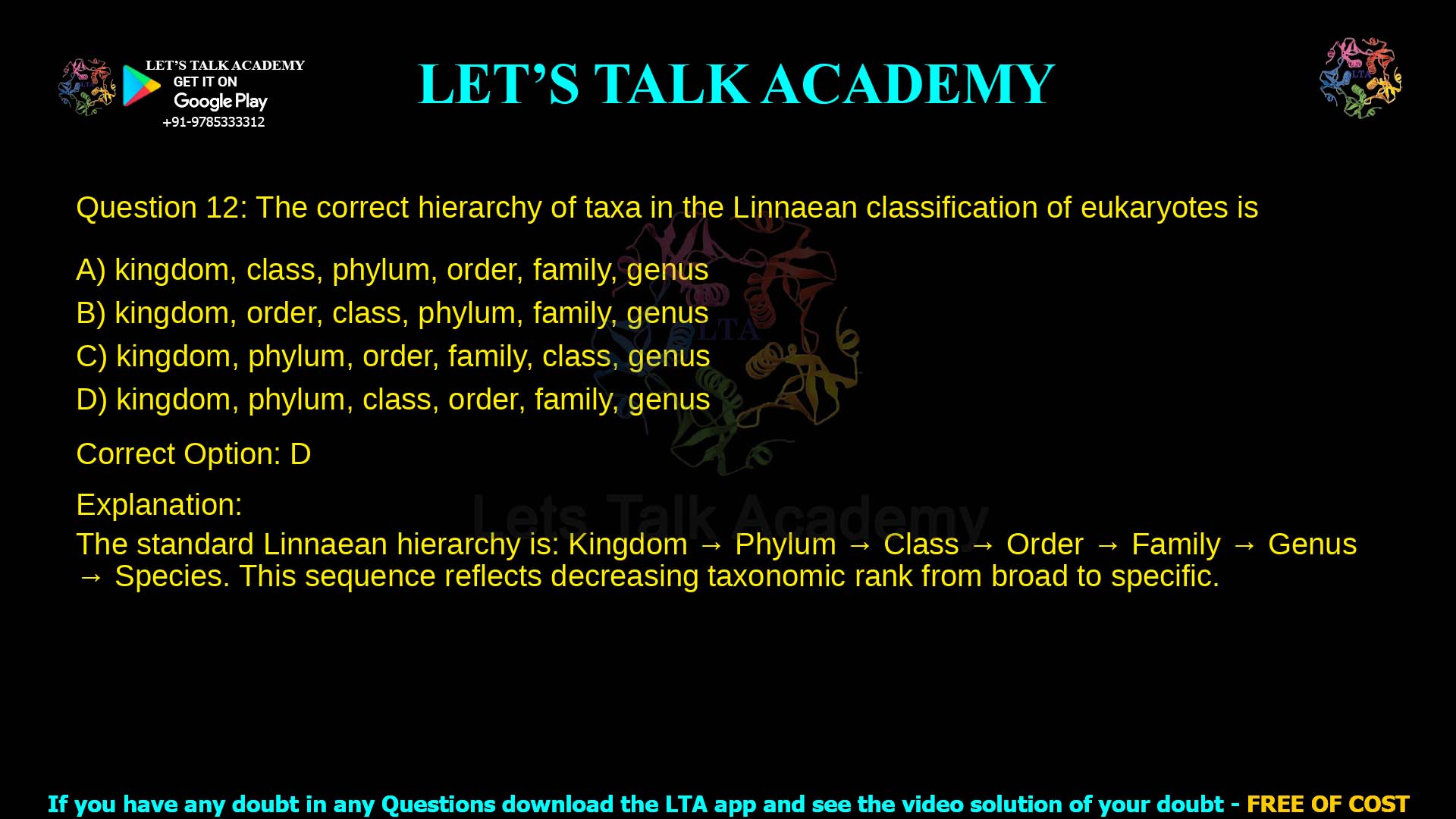
Q.12 The correct hierarchy of taxa in the Linnaean classification of eukaryotes is
(A) kingdom, class, phylum, order, family, genus
(B) kingdom, order, class, phylum, family, genus
(C) kingdom, phylum, order, family, class, genus
(D) kingdom, phylum, class, order, family, genus
The correct answer is (D) kingdom, phylum, class, order, family, genus. This follows the standard Linnaean taxonomic hierarchy for eukaryotes, which arranges categories from broadest to most specific.
Option Analysis
Option (A) kingdom, class, phylum, order, family, genus incorrectly places class before phylum, inverting their order since phylum groups broader body plans while class refines them further.
Option (B) kingdom, order, class, phylum, family, genus disrupts the sequence by putting order before class and phylum out of place; class must precede order.
Option (C) kingdom, phylum, order, family, class, genus wrongly positions order and family before class, as class divides phyla into more specific shared traits.
Option (D) matches the hierarchy: kingdom (e.g., Animalia), phylum (e.g., Chordata), class (e.g., Mammalia), order (e.g., Primates), family (e.g., Hominidae), genus (e.g., Homo).
The Linnaean classification hierarchy of eukaryotes organizes complex organisms like animals, plants, fungi, and protists into a structured system from kingdom to genus. Developed by Carl Linnaeus, this hierarchy ensures precise identification and evolutionary grouping. For CSIR NET Life Sciences aspirants, understanding this sequence is crucial for taxonomy questions.
Core Taxonomic Ranks
-
Kingdom: Broadest level, grouping eukaryotes by fundamental traits (e.g., Animalia for multicellular heterotrophs).
-
Phylum: Divides kingdoms by body plans (e.g., Chordata in Animalia).
-
Class: Refines phyla by shared features (e.g., Mammalia for warm-blooded vertebrates).
-
Order: Further specifies classes (e.g., Primates for advanced primates).
-
Family: Groups similar genera (e.g., Hominidae for great apes).
-
Genus: Close relatives that can interbreed (e.g., Homo for humans and extinct relatives).
This descending specificity aids in biodiversity studies and genetic analysis.
Eukaryote-Specific Context
Eukaryotes follow the same Linnaean ranks despite modern domains like Eukarya; revisions emphasize protists but retain the hierarchy. Examples include Plantae (kingdom) to Rosaceae (family) for roses. CSIR NET questions often test this exact order for eukaryotes.


1 Comment
Vanshika Sharma
December 30, 2025opt D is correct