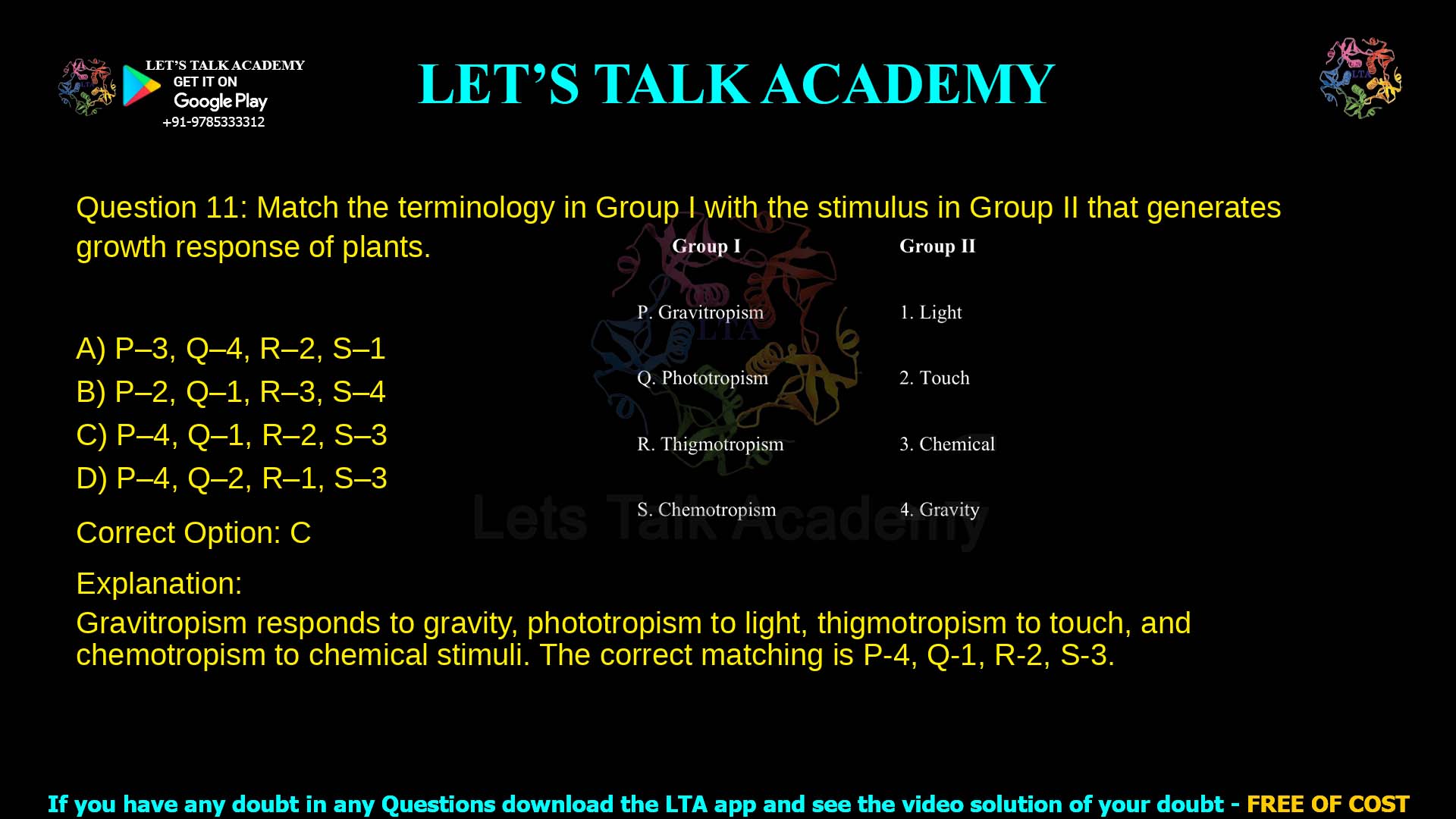
Q.11 Match the terminology in Group I with the stimulus in Group II that generates
growth response of plants
Group I Group II
P. Gravitropism 1. Light
Q. Phototropism 2. Touch
R. Thigmotropism 3. Chemical
S. Chemotropism 4. Gravity
(A) P – 3, Q – 4, R – 2, S – 1
(B) P – 2, Q – 1, R – 3, S – 4
(C) P – 4, Q – 1, R – 2, S – 3
(D) P – 4, Q – 2, R – 1, S – 3
Gravitropism responds to gravity, phototropism to light, thigmotropism to touch, and chemotropism to chemicals, making option (C) correct. This CSIR NET Life Sciences question tests matching plant tropisms with their stimuli.
Correct Matching
-
P. Gravitropism → 4. Gravity: Roots grow downward (positive gravitropism) and shoots upward (negative) due to statolith sedimentation in root caps, redistributing auxin for differential growth.
-
Q. Phototropism → 1. Light: Stems bend toward light via phototropins detecting blue light (450 nm), causing auxin accumulation on the shaded side for cell elongation.
-
R. Thigmotropism → 2. Touch: Tendrils coil around supports through mechanoreceptors triggering calcium influx and auxin/ethylene responses for differential growth.
-
S. Chemotropism → 3. Chemical: Pollen tubes grow toward ovules guided by chemical gradients like sugars, or roots toward nutrients.
Option Analysis
-
(A) P-3, Q-4, R-2, S-1: Incorrect; mismatches gravitropism (gravity) with chemicals and phototropism with gravity.
-
(B) P-2, Q-1, R-3, S-4: Incorrect; assigns touch to gravitropism and chemicals to thigmotropism.
-
(C) P-4, Q-1, R-2, S-3: Correct; aligns each tropism with its defining stimulus.
-
(D) P-4, Q-2, R-1, S-3: Incorrect; swaps phototropism (light) with thigmotropism (touch).
Plant tropisms matching gravitropism phototropism thigmotropism chemotropism is a key CSIR NET Life Sciences topic, testing how plants respond directionally to environmental stimuli through growth hormones like auxin. These tropic movements ensure survival by optimizing light capture, anchorage, support, and nutrient access.
Gravitropism Mechanism
Gravity sensing occurs via statoliths (amyloplasts) sedimenting in root cap columella cells, triggering PIN3-mediated auxin redistribution for curvature. Roots show positive gravitropism (downward), shoots negative (upward).
Phototropism Mechanism
Blue light activates phototropins (phot1/phot2), relocating to shaded sides and concentrating auxin for stem elongation toward light sources. Classic Darwin experiments confirmed tip-based perception.
Thigmotropism Examples
Touch stimuli activate ion channels, causing Ca²⁺ influx and ethylene/auxin bursts; seen in pea tendrils coiling around wires. Promotes climbing for better light exposure.
Chemotropism Applications
Chemical gradients (e.g., sugars from ovules) guide pollen tube growth via tip-focused Ca²⁺; roots seek minerals positively or avoid toxins negatively. Essential for reproduction and foraging.


1 Comment
Vanshika Sharma
December 30, 2025option C is correct