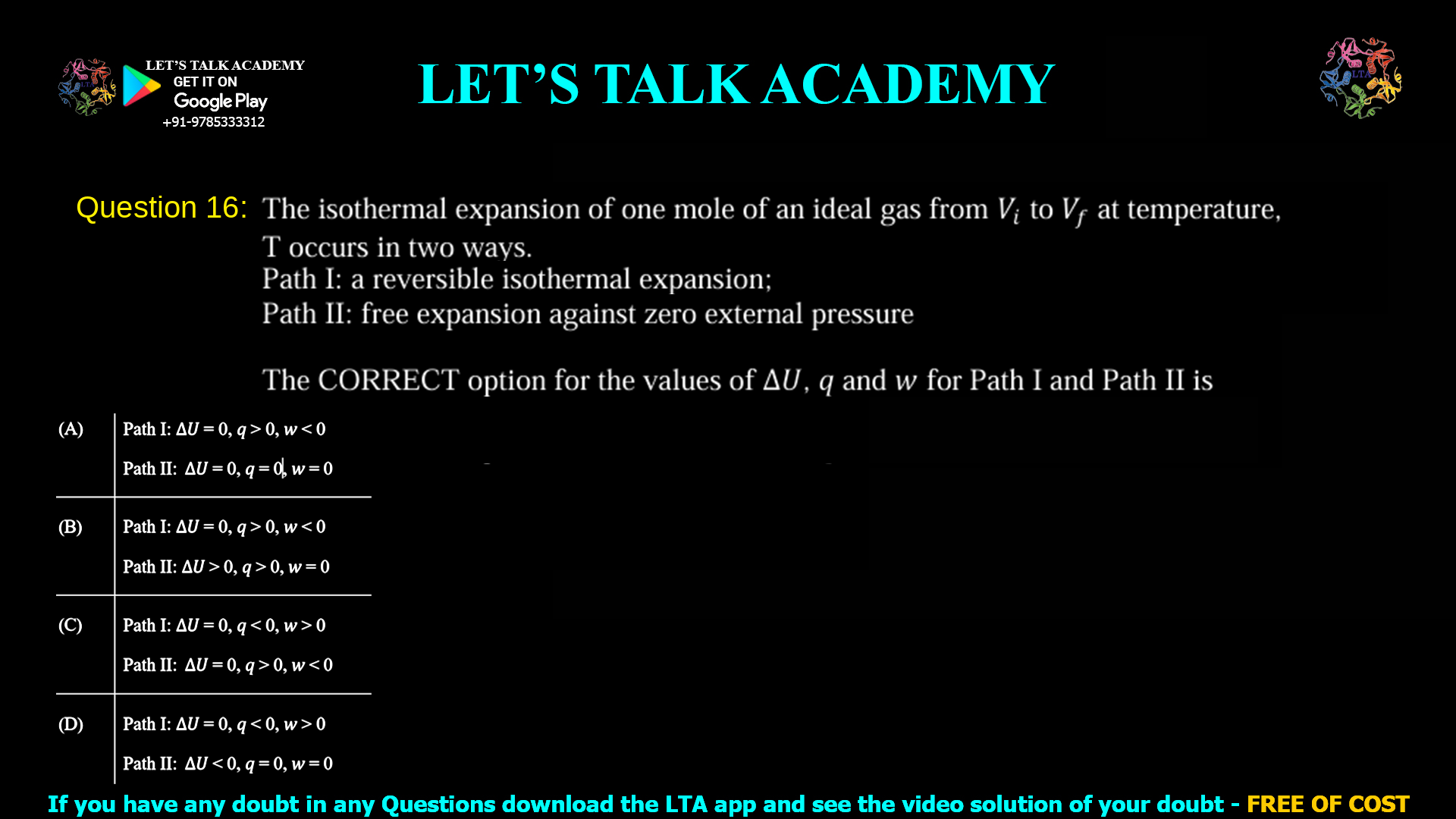
Q. 16 The isothermal expansion of one mole of an ideal gas from 𝑉𝑖 to 𝑉𝑓 at temperature,
T occurs in two ways.
Path I: a reversible isothermal expansion;
Path II: free expansion against zero external pressure
The CORRECT option for the values of ∆𝑈, 𝑞 and 𝑤 for Path I and Path II is
(A) Path I: ∆𝑈 = 0, 𝑞 > 0, 𝑤 < 0
Path II: ∆𝑈 = 0, 𝑞 = 0, 𝑤 = 0
(B) Path I: ∆𝑈 = 0, 𝑞 > 0, 𝑤 < 0
Path II: ∆𝑈 > 0, 𝑞 > 0, 𝑤 = 0
(C) Path I: ∆𝑈 = 0, 𝑞 < 0, 𝑤 > 0
Path II: ∆𝑈 = 0, 𝑞 > 0, 𝑤 < 0
(D) Path I: ∆𝑈 = 0, 𝑞 < 0, 𝑤 > 0
Path II: ∆𝑈 < 0, 𝑞 = 0, 𝑤 = 0
Option (A) is correct. For the isothermal expansion of one mole of an ideal gas, ΔU = 0 in both paths since internal energy depends only on temperature, which remains constant. In Path I (reversible), the system absorbs heat (q > 0) to perform expansion work (w < 0); in Path II (free expansion), no heat is exchanged (q = 0) and no work is done (w = 0) against vacuum.
Path I: Reversible Isothermal Expansion
Internal energy change is zero (ΔU = 0) because U for an ideal gas is solely a function of T, and ΔT = 0. Work done by the system is w = -nRT ln(V_f/V_i), which is negative (w < 0) since V_f > V_i. From the first law (ΔU = q + w), q = -w > 0, meaning heat is absorbed.
Path II: Free Expansion
No work occurs (w = 0) as external pressure is zero, so w = -P_ext ΔV = 0. The process is adiabatic with no heat transfer (q = 0) due to insulation typical in free expansion setups. Thus, ΔU = q + w = 0, consistent with constant T.
Option Analysis
-
(A) Matches both paths correctly: Path I (ΔU = 0, q > 0, w < 0); Path II (ΔU = 0, q = 0, w = 0).
-
(B) Incorrect for Path II: ΔU = 0 (not > 0), and q = 0 (not > 0).
-
(C) Wrong signs for Path I: q > 0 and w < 0 (not opposite); Path II signs incorrect.
-
(D) Reverses Path I signs and errs on Path II ΔU (should be 0, not < 0).
Introduction to Isothermal Expansion of Ideal Gas
Isothermal expansion of one mole of ideal gas from initial volume Vi to final volume Vf at constant temperature T compares reversible isothermal expansion (Path I) and free expansion against zero external pressure (Path II). Key thermodynamic quantities—ΔU (internal energy change), q (heat), and w (work)—differ due to process nature, vital for CSIR NET Life Sciences and thermodynamics exams.
Reversible Isothermal Expansion (Path I) Explained
In reversible isothermal expansion, the gas expands slowly against equal external pressure, maximizing work. Since ΔT = 0, ΔU = 0 for ideal gas. Work by system: w=−RTln(Vf/Vi)<0 (expansion). Heat absorbed q = -w > 0 maintains T via first law ΔU = q + w = 0.
Free Expansion Against Zero Pressure (Path II)
Free expansion into vacuum means P_ext = 0, so w = -P_ext (V_f – V_i) = 0. No surroundings interaction implies q = 0 (adiabatic-like). Thus, ΔU = 0, with T unchanged post-equilibration.
Comparing ΔU, q, w Across Paths
| Quantity | Path I (Reversible) | Path II (Free) | Reason |
|---|---|---|---|
| ΔU | 0 | 0 | ΔT = 0, ideal gas |
| q | > 0 | 0 | Heat for work (I); none (II) |
| w | < 0 | 0 | Expansion work (I); vacuum (II) |
Option (A) correctly identifies these values.
Why Option (A) is Correct for CSIR NET
Options (B)–(D) fail: (B) wrongly states ΔU > 0, q > 0 for Path II; (C), (D) invert Path I signs or mishandle Path II. Understanding signs—w negative for work by system—is key.


