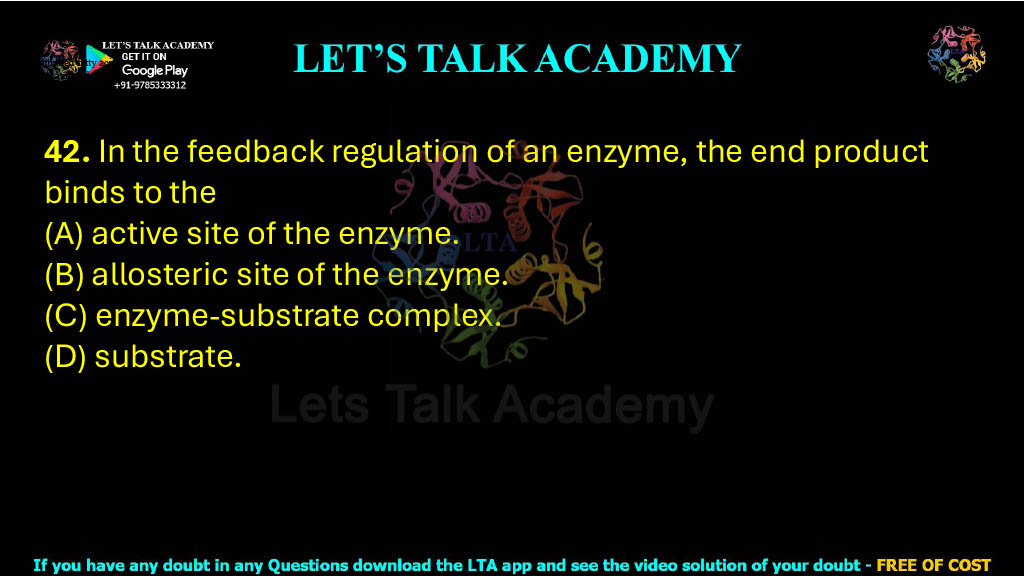
42. In the feedback regulation of an enzyme, the end product binds to the
(A) active site of the enzyme.
(B) allosteric site of the enzyme.
(C) enzyme-substrate complex.
(D) substrate.
Feedback Inhibition of Enzymes Explained | Why Does the End Product Bind to the Allosteric Site?
Correct Answer
(B) Allosteric site of the enzyme
Introduction
Living cells continuously synthesize thousands of different biomolecules through interconnected metabolic pathways. To maintain cellular homeostasis and avoid unnecessary energy expenditure, these pathways must be precisely regulated. One of the most efficient regulatory mechanisms employed by cells is feedback inhibition, also known as end-product inhibition. In this mechanism, the final product of a metabolic pathway inhibits an enzyme that functions earlier in the same pathway, thereby preventing excessive accumulation of the end product.
Feedback inhibition represents a classic example of negative feedback regulation, allowing cells to balance metabolic activity according to physiological needs. Instead of competing directly with the substrate at the catalytic site, the end product usually binds to a distinct regulatory region known as the allosteric site. This interaction induces conformational changes that reduce enzyme activity and slow the entire pathway.
Understanding the Concept Behind the Question
In a typical metabolic pathway:
Substrate
↓
Enzyme 1
↓
Intermediate A
↓
Enzyme 2
↓
Intermediate B
↓
Enzyme 3
↓
Final Product
When sufficient amounts of the final product accumulate, the cell no longer requires additional synthesis.
Instead of allowing the pathway to continue wasting ATP and metabolic resources, the final product binds to the allosteric site of the first committed enzyme.
This binding changes the enzyme’s three-dimensional structure, reducing its catalytic activity and slowing further product formation.
Because the regulatory molecule binds to a site other than the active site, the process is known as allosteric feedback inhibition.
Therefore, Option (B) is the correct answer.
Why Option (A) Is Incorrect
Active Site of the Enzyme
The active site is the region where the substrate binds and the chemical reaction takes place.
In feedback inhibition, the end product generally does not compete with the substrate for this catalytic site. Instead, it binds to a separate regulatory region.
Binding to the active site would represent competitive inhibition, whereas feedback inhibition is usually allosteric.
Therefore,
Option (A) is incorrect.
Why Option (B) Is Correct
Allosteric Site of the Enzyme
The allosteric site is a regulatory region distinct from the enzyme’s catalytic site.
When the end product binds to this site:
- The enzyme undergoes a conformational change.
- The shape of the active site is altered.
- Catalytic efficiency decreases.
- The metabolic pathway slows down.
This mechanism allows the cell to regulate enzyme activity rapidly without permanently modifying the enzyme.
Because feedback inhibition almost always involves allosteric regulation, the end product binds to the allosteric site.
Therefore,
Option (B) is correct.
Why Option (C) Is Incorrect
Enzyme–Substrate Complex
The enzyme–substrate complex is a temporary intermediate formed during catalysis.
Feedback inhibitors are designed to regulate enzyme activity before or during substrate binding, not by attaching specifically to the enzyme–substrate complex.
Although certain specialized inhibitors interact preferentially with enzyme–substrate complexes, this is not the mechanism of classical feedback inhibition.
Therefore,
Option (C) is incorrect.
Why Option (D) Is Incorrect
Substrate
The substrate is the molecule upon which the enzyme acts.
End products regulate enzymes rather than substrates.
Binding of the end product to the substrate would not directly inhibit enzyme activity and is not recognized as a mechanism of metabolic regulation.
Therefore,
Option (D) is incorrect.
What Is Feedback Inhibition?
Feedback inhibition is a regulatory mechanism in which the final product of a metabolic pathway inhibits an enzyme catalyzing an early step of the same pathway.
General scheme:
Substrate
↓
Enzyme
↓
Intermediate
↓
Intermediate
↓
Final Product
↓
End Product binds Allosteric Site
↓
Enzyme Activity Decreases
↓
Pathway Slows
This prevents unnecessary synthesis and conserves cellular energy.
Why Is the Allosteric Site Important?
The allosteric site allows regulatory molecules to control enzyme activity without interfering directly with substrate binding.
When an inhibitor binds to the allosteric site:
- Protein conformation changes.
- Active site geometry changes.
- Substrate binding becomes less efficient.
- Catalytic rate decreases.
Because substrate and inhibitor bind to different locations, increasing substrate concentration usually cannot overcome allosteric inhibition.
Biological Importance of Feedback Inhibition
Feedback inhibition is one of the most efficient mechanisms for maintaining metabolic homeostasis. It prevents excessive accumulation of metabolic products, conserves ATP, reduces unnecessary enzyme activity, and coordinates multiple biosynthetic pathways.
For example, during amino acid biosynthesis, the final amino acid produced often inhibits the first committed enzyme in its own synthetic pathway. This ensures that synthesis occurs only when the amino acid is needed, thereby optimizing cellular resource utilization.
Comparison of the Given Options
| Binding Site | Role in Feedback Inhibition | Correct? |
|---|---|---|
| Active Site | Catalytic region for substrate binding | ❌ |
| ** |


