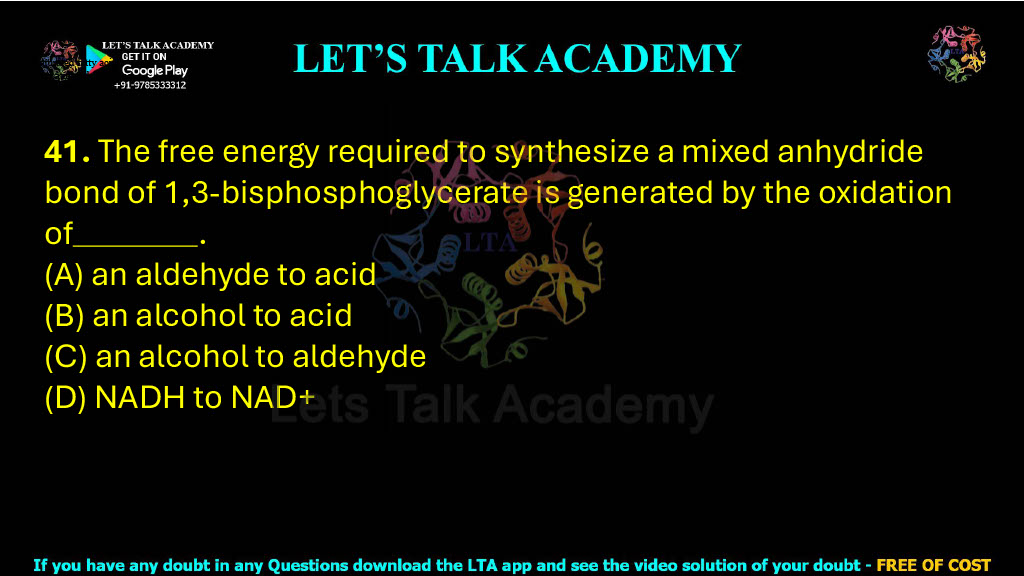
41. The free energy required to synthesize a mixed anhydride bond of 1,3-bisphosphoglycerate is generated by the oxidation of .
(A) an aldehyde to acid
(B) an alcohol to acid
(C) an alcohol to aldehyde
(D) NADH to NAD+
Formation of 1,3-Bisphosphoglycerate: Which Oxidation Generates the Required Free Energy?
Correct Answer
(A) An aldehyde to acid
Introduction
Glycolysis is one of the most fundamental metabolic pathways in living organisms, converting glucose into pyruvate while generating ATP and NADH. One of the most remarkable reactions in this pathway occurs during the conversion of glyceraldehyde-3-phosphate (G3P) into 1,3-bisphosphoglycerate (1,3-BPG). Unlike most phosphorylation reactions, this step does not require ATP. Instead, the energy needed to create the high-energy phosphate bond is obtained directly from an oxidation reaction occurring within the substrate itself.
The product, 1,3-bisphosphoglycerate, contains a mixed anhydride (acyl phosphate) bond, one of the highest-energy phosphate bonds found in metabolism. Rather than allowing the energy released during oxidation to dissipate as heat, the cell conserves it in this high-energy intermediate.
Understanding the Concept Behind the Question
The sixth step of glycolysis is catalyzed by the enzyme glyceraldehyde-3-phosphate dehydrogenase (GAPDH).
The reaction is:
Glyceraldehyde-3-phosphate + Pi + NAD⁺ → 1,3-Bisphosphoglycerate + NADH + H⁺
During this reaction, the aldehyde group (-CHO) present in glyceraldehyde-3-phosphate is oxidized to a carboxylic acid equivalent. The free energy released by this oxidation is not lost. Instead, it is used to attach inorganic phosphate (Pi), generating the high-energy acyl phosphate bond of 1,3-bisphosphoglycerate.
Simultaneously, NAD⁺ accepts electrons and is reduced to NADH.
Therefore, the energy required to synthesize the mixed anhydride bond originates from the oxidation of an aldehyde to an acid.
Hence, Option (A) is the correct answer.
Why Option (A) Is Correct
Oxidation of an Aldehyde to an Acid
Glyceraldehyde-3-phosphate contains an aldehyde functional group at carbon-1.
During the GAPDH reaction:
- The aldehyde is oxidized.
- NAD⁺ is reduced to NADH.
- Inorganic phosphate is incorporated.
- A high-energy acyl phosphate bond is formed.
This oxidation releases sufficient free energy to synthesize the mixed anhydride bond without requiring ATP.
The oxidation can be summarized as:
Aldehyde → Carboxylic acid equivalent
This is the exact biochemical process responsible for forming 1,3-bisphosphoglycerate.
Therefore,
Option (A) is correct.
Why Option (B) Is Incorrect
Oxidation of an Alcohol to an Acid
Oxidation of a primary alcohol to a carboxylic acid is a common biochemical reaction, but it does not occur in this glycolytic step.
The substrate entering the reaction is glyceraldehyde-3-phosphate, which already possesses an aldehyde group rather than an alcohol group.
Therefore, no alcohol oxidation takes place.
Hence,
Option (B) is incorrect.
Why Option (C) Is Incorrect
Oxidation of an Alcohol to an Aldehyde
This represents only the first stage of alcohol oxidation.
Examples include:
Ethanol → Acetaldehyde
However, glyceraldehyde-3-phosphate already exists in the aldehyde form before entering the GAPDH reaction.
Consequently, this oxidation does not occur during glycolysis at this step.
Therefore,
Option (C) is incorrect.
Why Option (D) Is Incorrect
Oxidation of NADH to NAD⁺
The reaction proceeds in the opposite direction.
During glycolysis,
NAD⁺ gains electrons and becomes NADH.
The reduction reaction is:
NAD⁺ + 2e⁻ + H⁺ → NADH
Thus, NADH is produced rather than oxidized.
Oxidation of NADH back to NAD⁺ occurs later in oxidative phosphorylation or fermentation, not during the GAPDH reaction.
Therefore,
Option (D) is incorrect.
The GAPDH Reaction in Glycolysis
The enzyme responsible for this reaction is:
Glyceraldehyde-3-phosphate Dehydrogenase (GAPDH)
Reaction:
Glyceraldehyde-3-phosphate + Pi + NAD⁺
↓
1,3-Bisphosphoglycerate + NADH + H⁺
This single reaction couples:
- Oxidation
- Reduction
- Phosphorylation
- Energy conservation
making it one of the most important reactions in glycolysis.
Why Is 1,3-Bisphosphoglycerate a High-Energy Molecule?
The phosphate attached to carbon-1 forms an acyl phosphate (mixed anhydride) bond.
This bond possesses a very high free energy of hydrolysis.
In the next glycolytic reaction, catalyzed by phosphoglycerate kinase, hydrolysis of this bond drives the synthesis of ATP through substrate-level phosphorylation.
Thus, oxidation energy is temporarily stored in the phosphate bond before being transferred to ATP.
Biological Importance
The GAPDH reaction represents one of the finest examples of energy coupling in biology. Instead of releasing oxidation energy as heat, cells conserve it in two useful forms:
- NADH, which later donates electrons to the electron transport chain.
- 1,3-Bisphosphoglycerate, whose high-energy phosphate bond is used to generate ATP.
This strategy maximizes energy efficiency during glucose metabolism and forms the basis of cellular ATP production.
Comparison of the Given Reactions
| Oxidation Reaction | Occurs During Formation of 1,3-BPG? | Correct? |
|---|---|---|
| Aldehyde → Acid | Yes | ✅ |
| Alcohol → Acid | No | ❌ |
| Alcohol → Aldehyde | No | ❌ |
| NADH → NAD⁺ | No | ❌ |
High-Yield Points
- Enzyme:Glyceraldehyde-3-phosphate dehydrogenase (GAPDH)
- Substrate:Glyceraldehyde-3-phosphate
- Product:1,3-Bisphosphoglycerate
- Oxidation:Aldehyde → Carboxylic acid equivalent
- NAD⁺ is reduced to NADH.
- High-energy bond:Acyl phosphate (mixed anhydride)
- Next step produces ATP through substrate-level phosphorylation.
Frequently Asked Questions
Why is ATP not required to form 1,3-bisphosphoglycerate?
The oxidation of the aldehyde group releases enough free energy to drive phosphate incorporation, eliminating the need for ATP.
Why is the bond called a mixed anhydride?
Because it is an acyl phosphate bond, formed between a phosphate group and a carboxylic acid derivative, making it one of the highest-energy bonds in metabolism.
What happens to the NADH produced?
During aerobic respiration, NADH transfers its electrons to the mitochondrial electron transport chain, where it contributes to ATP synthesis through oxidative phosphorylation.
Key Takeaways
The formation of 1,3-bisphosphoglycerate is a classic example of biochemical energy conservation. During the reaction catalyzed by glyceraldehyde-3-phosphate dehydrogenase, the aldehyde group of glyceraldehyde-3-phosphate is oxidized to a carboxylic acid equivalent, and the released energy is captured in the form of a high-energy mixed anhydride (acyl phosphate) bond. Simultaneously, NAD⁺ is reduced to NADH, providing another energy-rich molecule for later ATP production. Understanding this coupled oxidation-phosphorylation mechanism is essential for mastering glycolysis and solving competitive examination questions.
Final Answer
Correct Option: (A) An aldehyde to acid
Explanation
During the sixth step of glycolysis, glyceraldehyde-3-phosphate dehydrogenase (GAPDH) catalyzes the oxidation of the aldehyde group of glyceraldehyde-3-phosphate to a carboxylic acid equivalent while simultaneously reducing NAD⁺ to NADH. The free energy released during this oxidation is conserved by forming a high-energy mixed anhydride (acyl phosphate) bond in 1,3-bisphosphoglycerate. This stored energy is later used to generate ATP by substrate-level phosphorylation. Therefore, the free energy required to synthesize the mixed anhydride bond is generated by the oxidation of an aldehyde to an acid, making Option (A) the correct answer.


