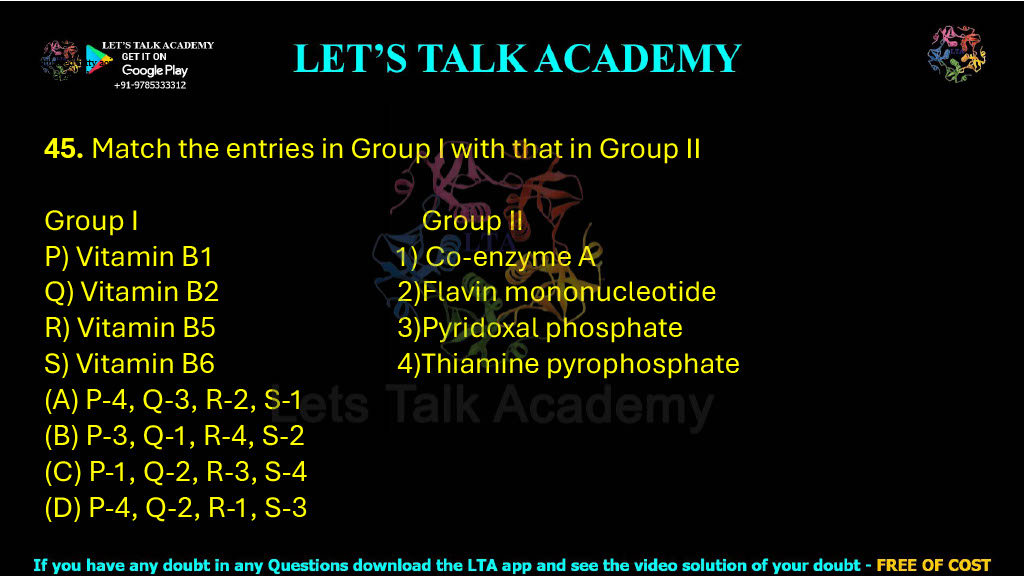
45. Match the entries in Group I with that in Group II
Group I Group II
P) Vitamin B1 1) Co-enzyme A
Q) Vitamin B2 2)Flavin mononucleotide
R) Vitamin B5 3)Pyridoxal phosphate
S) Vitamin B6 4)Thiamine pyrophosphate
(A) P-4, Q-3, R-2, S-1
(B) P-3, Q-1, R-4, S-2
(C) P-1, Q-2, R-3, S-4
(D) P-4, Q-2, R-1, S-3
Match Vitamins B1, B2, B5, and B6 with Their Coenzymes
Correct Answer
(D) P-4, Q-2, R-1, S-3
Introduction
Vitamins are essential organic micronutrients required in small quantities for normal growth, metabolism, and cellular function. Unlike carbohydrates, proteins, and lipids, vitamins do not serve as structural components or major energy sources. Instead, many vitamins function as precursors of coenzymes, molecules that bind to enzymes and participate directly in biochemical reactions. These coenzymes are indispensable for metabolic pathways such as carbohydrate metabolism, amino acid metabolism, fatty acid synthesis, and cellular respiration. A deficiency of these vitamins often results in impaired enzyme activity and characteristic metabolic disorders.
Among the water-soluble vitamins, the B-complex vitamins are especially important because nearly all of them are converted into biologically active coenzyme forms. Vitamin B1 (Thiamine) forms Thiamine Pyrophosphate (TPP), Vitamin B2 (Riboflavin) forms Flavin Mononucleotide (FMN) and FAD, Vitamin B5 (Pantothenic Acid) is a component of Coenzyme A (CoA), and Vitamin B6 (Pyridoxine) is converted into Pyridoxal Phosphate (PLP).
Understanding the Concept Behind the Question
The question requires matching each vitamin with its biologically active coenzyme.
The correct associations are:
- Vitamin B1 → Thiamine Pyrophosphate (TPP)
- Vitamin B2 → Flavin Mononucleotide (FMN)
- Vitamin B5 → Coenzyme A (CoA)
- Vitamin B6 → Pyridoxal Phosphate (PLP)
Thus,
- P → 4
- Q → 2
- R → 1
- S → 3
This combination corresponds to Option (D).
Why Option (A) Is Incorrect
Option (A) correctly matches Vitamin B1 with TPP but incorrectly associates Vitamin B2 with PLP, Vitamin B5 with FMN, and Vitamin B6 with Coenzyme A.
Each of these coenzymes belongs to a different vitamin.
Therefore,
Option (A) is incorrect.
Why Option (B) Is Incorrect
This option incorrectly matches every vitamin with the wrong coenzyme.
Vitamin B1 does not produce PLP, Vitamin B2 does not form Coenzyme A, Vitamin B5 does not produce TPP, and Vitamin B6 does not produce FMN.
Therefore,
Option (B) is incorrect.
Why Option (C) Is Incorrect
This option incorrectly associates Vitamin B1 with Coenzyme A and Vitamin B5 with Pyridoxal Phosphate.
Although Vitamin B2 is correctly matched with FMN, the remaining associations are incorrect.
Therefore,
Option (C) is incorrect.
Why Option (D) Is Correct
Vitamin B1 → Thiamine Pyrophosphate (TPP)
Vitamin B1 (Thiamine) is converted into Thiamine Pyrophosphate (TPP), an essential coenzyme involved in oxidative decarboxylation reactions such as the Pyruvate Dehydrogenase Complex, α-Ketoglutarate Dehydrogenase, and Transketolase reactions of the pentose phosphate pathway.
Vitamin B2 → Flavin Mononucleotide (FMN)
Vitamin B2 (Riboflavin) serves as the precursor of Flavin Mononucleotide (FMN) and Flavin Adenine Dinucleotide (FAD). These flavin coenzymes participate in numerous oxidation-reduction reactions and function as prosthetic groups in flavoproteins involved in cellular respiration.
Vitamin B5 → Coenzyme A (CoA)
Vitamin B5 (Pantothenic Acid) forms part of Coenzyme A, one of the most important coenzymes in metabolism. CoA carries activated acyl groups during fatty acid oxidation, fatty acid synthesis, and the citric acid cycle through compounds such as Acetyl-CoA.
Vitamin B6 → Pyridoxal Phosphate (PLP)
Vitamin B6 (Pyridoxine) is converted into Pyridoxal Phosphate (PLP), the principal coenzyme involved in amino acid metabolism. PLP participates in transamination, decarboxylation, deamination, racemization, and glycogen metabolism.
Therefore, the correct matching is:
P-4, Q-2, R-1, S-3
Hence,
Option (D) is correct.
Biological Roles of These Coenzymes
Each coenzyme performs specialized metabolic functions that are essential for normal cellular activity.
- TPP transfers activated aldehyde groups during oxidative decarboxylation.
- FMN carries electrons during oxidation-reduction reactions.
- Coenzyme A transports acyl groups in carbohydrate and lipid metabolism.
- PLP catalyzes reactions involving amino acid metabolism.
Because these coenzymes participate in central metabolic pathways, deficiencies of their corresponding vitamins produce severe metabolic disturbances.
Comparison of Vitamins and Their Coenzymes
| Vitamin | Chemical Name | Active Coenzyme | Major Function |
|---|---|---|---|
| B1 | Thiamine | TPP | Oxidative decarboxylation |
| B2 | Riboflavin | FMN / FAD | Electron transfer reactions |
| B5 | Pantothenic Acid | Coenzyme A | Acyl group transfer |
| B6 | Pyridoxine | PLP | Amino acid metabolism |
Biological Importance
The conversion of vitamins into coenzymes allows enzymes to catalyze reactions that would otherwise proceed extremely slowly. TPP enables carbohydrate oxidation, FMN transfers electrons during respiration, Coenzyme A activates acyl groups in lipid and carbohydrate metabolism, and PLP facilitates nearly every major reaction involving amino acids.
These coenzymes collectively support ATP production, neurotransmitter synthesis, fatty acid metabolism, and protein metabolism. Consequently, adequate dietary intake of B-complex vitamins is essential for maintaining normal cellular physiology.
High-Yield Points
- Vitamin B1 → Thiamine Pyrophosphate (TPP)
- Vitamin B2 → FMN and FAD
- Vitamin B5 → Coenzyme A
- Vitamin B6 → Pyridoxal Phosphate (PLP)
- TPP participates in oxidative decarboxylation.
- FMN functions in oxidation-reduction reactions.
- CoA carries activated acyl groups.
- PLP catalyzes amino acid metabolism.
Frequently Asked Questions
Why is Vitamin B5 associated with Coenzyme A?
Pantothenic acid forms an integral structural component of Coenzyme A, enabling the transport of activated acyl groups in numerous metabolic pathways.
Does Vitamin B2 produce only FMN?
No. Riboflavin forms both FMN and FAD, two important flavin coenzymes involved in electron transport.
Why is PLP important?
Pyridoxal phosphate is the major coenzyme involved in amino acid metabolism, including transamination, decarboxylation, and deamination reactions.
Key Takeaways
The B-complex vitamins function primarily as coenzyme precursors that enable enzymes to catalyze essential metabolic reactions. Vitamin B1 forms Thiamine Pyrophosphate (TPP) for oxidative decarboxylation, Vitamin B2 forms Flavin Mononucleotide (FMN) for oxidation-reduction reactions, Vitamin B5 forms Coenzyme A (CoA) for acyl group transfer, and Vitamin B6 forms Pyridoxal Phosphate (PLP) for amino acid metabolism. Remembering these vitamin–coenzyme relationships is fundamental for understanding metabolism and is a high-yield topic in competitive biochemistry examinations.
Final Answer
Correct Option: (D) P-4, Q-2, R-1, S-3
Explanation
The correct matching is:
- Vitamin B1 (Thiamine) → Thiamine Pyrophosphate (TPP), which functions in oxidative decarboxylation reactions.
- Vitamin B2 (Riboflavin) → Flavin Mononucleotide (FMN), an important electron carrier in oxidation-reduction reactions.
- Vitamin B5 (Pantothenic Acid) → Coenzyme A (CoA), which transfers activated acyl groups during metabolism.
- Vitamin B6 (Pyridoxine) → Pyridoxal Phosphate (PLP), the major coenzyme involved in amino acid metabolism.
Therefore, the correct matching is P-4, Q-2, R-1, S-3, making Option (D) the correct answer.


