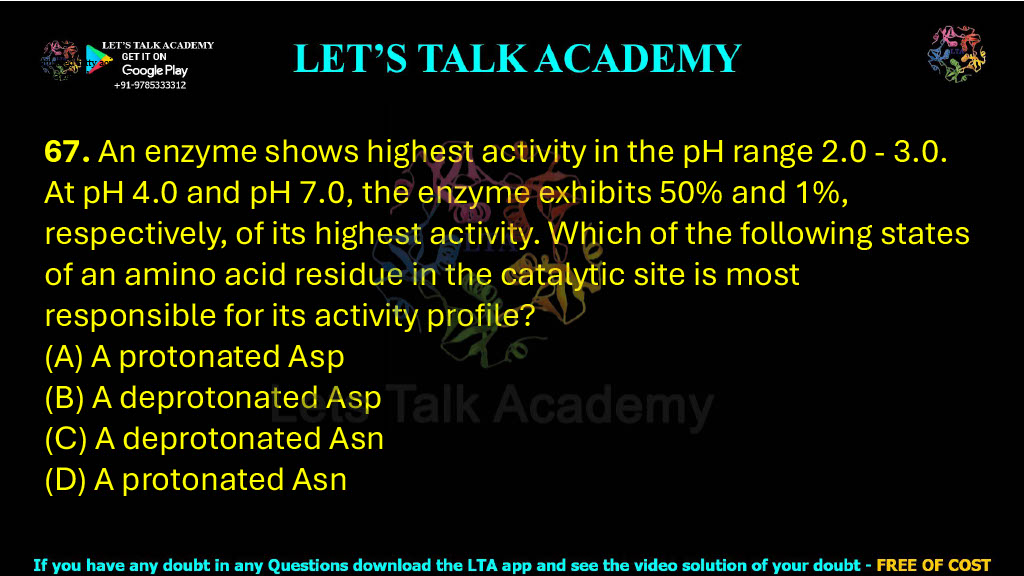
67. An enzyme shows highest activity in the pH range 2.0 – 3.0. At pH 4.0 and pH 7.0, the enzyme exhibits 50% and 1%, respectively, of its highest activity. Which of the following states of an amino acid residue in the catalytic site is most responsible for its activity profile?
(A) A protonated Asp
(B) A deprotonated Asp
(C) A deprotonated Asn
(D) A protonated Asn
Which Catalytic Residue Explains the pH Activity Profile of an Enzyme?
Correct Answer
(A) A Protonated Asp
Introduction
The catalytic activity of enzymes depends strongly on pH because the ionization state of amino acid residues within the active site determines whether they can participate in substrate binding and catalysis. Many enzymes employ amino acids such as Aspartate (Asp), Glutamate (Glu), Histidine (His), Lysine (Lys), Cysteine (Cys), and Tyrosine (Tyr) as catalytic residues. These amino acids can gain or lose protons depending on the surrounding pH, altering their charge and chemical reactivity. Consequently, every enzyme exhibits a characteristic pH–activity profile, with maximum activity occurring only when the catalytic residues possess the correct protonation state.
Aspartic acid is one of the most common catalytic residues involved in acid–base catalysis. Its side-chain carboxyl group has a pKa of approximately 3.9. Below this pH, the side chain remains protonated (–COOH), whereas above this pH it becomes deprotonated (–COO⁻). Therefore, enzymes whose activity is highest under strongly acidic conditions often require protonated Asp for catalysis.
Understanding the Concept Behind the Question
The enzyme exhibits:
- Maximum activity at pH 2–3
- 50% activity at pH 4
- Only 1% activity at pH 7
This pattern indicates that enzyme activity decreases steadily as pH increases.
Such behavior suggests that the catalytic residue must remain protonated for efficient catalysis.
When the pH rises above its pKa, the residue gradually loses its proton, resulting in loss of catalytic activity.
Analysis of Option (A)
A Protonated Asp
This statement is correct.
Aspartic acid possesses a side-chain carboxyl group with a pKa close to 3.9.
At pH 2–3, the side chain remains predominantly protonated (–COOH).
As the pH approaches 4, approximately half of the molecules become deprotonated, which explains why the enzyme retains only about 50% of its maximum activity.
At pH 7, nearly all Asp residues exist in the deprotonated state, leading to almost complete loss of catalytic activity.
The observed activity profile closely matches the ionization behavior of Aspartic acid.
Therefore,
Option (A) is correct.
Analysis of Option (B)
A Deprotonated Asp
This statement is incorrect.
If the catalytically active form were deprotonated Asp, enzyme activity would increase as the pH increased.
However, the enzyme shows the opposite pattern:
- Highest activity at acidic pH
- Very low activity at neutral pH
Therefore,
Option (B) is incorrect.
Analysis of Option (C)
A Deprotonated Asparagine
This statement is incorrect.
Asparagine contains an amide side chain rather than a carboxyl group.
Its side chain does not undergo protonation or deprotonation within the physiological pH range.
Consequently, Asparagine cannot explain a dramatic pH-dependent activity profile.
Therefore,
Option (C) is incorrect.
Analysis of Option (D)
A Protonated Asparagine
This statement is incorrect.
Like deprotonated Asparagine, protonated Asparagine is not relevant because the amide side chain remains essentially uncharged over the pH range encountered in biological systems.
Thus, it cannot account for the observed pH dependence.
Therefore,
Option (D) is incorrect.
Why Aspartic Acid Explains the Activity Profile
The side-chain pKa of Aspartic acid is approximately 3.9.
This perfectly matches the experimental observations.
- At pH 2–3, Asp is almost completely protonated, giving maximum enzyme activity.
- Around pH 4, approximately half the molecules are protonated, resulting in about 50% activity.
- At pH 7, Asp is almost entirely deprotonated, causing the enzyme to lose nearly all catalytic activity.
The close correspondence between the enzyme activity curve and the ionization curve of Asp strongly indicates that protonated Asp is the catalytically active species.
Biological Importance
Many hydrolytic enzymes and digestive enzymes utilize Aspartic acid as a catalytic acid. Examples include pepsin, rennin, cathepsin D, and several other aspartic proteases, which exhibit maximum activity under acidic conditions similar to those described in this question. In these enzymes, protonated Asp residues donate protons during catalysis, facilitating peptide bond hydrolysis. Understanding the relationship between amino acid ionization and enzyme activity is fundamental in enzymology, pharmacology, and protein engineering.
High-Yield Points
- Aspartic acid side-chain pKa ≈ 3.9.
- Below pH 4, Asp is predominantly protonated.
- Above pH 4, Asp becomes deprotonated.
- Many acidic enzymes require protonated Asp for catalysis.
- Asparagine possesses an amide side chain and is not ionizable under physiological conditions.
- Enzyme pH profiles often reflect the pKa values of catalytic residues.
Frequently Asked Questions
Why does enzyme activity decrease as pH increases?
Increasing pH causes catalytic amino acid residues to lose protons. If the protonated form is required for catalysis, enzyme activity decreases as deprotonation occurs.
Why is Aspartic acid the best choice?
Aspartic acid has a pKa near 4, which matches the observed transition from maximum activity at pH 2–3 to approximately 50% activity near pH 4.
Why is Asparagine not involved?
The amide side chain of Asparagine is not ionizable within the biological pH range and therefore cannot produce the observed pH-dependent activity profile.
Key Takeaways
The enzyme exhibits maximum catalytic activity under strongly acidic conditions, indicating that an active-site residue must remain protonated. Aspartic acid possesses a side-chain pKa of approximately 3.9, making it predominantly protonated between pH 2 and 3, partially protonated around pH 4, and almost completely deprotonated by pH 7. This ionization behavior closely matches the enzyme’s activity profile. Asparagine cannot explain the observed pattern because its amide side chain is not ionizable. Therefore, the catalytically important residue is protonated Aspartic acid.
Final Answer
Correct Option: (A) A Protonated Asp
Explanation
The enzyme exhibits maximum activity at pH 2–3, indicating that its catalytic residue must remain protonated under acidic conditions. Aspartic acid has a side-chain pKa of approximately 3.9, meaning it is predominantly protonated (–COOH) at pH 2–3, about 50% protonated at pH 4, and almost completely deprotonated (–COO⁻) at pH 7. This ionization pattern precisely corresponds to the observed decrease in enzyme activity from 100% to 50% and finally to 1%. Since Asparagine does not undergo protonation or deprotonation within the physiological pH range, it cannot account for the enzyme’s activity profile. Therefore, the correct answer is Option (A).


