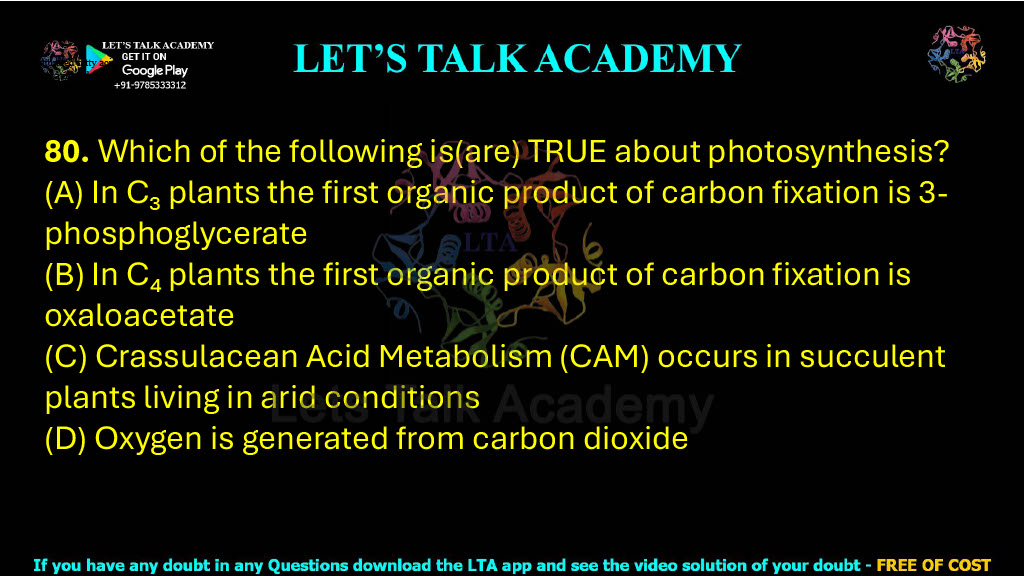
80. Which of the following is(are) TRUE about photosynthesis?
(A) In C₃ plants the first organic product of carbon fixation is 3-phosphoglycerate
(B) In C₄ plants the first organic product of carbon fixation is oxaloacetate
(C) Crassulacean Acid Metabolism (CAM) occurs in succulent plants living in arid conditions
(D) Oxygen is generated from carbon dioxide
Which Statements Are True About Photosynthesis?
Correct Answer
(A), (B) and (C)
Introduction
Photosynthesis is the fundamental biological process through which plants, algae, and cyanobacteria convert light energy into chemical energy, producing carbohydrates that sustain nearly all life on Earth. During photosynthesis, carbon dioxide is fixed into organic compounds using energy derived from sunlight, while water serves as the source of electrons required for carbon reduction. This process not only supports plant growth but also maintains atmospheric oxygen levels and drives the global carbon cycle.
Plants have evolved different photosynthetic pathways to maximize carbon fixation under varying environmental conditions. The three major pathways are the C₃ pathway, C₄ pathway, and Crassulacean Acid Metabolism (CAM). These pathways differ primarily in the mechanism of carbon fixation, the first stable product formed, and their adaptation to environmental stresses such as drought and high temperature.
Understanding the Concept Behind the Question
Each option tests a specific concept related to carbon fixation or oxygen evolution.
To determine the correct answer, it is important to know:
- The first stable product of carbon fixation in C₃ plants.
- The first stable product in C₄ plants.
- The ecological significance of CAM metabolism.
- The true source of oxygen released during photosynthesis.
Analysis of Option (A)
In C₃ plants the first organic product of carbon fixation is 3-phosphoglycerate
This statement is correct.
In C₃ plants, atmospheric carbon dioxide combines with ribulose-1,5-bisphosphate (RuBP) through the action of the enzyme RuBisCO.
The unstable six-carbon intermediate immediately splits into:
Two molecules of 3-phosphoglycerate (3-PGA)
Since 3-PGA is the first stable organic compound formed, these plants are known as C₃ plants.
Examples include:
- Wheat
- Rice
- Barley
- Soybean
Therefore,
Option (A) is true.
Analysis of Option (B)
In C₄ plants the first organic product of carbon fixation is oxaloacetate
This statement is correct.
In C₄ plants, carbon dioxide is first fixed by phosphoenolpyruvate (PEP) carboxylase in mesophyll cells.
The immediate product formed is:
Oxaloacetate (OAA)
Oxaloacetate is then converted into malate or aspartate before being transported to bundle sheath cells, where the Calvin cycle occurs.
Examples of C₄ plants include:
- Maize
- Sugarcane
- Sorghum
Therefore,
Option (B) is true.
Analysis of Option (C)
Crassulacean Acid Metabolism (CAM) occurs in succulent plants living in arid conditions
This statement is correct.
CAM plants are specially adapted to dry and desert environments.
To minimize water loss:
- Stomata open during the night.
- Carbon dioxide is fixed into malic acid.
- During the day, stomata remain closed while stored CO₂ is released internally for the Calvin cycle.
Typical CAM plants include:
- Cactus
- Agave
- Pineapple
- Aloe vera
This adaptation greatly improves water-use efficiency.
Therefore,
Option (C) is true.
Analysis of Option (D)
Oxygen is generated from carbon dioxide
This statement is incorrect.
The oxygen released during photosynthesis does not originate from carbon dioxide.
Instead, oxygen is produced by the photolysis of water during the light-dependent reactions.
The reaction is:
2H₂O → O₂ + 4H⁺ + 4e⁻
The released electrons move through the photosynthetic electron transport chain, while molecular oxygen diffuses into the atmosphere.
Isotope-labeling experiments using ¹⁸O conclusively demonstrated that the oxygen evolved during photosynthesis originates from water, not from carbon dioxide.
Therefore,
Option (D) is false.
Comparison of C₃, C₄ and CAM Plants
| Feature | C₃ Plants | C₄ Plants | CAM Plants |
|---|---|---|---|
| Primary CO₂ acceptor | RuBP | PEP | PEP |
| First stable product | 3-Phosphoglycerate | Oxaloacetate | Oxaloacetate (stored as malate) |
| Initial fixation enzyme | RuBisCO | PEP Carboxylase | PEP Carboxylase |
| Stomata open | Day | Day | Night |
| Adaptation | Moderate climate | High temperature | Arid conditions |
Biological Importance
The evolution of C₄ and CAM photosynthesis represents remarkable adaptations that improve photosynthetic efficiency under environmental stress. C₄ plants minimize photorespiration by concentrating carbon dioxide around RuBisCO, allowing efficient photosynthesis under high temperatures and intense light. CAM plants reduce water loss by separating carbon fixation and the Calvin cycle in time, making them exceptionally well adapted to deserts. Meanwhile, the C₃ pathway remains the most widespread photosynthetic mechanism and supports the majority of global agricultural production.
High-Yield Points
- First product of C₃ photosynthesis = 3-phosphoglycerate (3-PGA).
- First product of C₄ photosynthesis = Oxaloacetate (OAA).
- Initial enzyme of C₄ pathway = PEP carboxylase.
- Initial enzyme of C₃ pathway = RuBisCO.
- CAM plants open stomata at night.
- Oxygen released during photosynthesis originates from water, not carbon dioxide.
- The Calvin cycle occurs in the chloroplast stroma.
Frequently Asked Questions
Why are C₄ plants more efficient in hot climates?
PEP carboxylase has a much higher affinity for carbon dioxide than RuBisCO and does not catalyze photorespiration, making C₄ photosynthesis more efficient under high temperatures.
Why do CAM plants open their stomata at night?
Opening stomata during the cooler night reduces water loss through transpiration while allowing carbon dioxide uptake.
How do scientists know that oxygen comes from water?
Radioisotope experiments using oxygen-18 (¹⁸O) demonstrated that the oxygen released during photosynthesis originates from water molecules, not carbon dioxide.
Key Takeaways
Photosynthesis occurs through different pathways depending on environmental adaptation. C₃ plants produce 3-phosphoglycerate as the first stable product of carbon fixation, whereas C₄ plants initially produce oxaloacetate through the action of PEP carboxylase. CAM plants are specialized for arid habitats, fixing carbon dioxide at night to conserve water. The oxygen released during photosynthesis originates from the photolysis of water, not from carbon dioxide. Therefore, Options (A), (B), and (C) are correct, while Option (D) is incorrect.
Final Answer
Correct Options: (A), (B) and (C)
Explanation
In C₃ plants, the first stable product formed after carbon fixation is 3-phosphoglycerate (3-PGA), making Option (A) correct. In C₄ plants, carbon dioxide is initially fixed by PEP carboxylase to produce oxaloacetate, making Option (B) correct. CAM metabolism is an adaptation found in succulent plants living in arid environments, where stomata open at night to minimize water loss, making Option (C) correct. However, the oxygen released during photosynthesis is generated by the photolysis of water during the light reactions rather than from carbon dioxide. Therefore, Option (D) is incorrect. Hence, the correct answers are (A), (B), and (C).


