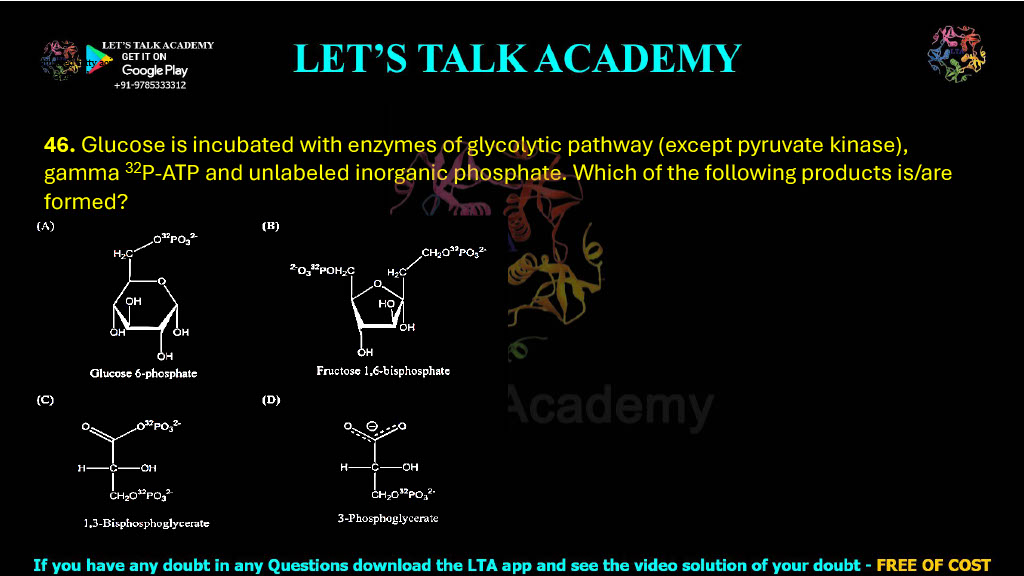
46. Glucose is incubated with enzymes of glycolytic pathway (except pyruvate kinase), gamma 32P-ATP and unlabeled inorganic phosphate. Which of the following products is/are formed?
Glucose Incubated with Glycolytic Enzymes and γ-32P ATP: Which Radioactive Products Are Formed?
Correct Answer
(A), (B) and (D)
Introduction
Radioisotopes are among the most powerful experimental tools in biochemistry because they allow scientists to trace the movement of individual atoms through complex metabolic pathways. One of the most commonly used radioactive tracers is γ-³²P ATP, in which the terminal (γ) phosphate group carries radioactive phosphorus-32. Whenever ATP donates its terminal phosphate during an enzyme-catalyzed phosphorylation reaction, the radioactive label is transferred to the product. By following the radioactive phosphate through glycolysis, researchers can determine which intermediates inherit the labeled phosphate and which obtain phosphate from another source.
This question focuses on one of the most important concepts in metabolic biochemistry: the origin of phosphate groups in glycolytic intermediates. Since pyruvate kinase is absent, glycolysis proceeds only up to phosphoenolpyruvate, allowing us to examine which compounds become radiolabeled when γ-³²P ATP is supplied together with unlabeled inorganic phosphate (Pi).
Understanding the Concept Behind the Question
The radioactive atom is present only on the γ-phosphate of ATP.
Therefore, every reaction that transfers ATP’s terminal phosphate will produce a radioactive product.
During glycolysis, ATP is consumed in two phosphorylation reactions:
Step 1
Glucose + ATP
↓
Glucose-6-phosphate
Catalyzed by Hexokinase
Here, the γ-phosphate of ATP is directly transferred to glucose.
Therefore,
Glucose-6-phosphate becomes radioactive.
The next ATP-dependent reaction is:
Fructose-6-phosphate + ATP
↓
Fructose-1,6-bisphosphate
Catalyzed by Phosphofructokinase-1
Again, ATP donates its γ-phosphate.
Thus,
Fructose-1,6-bisphosphate also becomes radioactive.
Later, glyceraldehyde-3-phosphate is converted into 1,3-bisphosphoglycerate.
However, the phosphate attached to carbon-1 is derived from inorganic phosphate (Pi).
The question specifically states that Pi is unlabeled.
Therefore:
- Carbon-1 phosphate is not radioactive.
- Carbon-3 phosphate originated earlier from ATP.
Hence the molecule is not labeled at both phosphate positions, as shown in Option (C).
Next,
1,3-Bisphosphoglycerate
↓
3-Phosphoglycerate
Catalyzed by Phosphoglycerate Kinase
The unlabeled phosphate at carbon-1 is transferred to ADP to form ATP.
The phosphate remaining on carbon-3 is the original ATP-derived phosphate.
Therefore,
3-Phosphoglycerate retains the radioactive phosphate.
Why Option (A) Is Correct
Glucose-6-phosphate
Hexokinase transfers the γ-phosphate of ATP directly onto glucose.
Since ATP is radioactive,
the phosphate attached to glucose is also radioactive.
Therefore, the labeled glucose-6-phosphate shown in Option (A) is formed.
Hence,
Option (A) is correct.
Why Option (B) Is Correct
Fructose-1,6-bisphosphate
Phosphofructokinase transfers another γ-phosphate from ATP to fructose-6-phosphate.
The phosphate originally present at carbon-6 was already radioactive because it came from glucose-6-phosphate.
The newly added phosphate at carbon-1 also comes from radioactive ATP.
Consequently,
both phosphate groups become radioactive.
Therefore,
Option (B) is correct.
Why Option (C) Is Incorrect
1,3-Bisphosphoglycerate
This intermediate contains two phosphate groups.
However, only the phosphate attached to carbon-3 originated from ATP.
The phosphate attached to carbon-1 comes from unlabeled inorganic phosphate (Pi) during the glyceraldehyde-3-phosphate dehydrogenase reaction.
Option (C) depicts radioactive labeling at the acyl phosphate position, which is incorrect under the experimental conditions.
Therefore,
Option (C) is incorrect.
Why Option (D) Is Correct
3-Phosphoglycerate
During the phosphoglycerate kinase reaction, the phosphate at carbon-1 (derived from unlabeled Pi) is transferred to ADP to generate ATP.
The phosphate remaining on carbon-3 originated from ATP and therefore remains radioactive.
Thus, the labeled structure shown in Option (D) is correctly formed.
Therefore,
Option (D) is correct.
Phosphate Transfer During Glycolysis
The movement of phosphate groups during glycolysis can be summarized as follows:
ATP (γ-³²P)
↓
Glucose-6-phosphate (radioactive)
↓
Fructose-6-phosphate
↓
Fructose-1,6-bisphosphate (both phosphates radioactive)
↓
Glyceraldehyde-3-phosphate
↓
1,3-Bisphosphoglycerate
- Carbon-3 phosphate → radioactive
- Carbon-1 phosphate → from unlabeled Pi
↓
3-Phosphoglycerate
↓
Retains only the radioactive phosphate at carbon-3
Biological Importance
Radioactive isotope experiments have played a fundamental role in elucidating the glycolytic pathway. By selectively labeling ATP or inorganic phosphate with radioactive phosphorus, researchers were able to determine the origin and fate of phosphate groups in metabolic intermediates. These studies demonstrated that ATP supplies phosphate during kinase reactions, whereas inorganic phosphate is incorporated during the glyceraldehyde-3-phosphate dehydrogenase step. Such experiments established many of the biochemical principles that form the foundation of modern metabolism.
High-Yield Exam Points
- γ-³²P labels the terminal phosphate of ATP.
- Hexokinase transfers radioactive phosphate to glucose.
- Phosphofructokinase transfers another radioactive phosphate.
- Glyceraldehyde-3-phosphate dehydrogenase uses inorganic phosphate, not ATP.
- Phosphoglycerate kinase removes the unlabeled acyl phosphate.
- Pyruvate kinase is absent, so the pathway stops before pyruvate formation.
Frequently Asked Questions
Why is glucose-6-phosphate radioactive?
Because hexokinase transfers the γ-phosphate of ATP directly to glucose, and the γ-phosphate carries the radioactive ³²P label.
Why is one phosphate of 1,3-bisphosphoglycerate not radioactive?
The phosphate attached to carbon-1 originates from inorganic phosphate (Pi) rather than ATP. Since the experiment specifies unlabeled Pi, this phosphate remains non-radioactive.
Why does 3-phosphoglycerate remain radioactive?
During conversion of 1,3-bisphosphoglycerate into 3-phosphoglycerate, the unlabeled phosphate at carbon-1 is transferred to ADP, while the ATP-derived phosphate at carbon-3 remains attached to the molecule.
Key Takeaways
This experiment demonstrates how radioactive tracers can identify the origin of phosphate groups during glycolysis. The γ-phosphate of ATP is transferred by hexokinase and phosphofructokinase, producing radioactive glucose-6-phosphate and fructose-1,6-bisphosphate. In contrast, the phosphate incorporated into 1,3-bisphosphoglycerate at carbon-1 originates from unlabeled inorganic phosphate, making that position non-radioactive. After phosphoglycerate kinase acts, 3-phosphoglycerate retains only the ATP-derived radioactive phosphate. Therefore, the products formed under these conditions are Options (A), (B), and (D).
Final Answer
Correct Answer: (A), (B) and (D)
Explanation
The radioactive isotope ³²P is present only in the γ-phosphate of ATP, so every ATP-dependent phosphorylation transfers the radioactive label to the product. Hexokinase produces radioactive glucose-6-phosphate, and phosphofructokinase-1 produces radioactive fructose-1,6-bisphosphate. During formation of 1,3-bisphosphoglycerate, the phosphate attached to carbon-1 comes from unlabeled inorganic phosphate, not ATP, so the labeling pattern shown in Option (C) is incorrect. After phosphoglycerate kinase transfers this unlabeled phosphate to ADP, 3-phosphoglycerate retains the original ATP-derived radioactive phosphate. Hence, the correct products formed are (A), (B), and (D).


