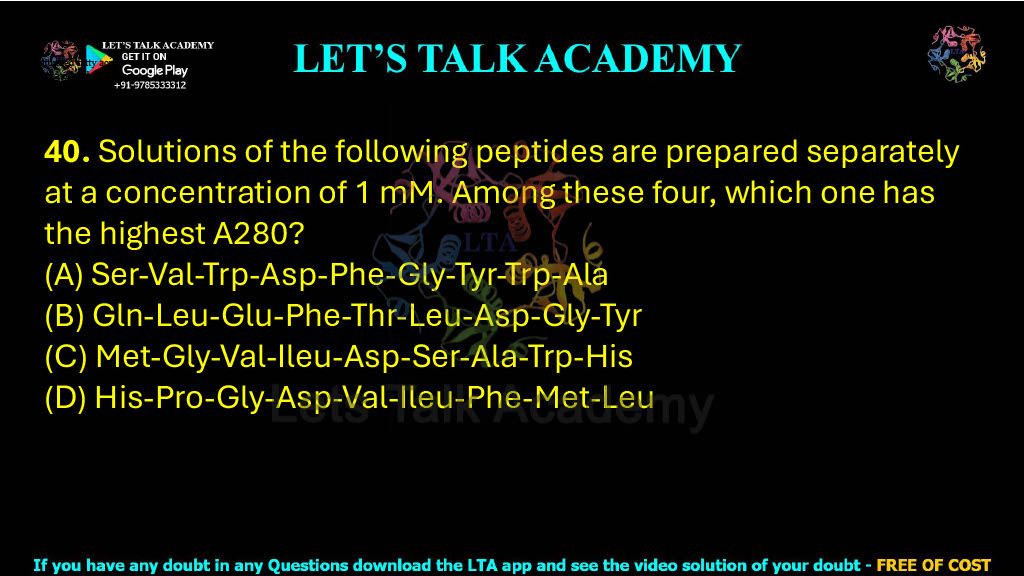
40. Solutions of the following peptides are prepared separately at a concentration of 1 mM. Among these four, which one has the highest A280?
(A) Ser-Val-Trp-Asp-Phe-Gly-Tyr-Trp-Ala
(B) Gln-Leu-Glu-Phe-Thr-Leu-Asp-Gly-Tyr
(C) Met-Gly-Val-Ileu-Asp-Ser-Ala-Trp-His
(D) His-Pro-Gly-Asp-Val-Ileu-Phe-Met-Leu
Which Peptide Has the Highest Absorbance at 280 nm (A280)? | Complete Aromatic Amino Acid Explanation
Correct Answer
(A) Ser–Val–Trp–Asp–Phe–Gly–Tyr–Trp–Ala
Introduction
Ultraviolet (UV) spectroscopy is one of the most widely used analytical techniques in biochemistry for measuring protein concentration and studying protein structure. Most proteins absorb ultraviolet light strongly at 280 nm (A280) because certain amino acids possess aromatic rings capable of absorbing UV radiation. Among the twenty standard amino acids, tryptophan (Trp) contributes the greatest absorbance at 280 nm, followed by tyrosine (Tyr), whereas phenylalanine (Phe) contributes only weakly. The overall absorbance of a protein or peptide at 280 nm therefore depends primarily on the number and type of aromatic amino acids present in its sequence.
Understanding the Concept Behind the Question
The absorbance of proteins at 280 nm is mainly due to three aromatic amino acids:
- Tryptophan (Trp) → Very strong absorbance
- Tyrosine (Tyr) → Moderate absorbance
- Phenylalanine (Phe) → Very weak absorbance
Their approximate contribution follows the order:
Tryptophan > Tyrosine >> Phenylalanine
Therefore, when comparing peptides of equal concentration, the peptide containing the greatest number of tryptophan residues will generally exhibit the highest A280 value.
To solve the question, each peptide should be examined for its aromatic amino acid content.
Why Option (A) Is Correct
Ser–Val–Trp–Asp–Phe–Gly–Tyr–Trp–Ala
This peptide contains:
- 2 Tryptophan (Trp)
- 1 Tyrosine (Tyr)
- 1 Phenylalanine (Phe)
This is the richest aromatic composition among all four peptides.
Since tryptophan contributes the largest extinction coefficient at 280 nm, the presence of two Trp residues gives this peptide the highest UV absorbance.
The additional tyrosine further increases the total absorbance.
Therefore,
Option (A) has the highest A280.
Why Option (B) Is Incorrect
Gln–Leu–Glu–Phe–Thr–Leu–Asp–Gly–Tyr
This peptide contains:
- 1 Tyrosine
- 1 Phenylalanine
- No Tryptophan
Although tyrosine absorbs significantly at 280 nm, the absence of tryptophan greatly reduces the overall absorbance compared with Option (A).
Therefore,
Option (B) is incorrect.
Why Option (C) Is Incorrect
Met–Gly–Val–Ile–Asp–Ser–Ala–Trp–His
This peptide contains:
- 1 Tryptophan
- No tyrosine
- No additional aromatic residues except one Trp
Because it possesses only one tryptophan, its absorbance is substantial but still much lower than Option (A), which contains two tryptophans plus one tyrosine.
Therefore,
Option (C) is incorrect.
Why Option (D) Is Incorrect
His–Pro–Gly–Asp–Val–Ile–Phe–Met–Leu
This peptide contains:
- 1 Phenylalanine
- No tryptophan
- No tyrosine
Phenylalanine has only a very small extinction coefficient at 280 nm and contributes minimally to UV absorbance.
Consequently, this peptide exhibits the lowest A280 among the four options.
Therefore,
Option (D) is incorrect.
Aromatic Amino Acids Responsible for A280
Three amino acids absorb ultraviolet light near 280 nm:
| Amino Acid | Relative Absorbance at 280 nm |
|---|---|
| Tryptophan (Trp) | Highest |
| Tyrosine (Tyr) | Moderate |
| Phenylalanine (Phe) | Very Low |
Approximate order:
Trp > Tyr >> Phe
Because of its indole ring, tryptophan contributes the largest extinction coefficient and therefore dominates protein absorbance measurements at 280 nm.
Comparison of the Four Peptides
| Option | Trp | Tyr | Phe | Expected A280 |
|---|---|---|---|---|
| A | 2 | 1 | 1 | Highest |
| B | 0 | 1 | 1 | Moderate |
| C | 1 | 0 | 0 | High |
| D | 0 | 0 | 1 | Lowest |
This comparison clearly shows that Option (A) contains the greatest number of strongly absorbing aromatic residues.
Biological Importance of A280 Measurement
Measurement of absorbance at 280 nm is one of the fastest and most convenient methods for estimating protein concentration. Because proteins containing tryptophan and tyrosine absorb strongly in the ultraviolet region, spectrophotometers can determine protein concentration without the need for additional reagents.
This technique is widely used in protein purification, enzyme assays, chromatography, recombinant protein production, and structural biology. However, proteins lacking aromatic amino acids exhibit low absorbance at 280 nm, making alternative assays such as the Bradford or BCA method more appropriate.
High-Yield Points
- Proteins are commonly quantified at 280 nm.
- Tryptophan contributes the greatest absorbance.
- Tyrosine contributes moderate absorbance.
- Phenylalanine contributes only weakly.
- Histidine does not significantly contribute to A280.
- Greater numbers of Trp residues produce higher absorbance.
Frequently Asked Questions
Why does tryptophan absorb more strongly than tyrosine?
Tryptophan contains an indole ring, which has a much higher molar extinction coefficient than the phenolic ring of tyrosine, resulting in stronger UV absorption at 280 nm.
Does phenylalanine contribute to A280?
Yes, but only weakly. Its contribution is much smaller than that of tryptophan or tyrosine.
Why is A280 widely used in protein estimation?
Most proteins contain tryptophan and tyrosine residues, allowing rapid, non-destructive estimation of protein concentration using UV spectroscopy without additional chemical reagents.
Key Takeaways
Protein absorbance at 280 nm depends primarily on the presence of aromatic amino acids, especially tryptophan, followed by tyrosine, while phenylalanine contributes only slightly. Among the four peptides given, Option (A) contains two tryptophan residues, one tyrosine, and one phenylalanine, providing the greatest total absorbance. Understanding the relative contributions of aromatic amino acids is essential for interpreting UV spectroscopy experiments and solving protein chemistry questions in competitive examinations.
Final Answer
Correct Option: (A) Ser–Val–Trp–Asp–Phe–Gly–Tyr–Trp–Ala
Explanation
Protein absorbance at 280 nm (A280) is mainly determined by the aromatic amino acids tryptophan, tyrosine, and phenylalanine, with their contributions following the order Trp > Tyr >> Phe. Among the four peptides, Option (A) contains two tryptophan residues, one tyrosine, and one phenylalanine, giving it the highest total molar absorptivity. The remaining peptides contain fewer or less strongly absorbing aromatic residues. Therefore, Option (A) exhibits the highest A280 and is the correct answer.


