













































































Q.8 Which of the following are produced by Mangrove trees to survive in the waterlogged swampy forests? (A) Trichomes (B) Pneumatophores (C) Spermatophores (D) Cambia Mangrove Trees Pneumatophores: Key Adaptation […]
Author: admin

CSIR NET Life Science Previous Year Questions and Solution on EXTENSION OF MENDELIAN PRINCIPLES (62)
IIT JAM Biotechnology Previous Year Question Paper 2022 Video Solution
Barr Bodies in Turner Syndrome Somatic Cells
Q.7 The number of “Barr Bodies” present in a somatic cell of a woman suffering from Turner syndrome is ____. (A) 0 (B) 1 (C) 2 (D) 3 Barr Bodies […]
IIT JAM Biotechnology Previous Year Question Paper 2022 Video Solution
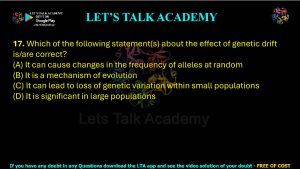
Genetic Drift: Random Fluctuation in Gene Frequency
Q.6 A random fluctuation in gene frequency is called (A) Genetic drift (B) Genetic load (C) Panmixis (D) Genetic shift Genetic Drift: Random Fluctuation in Gene Frequency Explained Genetic drift […]
IIT JAM Biotechnology Previous Year Question Paper 2022 Video Solution
Fossilization Processes
Q.5 The fossilization process in which mineral rich water penetrates through the pores of decomposed organic matter is known as _____. (A) Carbonization (B) Chemical fossilization (C) Petrifaction (D) Microfossilization […]
IIT JAM Biotechnology Previous Year Question Paper 2022 Video Solution
Dipicolinic Acid in Bacterial Endospores
Q.4 Which of the following bacterial component contains “dipicolinic acid”? (A) Endospore (B) Capsule (C) Flagella (D) Pili Dipicolinic acid is a key molecule found exclusively in bacterial endospores, contributing […]
IIT JAM Biotechnology Previous Year Question Paper 2022 Video Solution
Which of the Following is a Glycolipid?
Q.3 Which of the following is a glycolipid? (A) Cerebroside (B) Phosphatidylcholine (C) Phosphatidylserine (D) Cardiolipin Which of the Following is a Glycolipid? MCQ Answer and Explanation Cerebroside is the […]
IIT JAM Biotechnology Previous Year Question Paper 2022 Video Solution
Which Virus Belongs to Retroviridae Family?
Q.2 Which among the following belongs to the family “Retroviridae”? (A) Human Immunodeficiency virus (B) Ebola virus (C) Dengue virus (D) Influenza virus Which Virus Belongs to Retroviridae Family? MCQ […]
IIT JAM Biotechnology Previous Year Question Paper 2022 Video Solution
Innate Immune Response in Higher Mammals
Q.1 Which of the following is involved in innate immune response in higher mammals? (A) T cell antigen receptor (B) B cell antigen receptor (C) Toll-like receptor (D) Major histocompatibility […]

IIT JAM Biotechnology Previous Year Question Paper 2023
First Order Reaction Concentration After 10 Min
Q.60 Consider a first order reaction 𝐴 → 𝐵. The initial concentration of 𝐴 is 100 mol L–1and the value of first order rate constant is 0.01 min–1. The concentration […]
IIT JAM Biotechnology Previous Year Question Paper 2023
Bacterial Transcription Rate
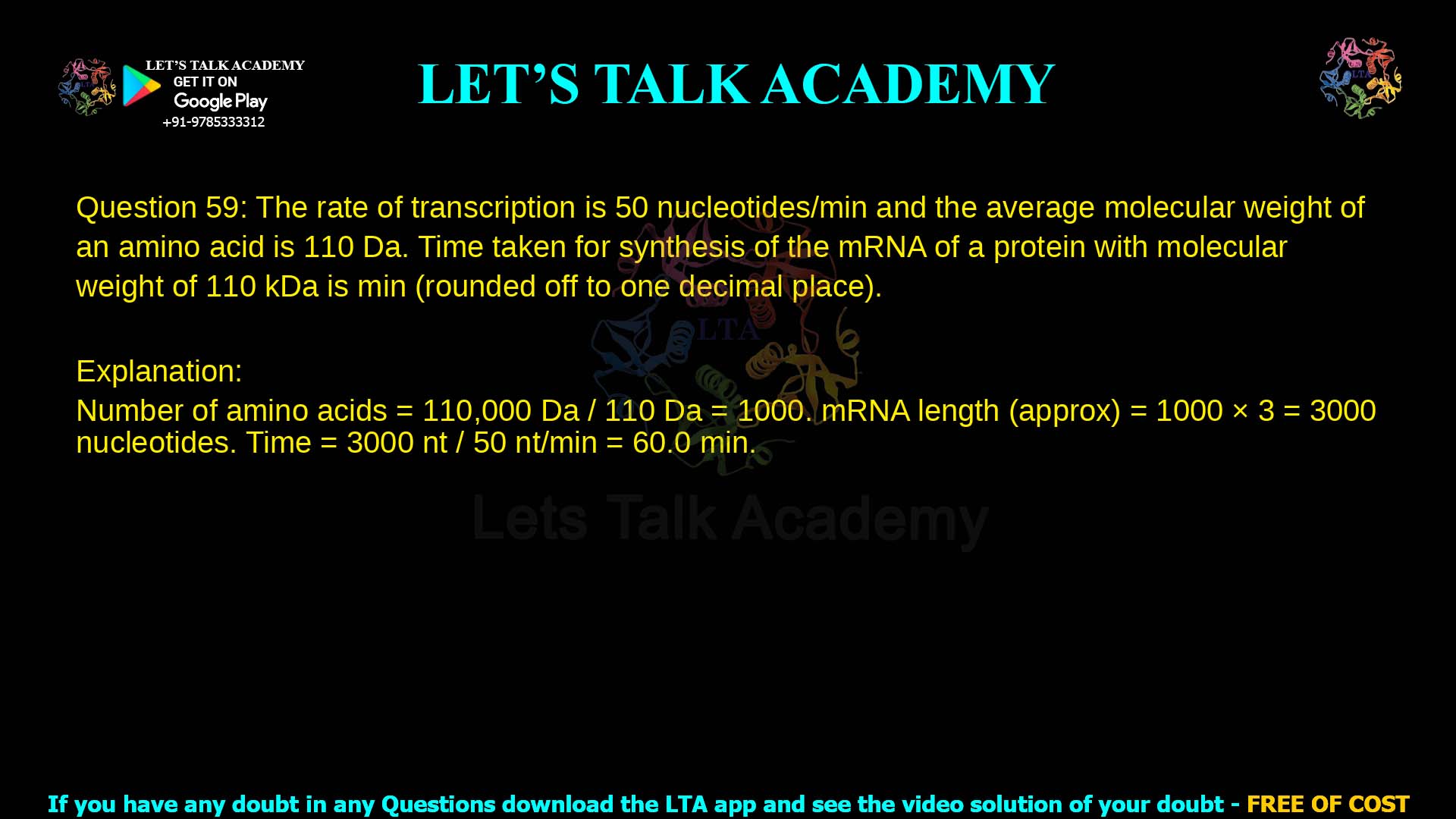
Q.59 The rate of transcription in a bacterium is 50 nucleotides/min and the averagemolecular weight of an amino acid is 110 Da. Time taken for synthesis of the mRNAof a […]


