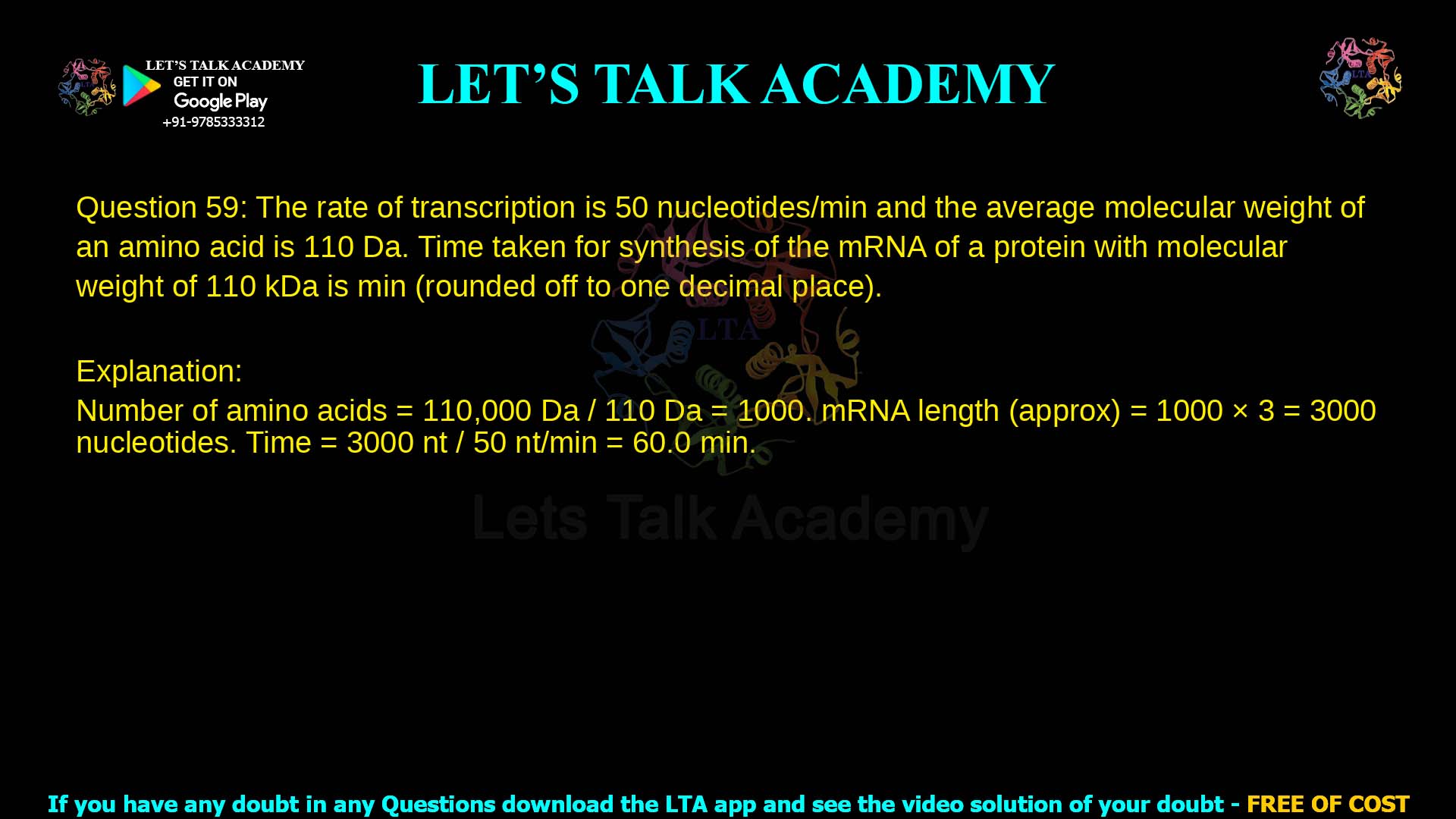
Q.59 The rate of transcription in a bacterium is 50 nucleotides/min and the average
molecular weight of an amino acid is 110 Da. Time taken for synthesis of the mRNA
of a protein with molecular weight of 110 kDa is _______ min. (rounded off to one
decimal place)
Assume no abortive transcriptions and no sequences upstream of the start codon.
The time taken for synthesis of the mRNA for a 110 kDa protein is 60.0 minutes. This calculation relies on standard bacterial transcription rates and protein composition assumptions relevant to CSIR NET Life Sciences exam problems.[execute_python]
Calculation Steps
A protein’s molecular weight of 110 kDa equals 110,000 Da. With an average amino acid residue mass of 110 Da, the protein contains 110,000 / 110 = 1,000 amino acids.
Each amino acid requires a 3-nucleotide codon in mRNA, so the coding sequence totals 1,000 × 3 = 3,000 nucleotides. The problem specifies no upstream sequences or abortive transcripts, so only the coding region is transcribed.
At 50 nucleotides per minute, transcription time is 3,000 / 50 = 60 minutes, rounded to one decimal place as 60.0.[execute_python]
Key Assumptions
Bacterial RNA polymerase elongates at rates around 40-80 nucleotides per second (2,400-4,800 nt/min), but the problem uses 50 nt/min, likely to simplify exam calculations.
The 110 Da average reflects residue masses in proteins (free amino acids average ~138 Da minus 18 Da water), weighted by common occurrences like glycine and alanine.
No 5′ UTR, promoter, or Shine-Dalgarno sequences are included per the problem’s explicit instructions.
Common Pitfalls
Trainees often forget to exclude water mass or include non-coding regions, yielding incorrect nucleotide counts like 3,300 nt. Others misconvert kDa to Da or overlook the codon triplet code.
Using free amino acid averages (138 Da) gives ~798 amino acids and underestimates time at ~47.8 min, a frequent trap in CSIR NET questions.
Real bacterial rates vary by conditions, but exam problems prioritize given values over literature ranges (e.g., 25-50 nt/s).
In bacterial transcription rate problems for CSIR NET Life Sciences, determining time for mRNA synthesis of a 110 kDa protein at 50 nucleotides/min is a classic quantitative genetics question. This SEO-optimized guide breaks down the calculation using average amino acid molecular weight of 110 Da, codon rules, and exam assumptions for precise 60.0 min answer.[execute_python]
Step-by-Step Solution
Start with protein molecular weight: 110 kDa = 110,000 Da. Divide by average amino acid residue mass (110 Da) to get number of amino acids: 110,000 ÷ 110 = 1,000.
Multiply by 3 nucleotides per codon: 1,000 × 3 = 3,000 nucleotides for the coding sequence. No upstream sequences means full mRNA length matches this.
Apply transcription rate: 3,000 nt ÷ 50 nt/min = 60.0 min (rounded to one decimal).
Why 110 Da Average?
Proteins use residue masses (~110 Da) after peptide bond formation removes water (18 Da from ~138 Da free amino acids). Frequent small residues like Ala/Gly lower the effective average.
Exam Relevance
CSIR NET tests integration of biochemistry (amino acid weights), molecular biology (codon table), and kinetics (transcription rates). Pitfalls include untranslated regions or wrong Da conversion.
This approach ensures accuracy for similar problems in genetics, biotechnology, and cell biology sections.


