



































































































39. Which of the following statements is incorrect? A. In affinity chromatography, lectins are used to purify a glycoprotein B. The separation in gel filtration chromatography is based on size, […]
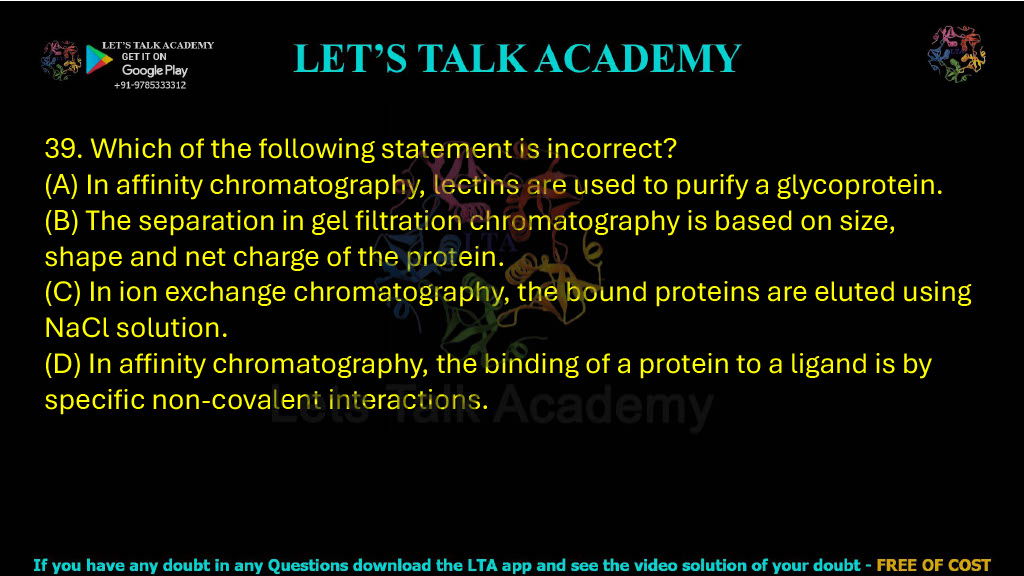

39. Which of the following statements is incorrect? A. In affinity chromatography, lectins are used to purify a glycoprotein B. The separation in gel filtration chromatography is based on size, […]
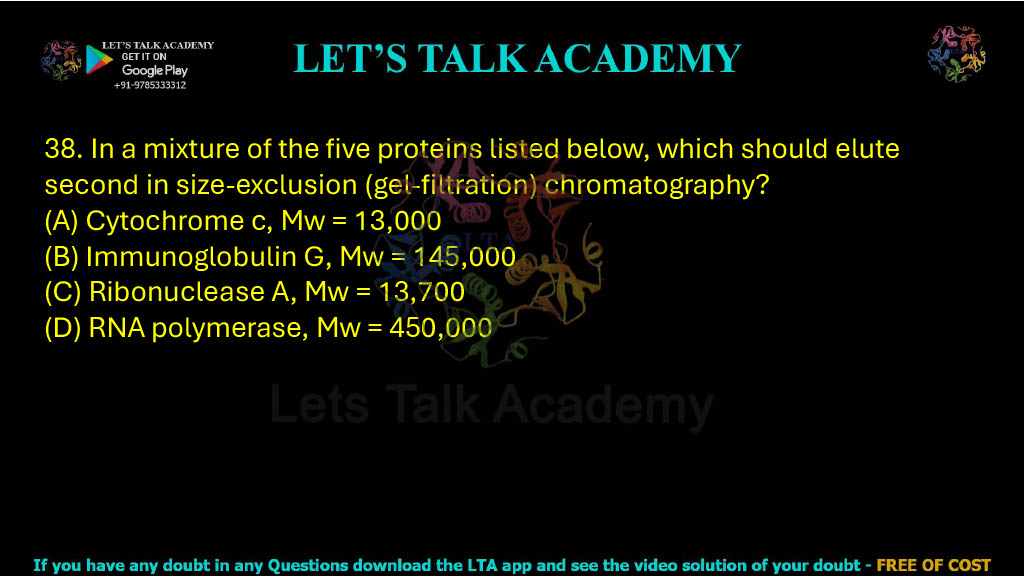
38. In a mixture of the five proteins listed below, which should elute second in size-exclusion (gel-filtration) chromatography? A. Cytochrome c (Mw = 13,000) B. Immunoglobulin G (Mw = 145,000) […]
37. Which of the following methods could be used to check the molecular weight of your purified protein? A. SDS-PAGE only B. Mass spectrometry only C. Analytical size exclusion chromatography […]
36. To elute target proteins from an affinity chromatography matrix, which of the following conditions would be the most appropriate? A. Low salt concentrations B. High salt concentrations C. Adding […]
35. What properties of a protein does hydrophobic interaction chromatography exploit for purification? A. Charged amino acids B. Hydrophobic amino acids on the protein surface C. Molecular weight D. Enzyme […]
34. For an application where you require a sample of your target protein at high purity, what would be a good purification strategy? Assume that your starting point is E. […]

33. Back diffusion occurs mostly in: A. Size exclusion chromatography B. Gas chromatography C. HPLC D. HPTLC Back diffusion occurs mostly in Gas Chromatography (GC), making option (B) correct. This is due […]
32. The process of release of volatile / soluble components of a GC or HPLC stationary phase is termed as: A. Bleed B. Creep C. Back flush D. Back diffusion […]

31. Which of the following is the correct statement: A. Resolution is proportional to the square root of the number of theoretical plates in a column B. Resolution is inversely […]
30. α-bungarotoxin binds to acetylcholine receptor (AChR) protein with high specificity and prevents the ion channel opening. This interaction can be exploited to purify AChR from membrane using (A) Ion-exchange […]


