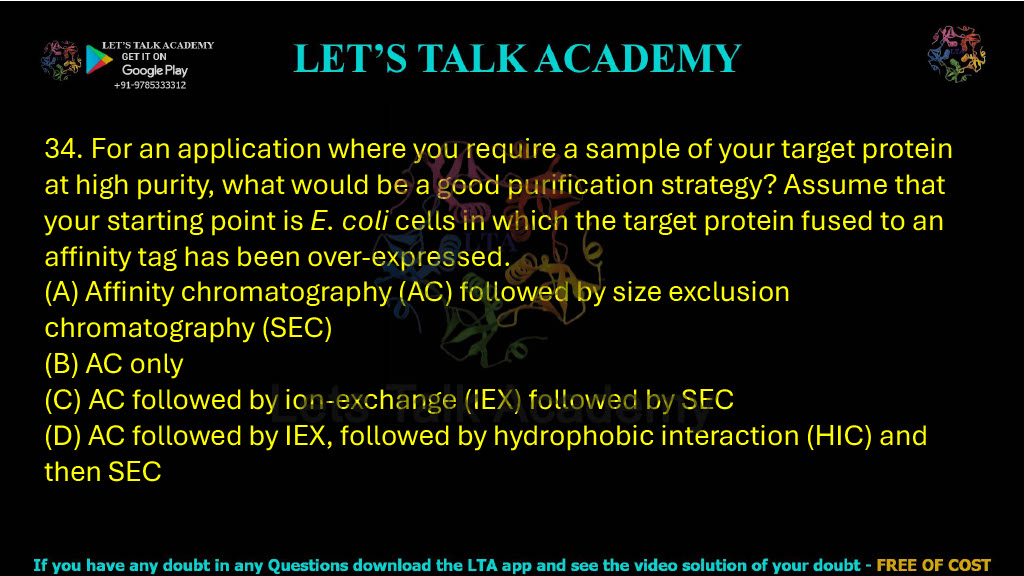
34. For an application where you require a sample of your target protein at high purity, what would be a good purification strategy?
Assume that your starting point is E. coli cells in which the target protein fused to an affinity tag has been over-expressed.
A. Affinity chromatography (AC) followed by size exclusion chromatography (SEC)
B. AC only
C. AC followed by ion-exchange (IEX) followed by SEC
D. AC followed by IEX, followed by hydrophobic interaction (HIC) and then SEC
Protein Purification Strategy: Affinity Chromatography Followed by Size Exclusion Chromatography
For high-purity target protein from E. coli overexpressing an affinity-tagged version, the optimal strategy balances efficiency and final polishing. The correct answer is A. Affinity chromatography (AC) followed by size exclusion chromatography (SEC).
Why This Question Matters
This multiple-choice question tests core biochemistry knowledge for recombinant protein purification, common in GATE Life Sciences and molecular biology research. Starting from E. coli lysate with an affinity tag (like His-tag or GST), the goal is high purity for applications like crystallography or assays. Standard protocols use orthogonal steps: capture via specific binding, then polishing.
Option Breakdown
Each option builds on AC as the capture step, exploiting the affinity tag for quick, high-yield isolation from crude lysate.
-
A. AC followed by SEC: Best choice. AC captures >90% pure target via tag-specific binding (e.g., Ni-NTA for His-tag). SEC polishes by size, removing aggregates, fragments, and minor contaminants while exchanging buffer. SEC acts as a “polishing” step, ideal for final high purity without overcomplicating.
-
B. AC only: Often 80-95% pure but insufficient for “high purity” needs. Residual E. coli proteins, tag-cleaving protease byproducts, or multimers remain. Fine for quick preps, but not for demanding apps.
-
C. AC followed by IEX followed by SEC: Overkill for most cases. IEX (charge-based) adds an intermediate step, good if post-AC impurities share size but differ in pI. Increases time, dilution, and risk of low yield; unnecessary when SEC alone suffices.
-
D. AC followed by IEX, HIC, and SEC: Excessive multi-step process. HIC (hydrophobicity-based) suits high-salt conditions or surface hydrophobics, but four steps dilute protein, raise costs, and risk instability. Used only for ultra-tricky proteins.
Standard Workflow
-
Lyse E. coli, clarify supernatant.
-
AC: Bind/elute via tag (e.g., imidazole gradient).
-
SEC: Run on Superdex column; target elutes by native size, separating monomers from dimers/aggregates.
| Step | Technique | Principle | Purity Gain | Typical Use |
|---|---|---|---|---|
| 1 | AC | Tag-ligand binding | High (80-95%) | Capture from lysate |
| 2 | SEC | Molecular size/shape | Final (95-99%) | Polishing, buffer exchange |
This AC-SEC combo achieves >95% purity efficiently, matching industrial and academic standards for tagged proteins.


2 Comments
Vanshika Sharma
February 3, 2026Affinity chromatography followed by size exclusion chromatography
Kanica Sunwalka
June 27, 2026Affinity chr. followed by SEC
AC – 90% purity by tag specific binding
SEC – final polishing step