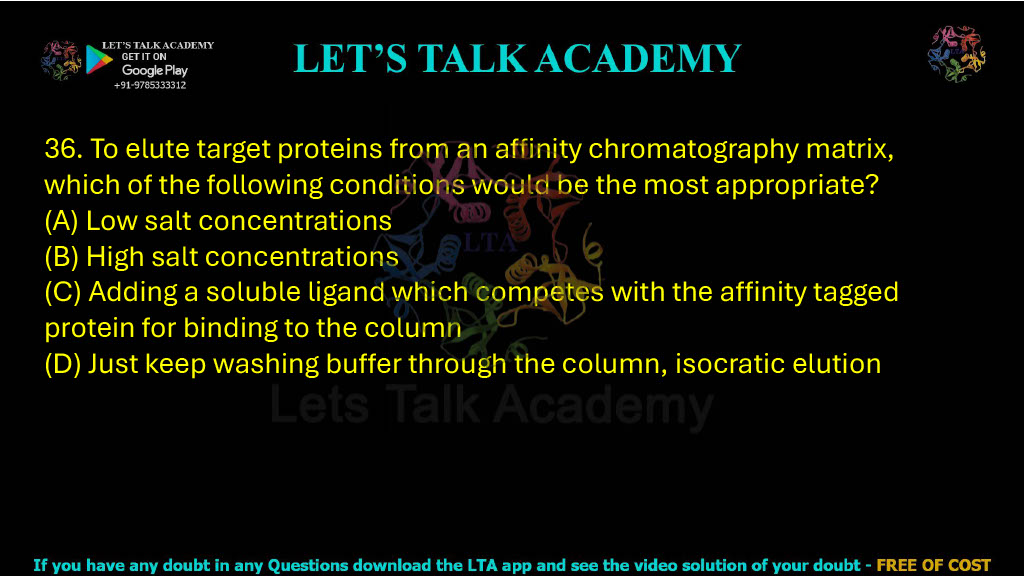
36. To elute target proteins from an affinity chromatography matrix, which of the following conditions would be the most appropriate?
A. Low salt concentrations
B. High salt concentrations
C. Adding a soluble ligand which competes with the affinity tagged protein for binding to the column
D. Just keep washing buffer through the column, isocratic elution
Affinity chromatography elutes target proteins by disrupting specific binding interactions between the protein (often affinity-tagged) and the column’s ligand. The most appropriate method involves competitive elution with a soluble ligand.
Option Analysis
-
A. Low salt concentrations: This weakens ionic interactions but fails in affinity chromatography, where binding relies on highly specific, non-ionic forces like those in His-tag/Ni-NTA systems. Low salt is more relevant for loading or washing in ion-exchange chromatography.
-
B. High salt concentrations: High salt disrupts hydrophobic or weak ionic bonds, suiting hydrophobic interaction chromatography (HIC) or sometimes ion-exchange, but not affinity’s biospecific interactions. It risks denaturing proteins without eluting the target.
-
C. Adding a soluble ligand which competes with the affinity tagged protein for binding to the column: This is ideal, as free ligand (e.g., imidazole for His-tags) directly competes for the same binding site, releasing the protein under mild conditions that preserve activity.
-
D. Just keep washing buffer through the column, isocratic elution: Isocratic washing removes unbound contaminants but cannot disrupt strong, specific affinity bonds, leaving the target bound.
Correct Answer: C
Introduction to Eluting Target Proteins in Affinity Chromatography
Eluting target proteins from an affinity chromatography matrix is a critical step in protein purification, especially for life sciences students preparing for GATE exams. This technique leverages specific ligand-protein interactions (e.g., His-tag with nickel) to isolate proteins with high purity. The keyphrase “elute target proteins from affinity chromatography matrix” highlights the need for precise conditions to disrupt binding without damaging the protein.
Core Principles of Affinity Chromatography Elution
Affinity chromatography binds target proteins selectively to a matrix-immobilized ligand. Elution requires reversing this via biospecific competition or harsh changes like pH or chaotropes. Competitive elution with a soluble ligand mimics the bound protein’s affinity, ensuring gentle release—vital for functional recovery.
Detailed Breakdown of Elution Options
| Option | Description | Suitability for Affinity Chromatography |
|---|---|---|
| A. Low salt | Reduces weak ionic bonds | Poor; used in ion-exchange loading, not specific affinity |
| B. High salt | Promotes hydrophobic disruption | Ineffective; for HIC, risks non-specific elution |
| C. Soluble ligand competition | Free ligand outcompetes bound protein (e.g., imidazole) | Most appropriate; mild, specific, preserves activity |
| D. Isocratic washing | Continuous same buffer flow | Insufficient; only removes unbound material |
Competitive elution stands out for tagged proteins, as seen in Ni-NTA systems.
Why Competitive Elution Excels
Adding soluble ligand ensures high yield and native protein structure, outperforming pH shifts (which may denature) or salts (ineffective for biospecific bonds). For biochemistry labs, start with 100-500 mM imidazole gradients. This method aligns with GATE Life Sciences PYQs on purification techniques.


2 Comments
Vanshika Sharma
February 3, 2026Opt c ic correct
Kanica Sunwalka
June 26, 2026ligand compete for the same binding site -> protein elute
so option c is correct