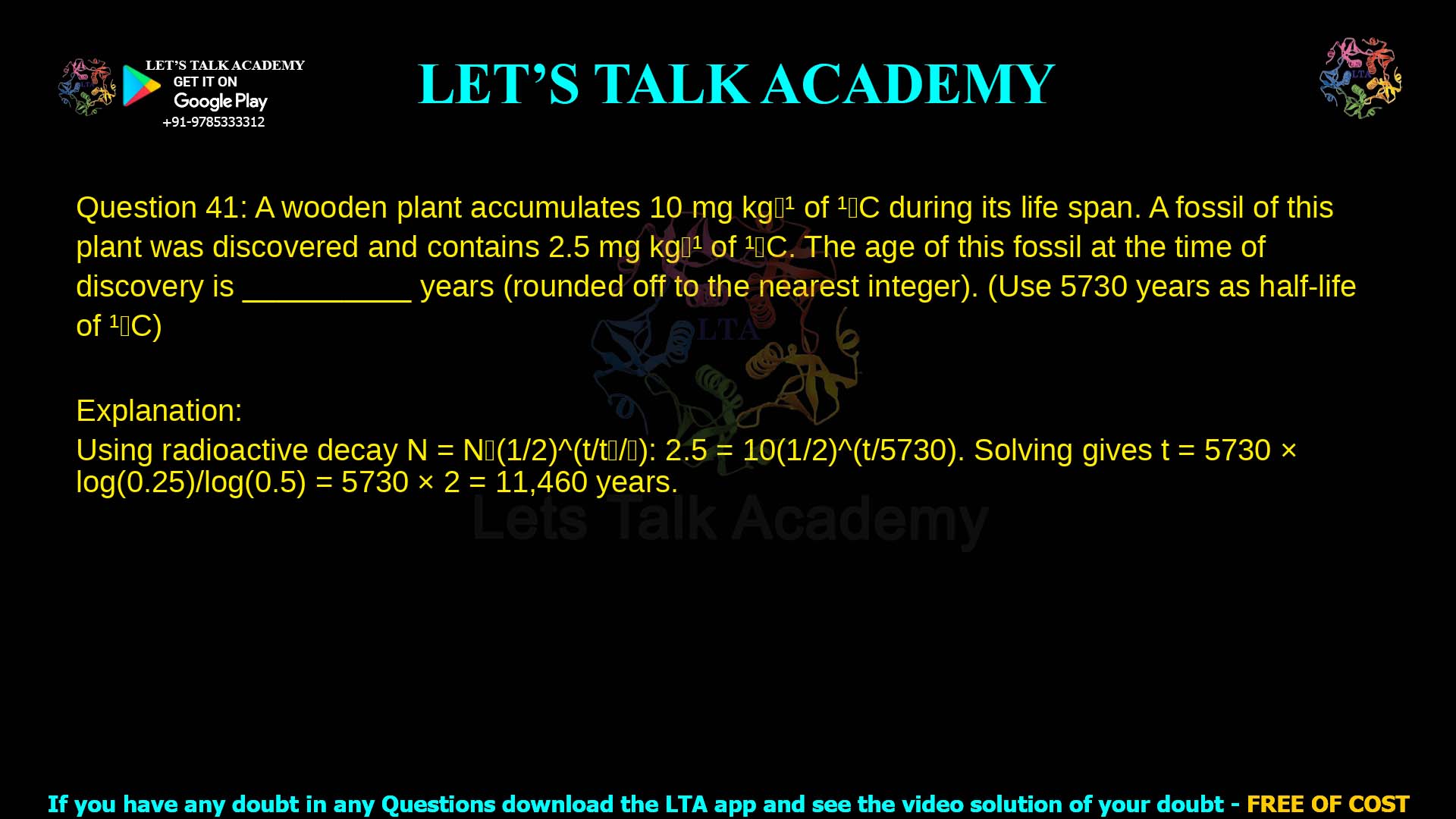
Q.41 A wooden plant accumulates 10 𝑚𝑔 𝑘𝑔−1 of 14C during its life span. A fossil of
this plant was discovered and contains 2.5 𝑚𝑔 𝑘𝑔−1 of 14C. The age of this
fossil at the time of discovery is __________ years (rounded off to the nearest
integer).
(Use 5730 years as half–life of 14C)
11460 years
The fossil’s age is 11460 years. This result comes from applying the radioactive decay formula for carbon-14, where the amount has reduced to exactly one-quarter of the living plant level.
Problem Breakdown
A living wooden plant accumulates 10 mg kg⁻¹ of ¹⁴C. The fossil contains 2.5 mg kg⁻¹, or 25% of the original amount (2.5/10 = 0.25). The half-life of ¹⁴C is given as 5730 years, a standard value used in radiocarbon dating calculations.
Decay Formula
Radioactive decay follows: N = N₀ × (1/2)^(t/T)
Where:
N₀ = 10mg kg⁻¹ (living plant level)N = 2.5mg kg⁻¹ (fossil level)T = 5730years (half-life)
Rearrange to solve for age t: t = T × [ln(N₀/N) / ln(2)]
Here, N₀/N = 4, so ln(4)/ln(2) = 2 exactly—meaning two half-lives have passed.
Step-by-Step Calculation
- Ratio remaining:
N/N₀ = 0.25, soN₀/N = 4 - Number of half-lives:
n = log₂(4) = 2 - Age:
t = 2 × 5730 = 11460years - Rounded to nearest integer: 11460 (no adjustment needed)
Key Insight: Exact quarter decay (25% remaining) = exactly 2 half-lives, making this a straightforward CSIR NET/IIT JAM calculation.
Why No Options?
This appears to be a numerical answer question from exams like IIT JAM Biotechnology, with no multiple-choice options provided. The exact quarter decay simplifies to two half-lives, avoiding logarithmic approximations common in partial-decay problems (e.g., 80% remaining yields ~1840 years).
Radiocarbon Dating: Wooden Plant Fossil Age Calculation (10 mg/kg to 2.5 mg/kg 14C)
Introduction to ¹⁴C Dating in Fossil Age Calculation
Radiocarbon dating determines the age of organic fossils like wooden plant remains by measuring ¹⁴C decay. Living plants fix atmospheric CO₂ containing ¹⁴C at 10 mg kg⁻¹; post-death, it decays with a 5730-year half-life. This fossil problem—from exams like IIT JAM—tests precise application: from 10 mg kg⁻¹ to 2.5 mg kg⁻¹ signals exact two half-lives, or 11460 years.
Core Concept: Radioactive Half-Life Decay
¹⁴C decays exponentially:
- After 1 half-life (5730 years): 5 mg kg⁻¹ remains
- After 2 half-lives (11460 years): 2.5 mg kg⁻¹ remains
Formula t = [ln(N₀/N)] / λ (where λ = ln(2)/5730) confirms this without complex logs.
Key Data Points
- Living level: 10 mg kg⁻¹ ¹⁴C
- Fossil level: 2.5 mg kg⁻¹ (¼ original)
- Half-life: 5730 years (exam standard)
Detailed Solution for CSIR NET/JAM Exams
- Compute ratio:
2.5/10 = 0.25 - Half-lives elapsed:
log₂(1/0.25) = 2 - Multiply:
2 × 5730 = 11460
Common trap: Using natural log approximations yields identical result due to exact powers of ½.
Applications in Plant Biotechnology & Ecology
This method dates plant fossils up to ~50,000 years, aiding evolutionary biology and paleoecology studies. For CSIR NET Life Sciences, master variations like partial decay (e.g., 80% → ~1840 years via t = (5730/ln(2)) × ln(1/0.8)).
Exam Tips for ¹⁴C Problems
- Exact fractions (½, ¼): = integer half-lives × 5730
- Partial decay: Use
t = 5730 × log₂(N₀/N) - Always round as instructed


