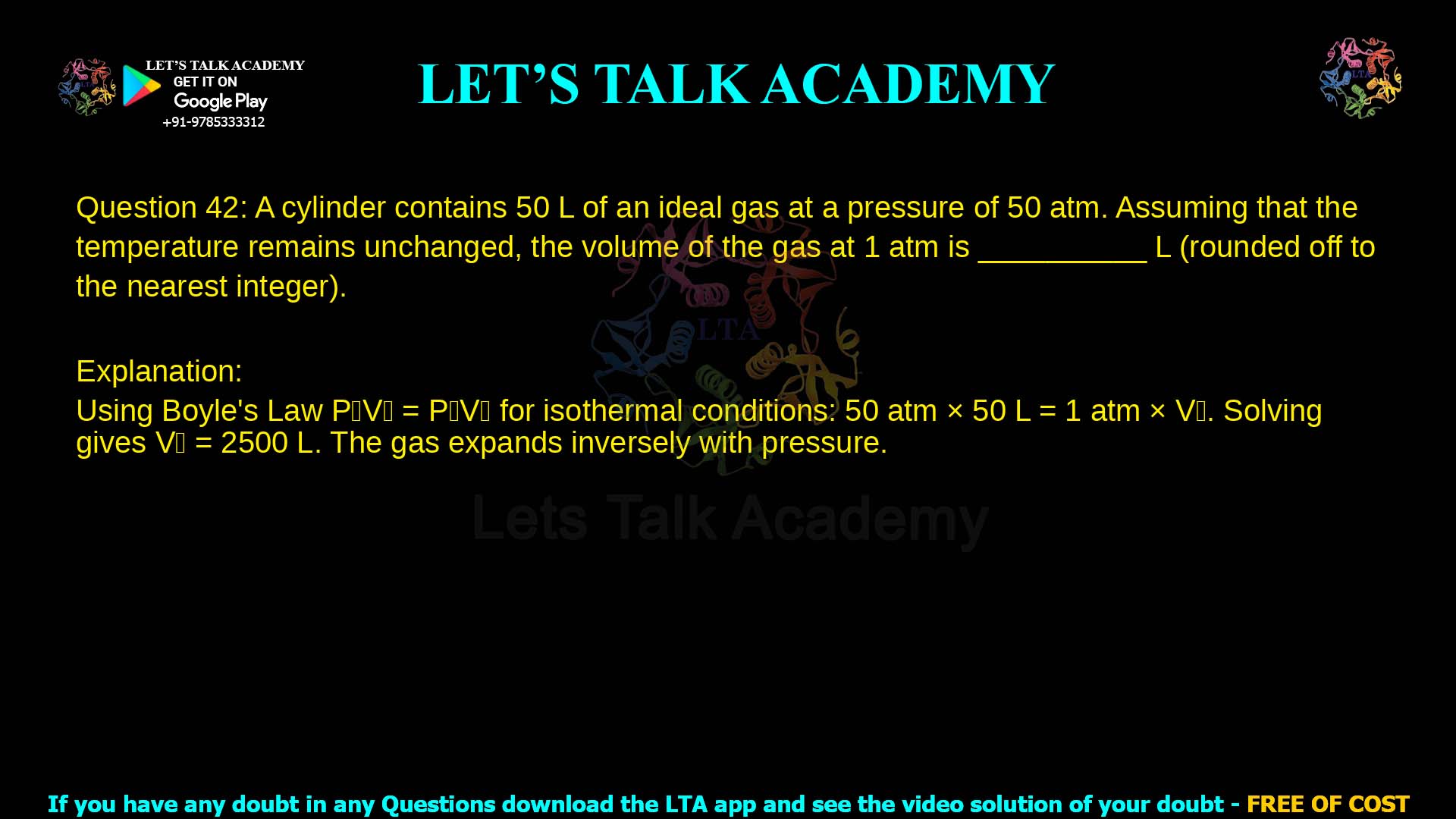
Q.42 A cylinder contains 50 𝐿 of an ideal gas at a pressure of 50 𝑎𝑡𝑚. Assuming that
the temperature remains unchanged, the volume of the gas at 1 𝑎𝑡𝑚
is __________ 𝐿 (rounded off to the nearest integer)
Answer
The volume of the gas at 1 atm is 2500 L.
Problem Analysis
This question tests Boyle’s law for an ideal gas under isothermal conditions (constant temperature). Boyle’s law states that pressure (P) and volume (V) are inversely proportional: P₁V₁ = P₂V₂.
Here, initial conditions are P₁ = 50 atm and V₁ = 50 L; final pressure is P₂ = 1 atm.
Step-by-Step Solution
- Rearrange Boyle’s law to solve for
V₂: V₂ = (P₁V₁)/P₂ - Substitute values: V₂ = (50 × 50)/1 = 2500 L
- The result is already an integer, so no rounding is needed.
Common Mistakes
- Forgetting inverse proportionality (using
V₂ = V₁/P₁) - Applying Charles’s law (volume-temperature relation) instead
- Ignoring temperature constancy which confirms Boyle’s law applies exclusively
Introduction
In cylinder ideal gas 50 L 50 atm 1 atm volume problems, Boyle’s law governs isothermal expansion for CSIR NET aspirants. A cylinder holds 50 L ideal gas at 50 atm; find volume at 1 atm (temperature constant). Answer: 2500 L.
Boyle’s Law Explained
Boyle’s law: PV = constant at fixed T, or P₁V₁ = P₂V₂. Pressure drops 50-fold (50 atm to 1 atm), so volume rises 50-fold. Graph: hyperbolic P-V curve.
Detailed Calculation
- Given:
P₁ = 50 atm,V₁ = 50 L,P₂ = 1 atm - V₂ = (50 × 50)/1 = 2500 L
- Units consistent (L, atm); ideal gas assumes no deviations
CSIR NET Applications
Such cylinder ideal gas questions test gas laws basics. Similar: 20 cm³ at 1 atm to 50 cm³ yields 0.4 atm. Practice verifies inverse relation.
Real-World Examples
- Syringe compression: smaller volume, higher pressure
- Scuba tanks: expand gas volume at surface
- Always isothermal for Boyle’s law application


