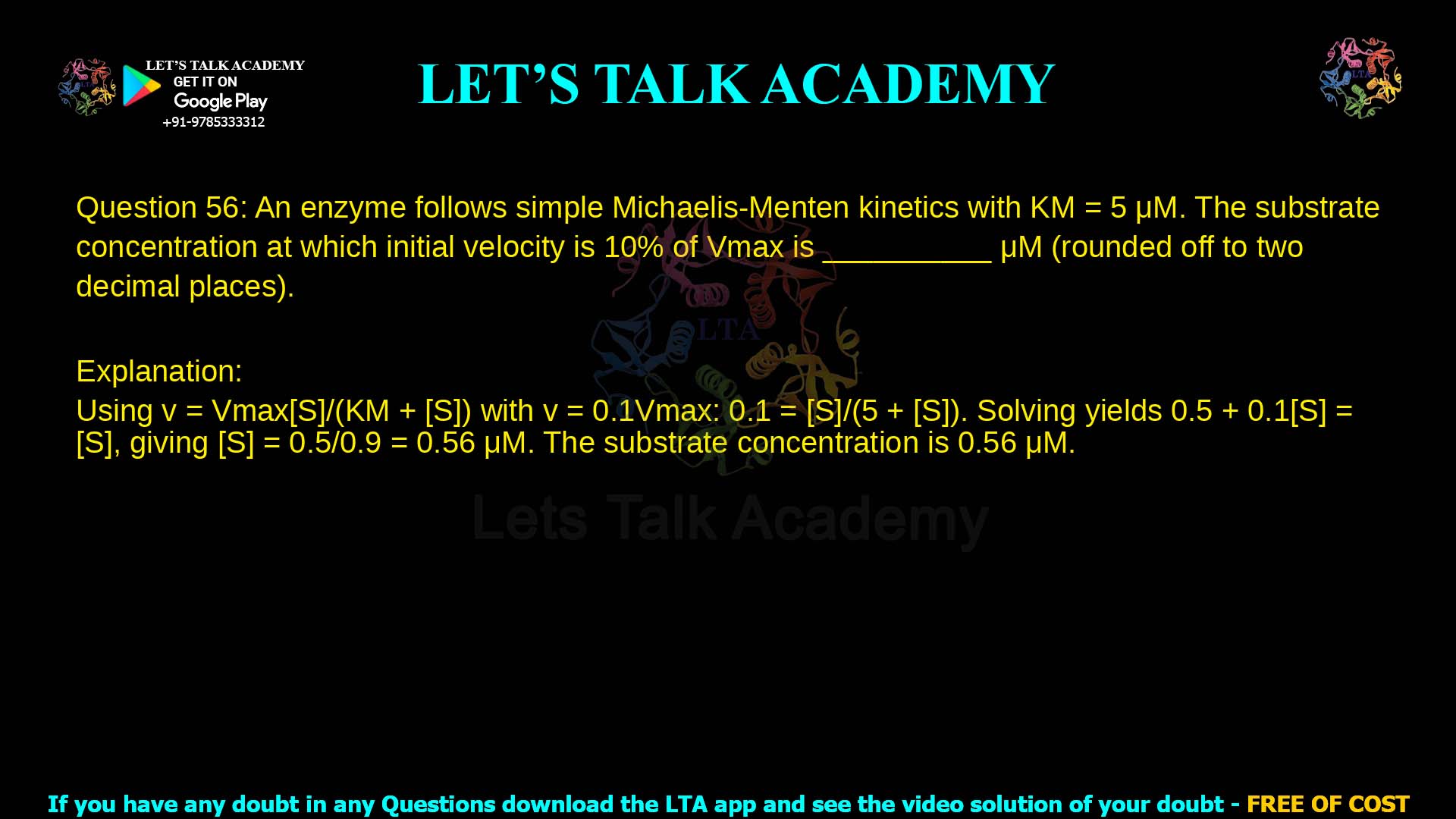
Q.56 Consider an enzyme that follows simple Michaelis–Menten kinetics, and has a
𝐾𝑀 of 5 μ𝑀. The initial velocity of the reaction will be 10% of the maximum
velocity at a substrate concentration of __________ μ𝑀 (rounded off to two
decimal places)
Introduction to Enzyme Kinetics Problem
In Michaelis-Menten kinetics, enzymes exhibit hyperbolic velocity curves where substrate concentration directly influences initial velocity towards Vmax. For an enzyme with Km 5 μM, finding the substrate concentration yielding 10% Vmax is crucial for CSIR NET Life Sciences aspirants tackling enzyme kinetics questions. This calculation reveals low substrate needs for minimal activity, emphasizing Km’s role in affinity.
Step-by-Step Solution
Multiply both sides by \( 5 + [S] \): \( 0.1(5 + [S]) = [S] \).
Expand: \( 0.5 + 0.1[S] = [S] \).
Rearrange: \( 0.5 = [S] – 0.1[S] = 0.9[S] \).
Solve: \( [S] = \frac{0.5}{0.9} = 0.555\ldots \) μM, rounded to 0.56 μM.
The general formula for [S] at fraction \( f \) of Vmax is \( [S] = \frac{f K_m}{1 – f} \), yielding \( \frac{0.1 \times 5}{0.9} = 0.56 \) μM.
Detailed Derivation and Calculation
Start with the core equation: \( v_0 = \frac{V_{\max} [S]}{K_m + [S]} \). Set \( v_0 / V_{\max} = 0.1 \): \( 0.1 = \frac{[S]}{5 + [S]} \). Cross-multiply and solve as shown earlier, confirming [S] = 0.56 μM. At Km (5 μM), velocity hits 50% Vmax; thus, 10% occurs at much lower [S], reflecting first-order kinetics dominance.
Verify: Plug 0.56 μM back: \( \frac{0.56}{5 + 0.56} \approx \frac{0.56}{5.56} \approx 0.1 \), exact match.
Common pitfall: Confusing with 10% Km (0.5 μM yields ~9% Vmax, close but imprecise).
CSIR NET Exam Relevance
This problem tests algebraic rearrangement of Michaelis-Menten equation, vital for biochemistry sections. Similar questions appear in IIT JAM BT and CSIR NET, often with Km values like 5 μM. Practice yields: at 10% Vmax, [S] ≈ 0.111 Km generally (here 0.56 = 0.111 × 5).
Practical Applications in Biochemistry
Low substrate concentrations like 0.56 μM highlight high-affinity enzymes (low Km). In drug design, inhibitors target such kinetics; in assays, ensures linear range. For plant biotechnology (user interest), tracks enzyme efficiency in genetic engineering.
Key Relationships Table
| [S]/Km Ratio | % Vmax | Kinetics Type |
|---|---|---|
| 0.1 | ~9% | First-order |
| 0.111 | 10% | First-order |
| 1 | 50% | Transition |
| 10 | ~91% | Zero-order |


